Ten Women Driving Nollywood's Box Office Dominance in 2026
Key Takeaways
- •Nigerian films outnumbered Hollywood titles at the domestic box office in the first half of 2026, with seven local productions crossing the ₦100 million mark compared to three foreign releases.
- •Total Nigerian box-office revenue grew to ₦8.83 billion in H1 2026, an increase from ₦7.75 billion recorded during the same period in 2025.
- •Funke Akindele's 'Behind the Scenes' became the first Nollywood production to exceed ₦2 billion, reaching ₦2.6 billion by February 2026.
- •Women are increasingly driving Nollywood's commercial success as producers, directors, writers, and lead actors, with female-led films such as 'Call of My Life,' 'Gingerrr,' and 'Oversabi Aunty' ranking among the top performers.
- •Global streaming platforms including Netflix and Amazon Prime Video have invested heavily in Nollywood content, broadening the audience for Nigerian storytelling both domestically and across the African diaspora.
"Nollywood is quietly taking its own country back," a social entrepreneur wrote on X, capturing a shift that has been reshaping Nigerian cinemas for some time.
For years, Hollywood maintained a firm grip on the Nigerian box office, with local films left to compete for whatever audience remained. That balance has now shifted decisively.
In 2025, local and foreign films were nearly evenly matched at the Nigerian box office. By the first half of 2026, Nollywood had pulled clearly ahead: seven Nigerian films crossed the ₦100 million mark, compared to just three Hollywood titles. The period generated ₦8.83 billion in box-office revenue, up from ₦7.75 billion in H1 2025.
The trend marks a turning point for an industry widely recognised as one of the world's most prolific by output, producing well over a thousand titles annually. Yet for much of Nollywood's history, that volume was concentrated in the direct-to-video market — low-budget films sold on VCDs and DVDs, consumed in living rooms rather than cinemas. The current box-office surge reflects a decade-long migration of that same audience into theatrical viewing, driven by expanding multiplex infrastructure in cities like Lagos, Abuja, and Port Harcourt.
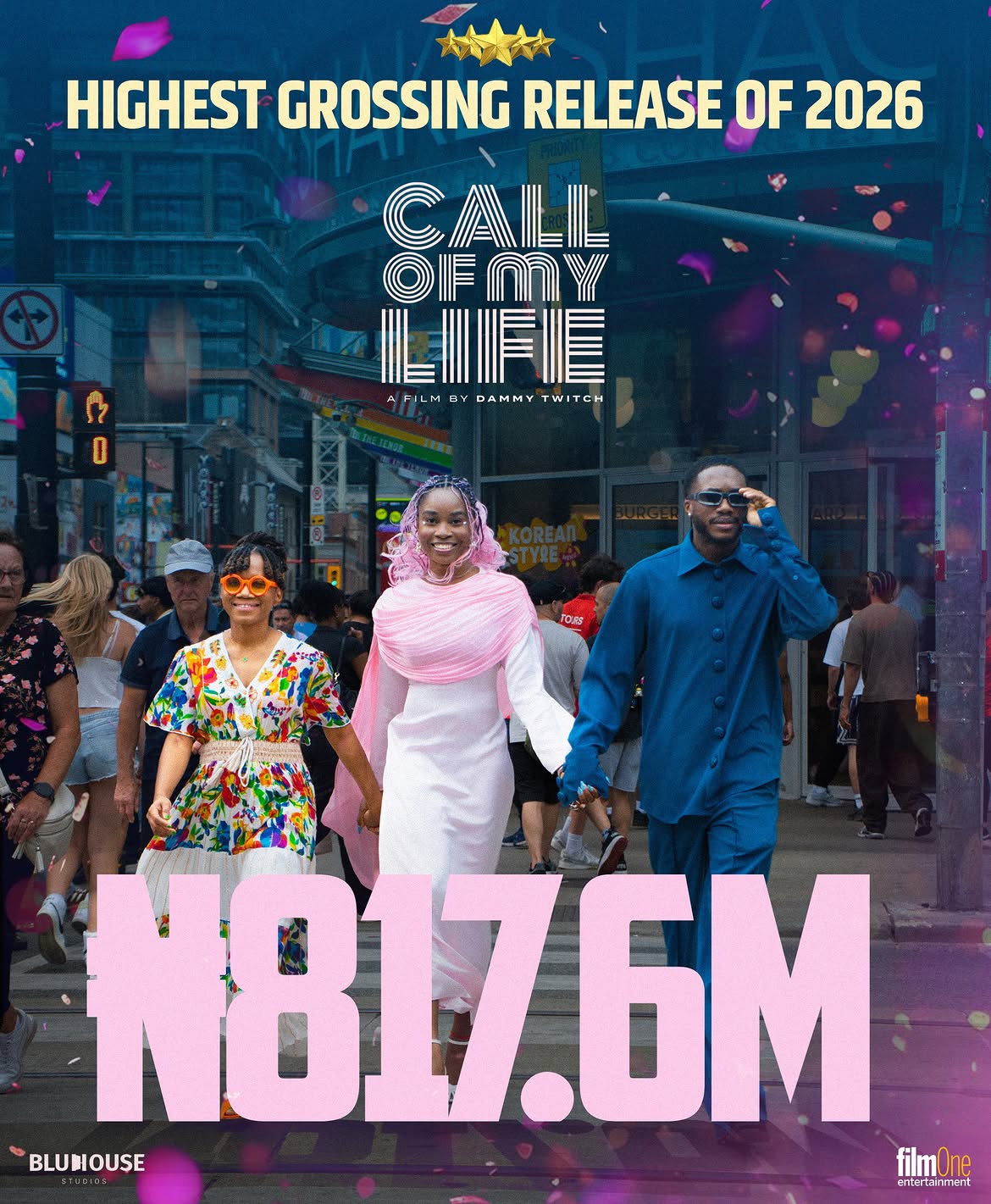
Among the standout performers was Dammy Twitch's romantic comedy Call of My Life, which grossed over ₦817.6 million despite bypassing the traditional December cinema window.
Beyond the revenue figures, what stands out is what Nigerian audiences are choosing to watch. Nollywood was once an industry where films were consumed at home, discussed casually, and quickly replaced by the next title. Over time, however, the cinema experience itself became part of the appeal — audiences began anticipating new releases, checking showtimes, and debating which films deserved their money.
In 2026, that excitement has reached new heights, with Nigerian women at the centre of many of the industry's biggest commercial successes.
The range of stories now reaching screens is broad: love, family, friendship, faith, culture, ambition, womanhood, and the realities of Nigerian society. In an industry where men have historically dominated the most visible behind-the-camera roles, the rise of Nigerian women as both creative forces and box-office draws is a notable development. It also comes at a time when global streaming platforms — Netflix, Amazon Prime Video, and others — have invested heavily in Nollywood content, expanding the audience base for Nigerian storytelling both at home and across the African diaspora, even as theatrical releases remain the benchmark for commercial success.
Below are profiles of women whose creative contributions — though not all from films produced in 2026 — are giving audiences fresh reasons to visit Nigerian cinemas this year.
Funke Akindele
Funke Akindele has evolved from one of Nollywood's most recognizable actresses into one of its most influential filmmakers. Her rise did not happen overnight; from her early television work to becoming a producer and filmmaker capable of filling cinemas, her trajectory mirrors the broader growth of the industry.
In Behind the Scenes, Akindele served as producer, co-director, co-writer, and lead actress, with the story also credited to her. The film premiered in December 2025 and became the first Nollywood production to cross ₦2 billion, reaching ₦2.6 billion by February 2026.
Her track record of major hits extends well beyond that single title. Other notable box-office performers include Everybody Loves Jenifa (₦1.88 billion), A Tribe Called Judah (₦1.40 billion), Battle on Buka Street (₦668.4 million), and Omo Ghetto: The Saga (₦636.1 million). Several of these titles are built around the Jenifa character — a persona rooted in her long-running television series — which has given Akindele a franchise-like audience foundation that few Nigerian filmmakers, male or female, can match.
What distinguishes Akindele is her consistency. She has built a dedicated audience around stories that blend comedy, family, friendship, Nigerian culture, and everyday social realities with the scale and spectacle of cinema. Her achievement lies not in a single blockbuster but in her repeated ability to turn Nigerian stories into major theatrical events.
Toyin Abraham
Toyin Abraham has established herself as another major female force in Nollywood's commercial cinema. In Oversabi Aunty, she took on both the lead role and the director's chair, portraying Toun, a church usher whose habit of involving herself in other people's affairs brings trouble to her own family.
The film was a significant box-office success, reinforcing Abraham's ability to draw audiences to cinemas. She followed it with Alakada: Bad and Boujee, which grossed ₦500.6 million.
Abraham's strengths lie in her capacity to take familiar Nigerian characters and social situations and transform them into stories audiences immediately recognize. Her evolution from actress to filmmaker and box-office draw is notable. Her films typically sit at the intersection of comedy, class, family, and social expectations, making them both entertaining and culturally resonant.
Uzoamaka Power
Uzoamaka Power represents one of the most surprising entries on this list. In Call of My Life, she plays Soluchi, the central character in Dammy Twitch's romantic drama. Her contribution extends beyond performance: she is also credited as the film's writer.
The film's success is remarkable because it did not rely on the traditional December release window. It became one of the biggest Nigerian films of 2026, with box-office revenue reaching ₦837.4 million as of August 7, 2026, according to PartyJollof.
Call of My Life stands out for its blend of romance, family dynamics, and emotional storytelling, while placing a relatively new female creative voice at the centre of a major commercial success. Power's dual role as performer and writer highlights a growing trend in Nollywood: women who are not only acting in stories but actively shaping them.
Gingerrr — KieKie, Bisola Aiyeola, Wunmi Toriola, and Bolaji Ogunmola
Gingerrr demonstrates what happens when four women combine their creative and commercial power. Bukunmi "KieKie" Adeaga-Ilori, Bisola Aiyeola, Wunmi Toriola, and Bolaji Ogunmola are all credited as producers on the film, in addition to their acting roles. KieKie plays Lala, Bisola plays Sylvia, Wunmi plays Alabokun, and Bolaji plays Bugari.
The action-comedy heist follows four childhood friends who embark on a chaotic mission involving a box of gold. It grossed ₦522.9 million in 2025, ranking among Nollywood's biggest commercial successes and continuing to factor into the 2026 box-office conversation.
What sets Gingerrr apart is the collaboration behind and in front of the camera. Rather than waiting for someone to create opportunities for them, these women pooled their talents and resources to build a project themselves. The result was a female-led film driven by friendship, humour, adventure, and on-screen chemistry — and audiences responded.
Iyabo Ojo
Iyabo Ojo took on a substantially expanded role in The Return of Arinzo, serving as both producer and director rather than simply appearing as a performer. The film grossed ₦351.5 million, placing it among the strongest-performing Nigerian films of 2026.
Ojo's approach uses filmmaking to tell stories rooted in Nigerian culture and social realities while maintaining broad commercial appeal. Her transition from performer to filmmaker reflects a wider shift in Nollywood, where women are increasingly taking ownership of the stories they wish to tell.
Sophia Alakija
Sophia Alakija starred in Love and New Notes, a romantic drama directed by Kayode Kasum. She was part of the film's principal cast alongside Timini Egbuson, Odunlade Adekola, and Eniola Badmus.
The film grossed ₦400.47 million, making it one of the highest-grossing Nigerian films in the 2026 tracking period. Its success demonstrates that Nollywood's commercial performance does not depend exclusively on action, crime, or holiday-season comedies. Alakija's involvement underscores the continued ability of female actors to lead emotionally driven stories that attract cinema audiences.
Ruby Akubueze
Ruby Akubueze is part of the cast of Onobiren, a film notable for placing women's experiences and perspectives at the centre of the narrative. The film grossed ₦138.34 million during the H1 box-office tracking period.
Onobiren is particularly significant for its deliberate choice to make women and their stories the focus of the plot rather than relegating them to supporting roles. Akubueze's involvement aligns with the broader trend this list illustrates: Nigerian women are not merely helping Nollywood sell tickets — they are increasingly shaping whose stories get told and how those stories are presented on screen.

