Nigeria's ATM Cards Have Never Been Successfully Hacked, Says INTERPOL Cybercrime Chief AIG Uche Ifeanyi
Key Takeaways
- •AIG Uche Henry Ifeanyi said Nigerian ATM card fraud typically results from victims being deceived into sharing PINs, OTPs or personal details, not from direct card-system breaches.
- •Nigeria’s ATM card security is supported by EMV chip-and-PIN technology and the Central Bank of Nigeria’s Bank Verification Number system.
- •Uche said physical bank robberies have declined while digital financial crimes such as ransomware, crypto money laundering and AI-enabled fraud are increasing.
- •He cited a joint operation involving UK intelligence that led to the arrest of six fraud suspects in Aba within 48 hours.
- •Uche said Nigeria’s process for freezing suspicious bank accounts can take two to three weeks, allowing stolen funds to be moved before action is completed.
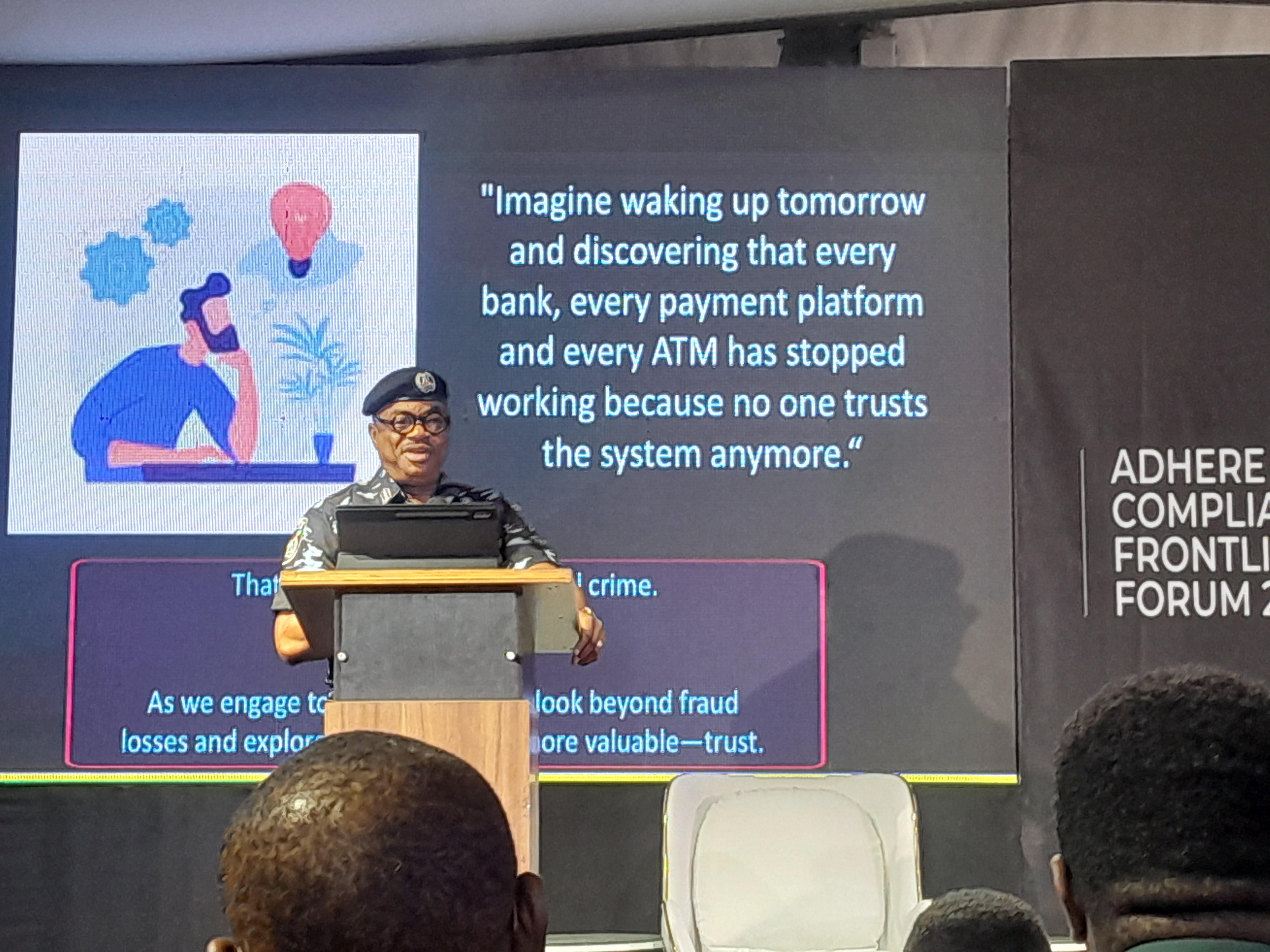
Nigerian ATM cards have never been successfully hacked, according to AIG Uche Henry Ifeanyi, Chairman of INTERPOL's African Working Group on Cybercrime, who made the assertion at the Adhere Compliance Frontline Forum held at the Radisson Blu Anchorage Hotel in Victoria Island, Lagos.
The forum, organized by Smart Comply—a compliance and risk management firm—brought together bankers, fintech operators, law enforcement officials, and policy professionals to examine the growing cost of financial crime in Nigeria, Africa's largest economy by GDP and one of its fastest-growing digital payment markets.
"Do you know that our ATM card is the safest card in the world? There has not been any successful hack," AIG Uche stated during his address.
He explained that when individuals lose money through ATM-related fraud, the cause is almost never a breach of the card's underlying system. Rather, criminals deceive cardholders into voluntarily surrendering sensitive details such as their PIN, OTP, or other personal information. Nigeria's payment infrastructure relies on EMV chip-and-PIN technology and the Central Bank of Nigeria–mandated Bank Verification Number system, a biometric identity framework linking each account holder to a unique identifier—layers that make direct card-system compromise difficult.
"What they do is the use of social engineering to manipulate victims to get their confidential information, and that is the only way you can infiltrate an ATM card in Nigeria," he said.
AIG Uche was appointed Chairman of the African Heads of Cybercrime Units by INTERPOL, a coordinating body that brings together cybercrime chiefs from all 54 African countries. He was promoted to Assistant Inspector General of Police in March 2026, having previously served as Director of the Nigeria Police Force National Cyber Crime Centre (NPF-NCCC). With more than eight years of experience in cybercrime investigations, he has led joint operations with the UK's National Crime Agency that dismantled organized fraud rings.
A central theme of his remarks was the fundamental transformation underway in how financial crime is perpetrated. He posed a direct question to the audience: Could anyone name a Nigerian bank that had been robbed at gunpoint since 2024? When no one answered, he pressed further—2025? 2024? The room remained silent.
That silence underscored a broader trend. Armed robbery of physical bank branches has diminished dramatically as a threat. The armed robber who once entered a banking hall with weapons has been supplanted by an individual equipped with a laptop, a phone, and a router.
"Armed robbers no longer carry instruments of violence. Armed robbers go with systems; they carry laptops, and they carry phones. That is the new trend," AIG Uche said.
While physical bank raids have declined, digital financial crime has surged. AIG Uche reported that ransomware attacks—where criminals encrypt an organization's data and demand payment for decryption—are rising sharply across Nigeria. Financial institutions remain primary targets, and crypto money laundering and AI-powered fraud continue to expand. Nigeria has one of Africa's largest populations of digital banking users and mobile money adopters, making the scale of potential exposure significant as digital channels displace cash transactions.
"The cybercriminals we have in Nigeria, financial fraud actors we have in Nigeria, are getting more vicious," he warned.
He cited an operation he led prior to his promotion as an illustration of how modern fraud networks operate. The UK's National Crime Agency provided his team with intelligence on a fraud syndicate based in Aba, estimating it would take at least a month to dismantle. AIG Uche told them he could do it in 48 hours. Within 24 hours, his undercover team returned with video footage. Within 48 hours, six fraud actors were arrested. The raided premises resembled a small technology office—routers, phones, laptops, multiple screens, ATM cards, and a full infrastructure for running scams. No firearms were recovered.
AIG Uche was candid about the structural limitations hampering Nigerian law enforcement. Criminals operate at the speed of technology, he noted, while law enforcement operates at the speed of bureaucracy. To freeze a suspicious bank account in Nigeria, authorities must go to court, obtain a banker's order, transmit it to the bank, and wait for the bank to verify it back through the court before any action can be taken. The entire process takes a minimum of two to three weeks—by which point the funds have typically been moved beyond reach. The Cybercrimes (Prohibition, Prevention, etc.) Act of 2015 provides the legal basis for investigation and prosecution, but the procedural requirements AIG Uche described highlight the gap between legislative intent and operational speed.
The only viable solution, he argued, is for financial institutions and law enforcement to deploy AI-powered tools capable of detecting suspicious transaction patterns in real time, before transfers are completed rather than after the fact.
"You can only use tech to fight crimes that are being generated with the use of tech," he said.
He also characterized public distrust as a "hidden tax" borne by every Nigerian. When citizens lose confidence in banks, institutions, or payment platforms, investment contracts, financial inclusion declines, and economic growth slows. That cost never appears in any financial crime report, he noted, but it is real and compounds daily.
The Adhere Compliance Frontline Forum, organized by Smart Comply, addressed these pressing challenges as Nigeria confronts elevated levels of digital fraud and a financial system under strain. AIG Uche's assessment was unequivocal: the building is still standing, but the fire is already inside the walls.

