Nigeria and Togo Sign $30M–$50M Twin Data Park Deal to Keep West Africa's Data at Home
Key Takeaways
- •Nigeria and Togo signed a memorandum of understanding targeting $30 million to $50 million in initial investment for a joint data park structured as a Special Purpose Vehicle combining government and private sector investment.
- •Nigeria will site its park next to the Egbin Power Plant in Lagos for access to power, water and subsea cable landing stations, while a diplomatic hosting arrangement will allow ECOWAS states to store sovereign data backups across borders under their own laws.
- •The two countries are targeting initial project milestones by the second quarter of 2027, a timeline dependent on access to funding and transaction processes.
- •Nigeria's Central Bank directive requiring local storage of payment transaction data from January 2027 and the National Digital Cloud Policy's 24-month goal of attracting $750 million in investments are driving demand for domestic data hosting.
- •The initial $30 million to $50 million covers only land preparation, power and water provision and shell infrastructure, far below the roughly $600 million to more than $1.2 billion cost of building a mid-sized hyperscale data centre.
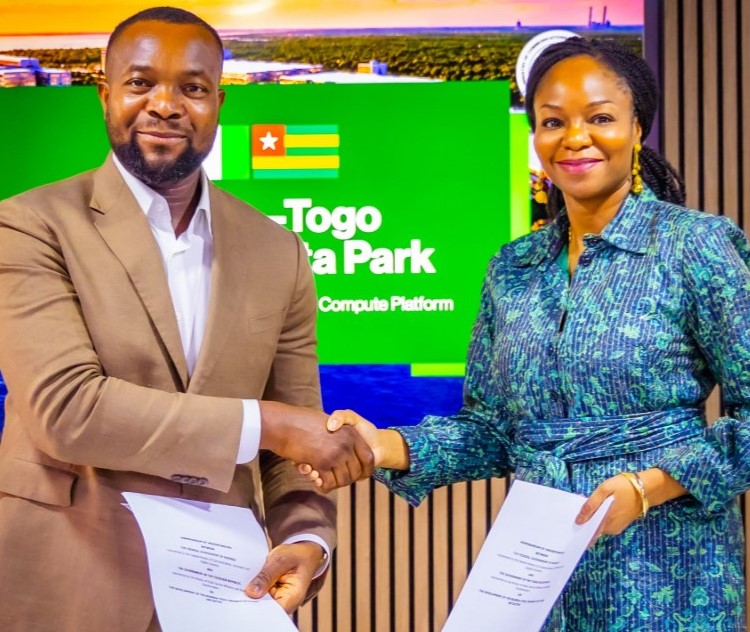
Nigeria and Togo have signed a memorandum of understanding targeting an initial investment of $30 million to $50 million to establish a joint data park, a deal that lands at a moment when African governments are pushing to host data locally and take independent control of internet performance.
The Nigeria–Togo Twin Data Park is designed to move the two countries from consuming foreign cloud services toward operating a regional data hosting facility of their own. Its defining feature is a public-private orientation: both governments intend to attract investors and international technology giants to the project.
Nigeria's Minister of Communications, Innovation and Digital Economy, Bosun Tijani, announced on X that the Nigeria-Togo Twin Data Park initiative will be structured as a joint Special Purpose Vehicle (SPV) — a standalone legal entity created for a single project — combining government and private sector investment.
The facility will combine data centres, fibre, internet speed enhancement and cross-border legal protections, and is intended to bring global cloud and data centre operators — including hyperscalers AWS, Google and Microsoft, and interconnection and data centre specialist Equinix — into the region. According to Tijani, the two countries are targeting initial project milestones by the second quarter of 2027, a timeline subject to access to funding and transaction processes.
At the core of the twin data parks
Recognizing that most African data centres face energy and water supply constraints, Nigeria is siting its park next to the Egbin Power Plant in Lagos, which offers access to gas, grid power and subsea cable landing stations — the shore-end points where submarine fibre systems connect to land networks — and, most importantly, water, the resource data centres draw on heavily for cooling.
The project also implements diplomatic data hosting, an arrangement in which one country's servers can be hosted by another. Under this model, Togo — or any other ECOWAS state (the Economic Community of West African States) — can host national backups in Lagos under its own laws, and Nigeria can do the same in reverse.
The initiative is framed as a partnership between private investors and government: the public side provides land, power access, regulatory waivers and legal frameworks, while private operators fund and run the facilities, improving the feasibility of productivity and earnings.
Notably, Nigeria currently has 28 data centres, while Togo has two, both located in Lomé. These private facilities, however, are not captured under the bilateral design. A private data centre operates strictly under local laws, which means Togo, Nigeria or other West African governments will not store sensitive sovereign data — such as national IDs, tax records or defence files — in a Nigerian or Togolese private facility. That gap is what the diplomatic hosting arrangement is designed to fill, pairing cross-border capacity with the legal protections sovereign data requires.
Why Nigeria and Togo need local data centres
The development comes as Nigeria sharpens its focus on hosting cloud and data workloads locally. The Central Bank of Nigeria (CBN) has issued a directive requiring banks, fintechs and regulated institutions to store critical payment transaction data locally, taking effect in January 2027 — a mandate that is driving new demand for domestic data hosting, and whose effective date falls just months ahead of the twin park's targeted second-quarter 2027 milestones.
In a further step toward local hosting, Nigeria launched the National Digital Cloud Policy in August 2026, with a 24-month goal of attracting $750 million in cloud and data capacity investments. The partnership with Togo is expected to help crowd in private capital toward these ambitions.
At present, a significant share of the content, banking and streaming traffic used by Nigerians and Togolese is hosted in Europe, meaning each request makes a long round trip across continents before a page loads, a payment clears or a stream starts. Bringing that data to Lagos and Lomé would translate into faster internet speeds, smoother video calls and an improved quality of experience for citizens. Local hosting also complements Nigeria's nationwide deployment of a 90,000km fibre optic cable and 3,700 telecom towers for rural communities, by reducing the distance data travels and easing congestion on domestic networks.
Nigeria brings a data-hungry population to the table: the country consumed 1.76 million terabytes of data in August 2026. Togo, meanwhile, is a strategic coastal hub with strong Francophone ties and submarine cable access.
Togo's Minister for Digital Economy and Transformation, Cina Lawson, described the initiative as the first joint digital infrastructure project between the two countries and cited Togo's ongoing digital connectivity projects. The country is currently expanding fibre connectivity to 2,700 schools, 250 hospitals and all districts under its digital development programme. The partnership is expected to attract international data centre operators to Togo and advance its existing digital infrastructure plans.
The feasibility question
The ambition is strong on paper, but whether construction can begin in the second quarter of 2027 will be determined by two factors.
Funding gap: $30 million to $50 million is only enough for land preparation, power and water provision and initial shell infrastructure; it cannot build a full hyperscale data centre. A mid-sized hyperscale data centre of 50 MW to 100 MW costs around $600 million to more than $1.2 billion for facility construction and infrastructure. For comparison, MTN Nigeria's Dabengwa Data Centre — a 4.5 MW facility unveiled on July 1, 2025 — cost $150 million.
Capacity: how much information a data centre can carry depends on the strength of the fibre cables connecting Nigeria to Togo, and both countries to the wider West African region. Modern data centres rely on fibre optic cables to function at scale; without quality fibre lines, they cannot move data fast enough or far enough to support cloud computing, streaming or AI. It is a constraint that also explains the logic of anchoring the Lagos park beside power and cable-landing infrastructure.
To make the project a reality, Nigeria and Togo will need to attract investors to build it — and to prevent it from becoming another abandoned project. The markers of progress are already defined: the formalization of the joint SPV, the attraction of private and international capital beyond the initial $30 million to $50 million tranche, and delivery on the second-quarter 2027 milestones within the funding and transaction constraints Tijani outlined.

