Nigeria's Ban on Unapproved Phones Risks Repeating Enforcement Failures Across Africa
Key Takeaways
- •AMPAT says traders were not adequately consulted and wants the NCC to pause implementation for 120 days.
- •The NCC’s proposed validation fees are approximately ₦670 per IMEI for feature phones and nearly ₦4,000 for high-end smartphones.
- •Tanzania, Kenya, Ghana and Uganda all encountered enforcement setbacks involving public opposition, legal disputes, registry weaknesses or limited identification coverage.
- •The policy requires coordination of device registration, subscriber verification, legal authority and stakeholder communication before disconnections begin.
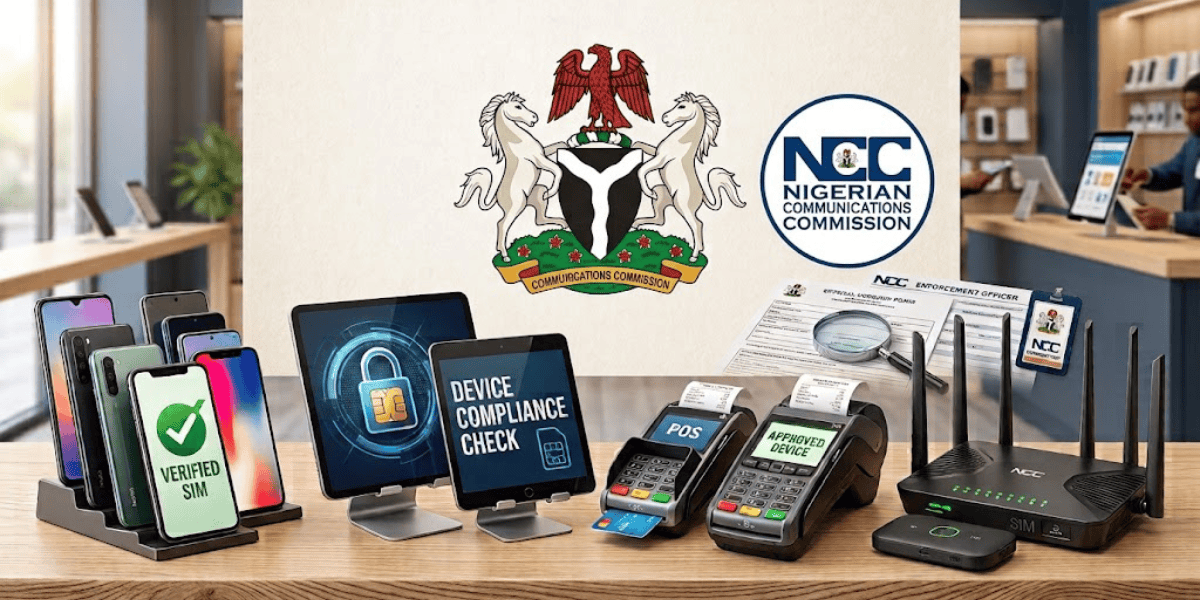
The Nigerian Communications Commission's (NCC) move to block unapproved phones, routers, tablets, and POS machines — categorised collectively as SIM-enabled devices — is a major initiative to curb fake devices and reduce the use of cloned phones in kidnappings and other fraudulent activities.
As the commission works to strengthen network security, the policy marks a significant step toward ensuring that every SIM-enabled device is registered and verified, with its International Mobile Equipment Identity (IMEI) information submitted to the appropriate authorities for verification before sale and distribution.
Yet many Nigerian policies follow a familiar pattern of failing at the implementation stage, and the SIM-enabled device registration scheme risks falling into the same trap that has caught out several of its African counterparts. Four countries — Tanzania, Uganda, Kenya, and Ghana — previously introduced policies aimed at blocking unapproved phone devices, only to run into enforcement problems driven by market rejection and intense public pressure.
Nigeria may be heading into that same trap. After the NCC warned Nigerians holding unregistered phone types that their devices would be disconnected from local cellular networks within 30 days, the Association of Mobile Phones and Allied Products Traders of Nigeria (AMPAT) asked the commission to suspend the policy for 120 days. The traders said they were not informed prior to implementation and need ample time for consultations with stakeholders in the industry.
In a separate case, phone traders raised concerns that importers and dealers will pass verification costs directly to end-users. The concerns followed the NCC's introduction of administrative validation fees of about ₦670 per IMEI for standard or feature phones and nearly ₦4,000 for high-end smartphones. When those costs are eventually passed down to Nigerians, the commission could face pressure that puts the policy through its own enforcement-trap test.
During their enforcement campaigns, Kenya, Tanzania, Uganda, and Ghana each fell into structural pitfalls that forced governments to delay or entirely pause their policies. Ironic as it may be, the episodes illustrate how the cost of public outcry and pressure groups' actions can outweigh the benefits of policy crackdowns on mobile phones.
Tanzania: heavy penalties, passive enforcement
On June 16, 2026, the Tanzania Communications Regulatory Authority (TCRA) launched its major crackdown on unapproved and counterfeit mobile phones, enforcing a ban that disconnected more than 600,000 fake devices from the country's telecom networks.
As in the Nigerian case, Tanzania initiated the shutdown to combat cybercrime, protect mobile payment security, and safeguard consumer health against high radiation levels and substandard electronic materials. The rule made altering or forging IMEI numbers illegal, carrying heavy penalties of up to 10 years in prison, a $15,000 fine, or both.
While Tanzania was one of the earliest African countries to introduce such a policy, commercial tension soon emerged between achieving rigid compliance and maintaining network service growth, as telcos suffered notable losses in active subscribers following the mass cutoffs. Despite the heavy legal penalties, black-market traders adapted by using software to clone or overwrite invalid IMEI numbers with valid ones copied from legitimate phones, allowing fake devices to bypass network filters undetected. Beset by hurdles and countermoves, enforcement later became passive.
Kenya: legal gridlock and a decade-long restart
Kenya's first crackdown on unapproved phones began in 2012, when it carried out a large-scale switch-off of thousands of handsets lacking authentic IMEI numbers.
The latest move came on February 10, 2026, when the Communications Authority of Kenya (CA) banned 21 unapproved phone brands — including Tinsik, Realfone, and Fonrox — over safety, health, and electromagnetic radiation concerns. The following month, the CA implemented a directive blocking the import and sale of mobile phones and tablets that do not feature USB Type-C charging ports.
Following these moves, Kenya fell into an enforcement trap driven by institutional and legal pushback. In 2012, telcos that feared a massive drop in active subscribers and revenue, along with civil rights groups, sued the government. The legal gridlock lasted nearly half a decade and froze enforcement while unapproved and smuggled phones continued to flood the market.
Kenya's enforcement trap was defined by attempting to deploy a high-tech solution before establishing consensus on data privacy laws. The February enforcement drive is its latest attempt to revisit plans to wipe out unapproved devices.
Ghana: registry gaps and a traveller-tax U-turn
Ghana faced implementation challenges both before and after introducing its enforcement rule. The country first announced plans to clamp down on unapproved mobile phones between 2019 and 2020, but the crackdown was delayed and only launched in July 2026. It then struggled to integrate the Central Equipment Identity Register (CEIR) with the national registry, owing to weaknesses in verifying subscriber data against the National Identification Authority (NIA) database.
During the period of delays, authorities reported that multiple SIM cards and unapproved devices were successfully registered using fake or unverified profiles, forcing a new plan for real-time biometric verification.
After enforcement began, public outcry erupted in September 2026 over a rule stating that air travellers could bring a maximum of two mobile phones into the country before being heavily taxed as a commercial import. After facing severe backlash from travellers and the diaspora, the Ghana Revenue Authority (GRA) was forced to issue clarifications stating that carrying more than two phones would not automatically trigger duties.
Uganda: no legal frame, no IDs, no enforcement
Uganda's situation was more dramatic, as its enforcement plan was met with public outcry and a lack of legal framework. In September 2012, the Uganda Communications Commission (UCC) set a target date of July 1, 2013, to disable counterfeit phones lacking IMEI numbers. Enforcement was repeatedly deferred, however, after pushback from phone traders.
In 2018, the UCC announced a fresh enforcement and confiscation exercise targeting substandard devices and illegal dealers. It was backed by the Centralised Equipment Identification Register, passed by Parliament in March 2019, which gave the UCC the legal basis to operate a Central Equipment Identification Registry (CEIR).
Even with that legal footing, Uganda found that millions of rural citizens lacked national ID cards, and that forcing the switch-off of unapproved phones would cut a massive portion of the population off from mobile money — crippling small businesses in the process. The UCC was forced to grant multiple extensions over a multi-year period because total enforcement amounted to economic self-sabotage. In August 2022, it re-launched phase two of its anti-counterfeit campaign (Simu Klear), centred on a six-month public awareness and sensitisation drive before moving toward device disconnection.
The road ahead for the NCC
Across all four markets, the enforcement trap reflects how mobile phones in sub-Saharan Africa are not luxury items but the primary tool for financial inclusion, improvements in agriculture, and daily survival. Regulators are faced with a choice between creating a political problem by shutting down people's only access to the economy or withholding enforcement.
The recurring challenge is therefore not only identifying an unapproved device, but coordinating device registration, subscriber verification, legal authority, stakeholder communication, and enforcement before disconnections begin. The experiences of the four countries show how weaknesses in any one of those parts can delay or undermine the wider policy.
For Nigeria, the NCC should expect a strict 30-day window to face constraints. Phasing enforcement by targeting bulk commercial importers first, rather than individual end-users all at once, could help mitigate public pushback — as could maintaining the status quo of clear boundaries regarding data access.

