What 739,294 Network Tests Reveal About MTN, Airtel, Globacom and 9mobile Performance in Nigeria
Key Takeaways
- •The NCC and Ookla study drew on 739,294 real-world network tests conducted between June 2025 and May 2026 to map Nigeria's mobile internet experience.
- •Urban users averaged 19.2 Mbps downloads with 31 ms latency, compared with 13.0 Mbps and 39 ms in rural corridors, confirming a geographic digital divide.
- •MTN delivered the strongest performance with 25.2 Mbps urban download speeds, while Globacom's 10.1 Mbps urban downloads were comparable to Airtel's rural figure.
- •5G coverage is limited to Lagos, Abuja and Port Harcourt, where it reaches 181.5 Mbps, while 4G LTE at 15.7 Mbps remains the nationwide backbone.
- •Rural network speeds improved by roughly 0.2 Mbps per month over the 17-month study, a pace the report says requires sustained long-term gains to satisfy users.
For Nigeria's 157 million internet subscribers, the quality of the connection depends on the provider, the location, the population per tower, and the network technology in use (4G or 5G). These factors determine how smoothly a four-minute HD video on Netflix streams: about 4.5 minutes in Lagos or Abuja, and up to 30 minutes in Northern Nigeria. The stakes are practical rather than abstract: in a market where mobile networks, not fixed broadband, are the main gateway to the internet for most subscribers, banking, trading, remote work and content creation all run on the same infrastructure the report measures.
A quality-of-experience report by the Nigerian Communications Commission (NCC), the industry regulator, produced in partnership with Ookla — the company behind Speedtest, one of the world's most widely used internet testing platforms — analysed 739,294 real-world network tests over 17 months (June 2025 to May 2026) to map out Nigeria's actual mobile footprint.
The report's central conclusion is that geographical location creates a digital divide. It also finds that a network provider's infrastructure — towers, network quality, fibre deployments and backhaul investment — plays a critical role in dictating Nigerians' daily internet experience.
Over the 17 months, Nigeria's top four mobile network operators (MNOs) provided relatively stable service in urban areas, while the quality gaps were obvious in suburban areas.
MTN Nigeria
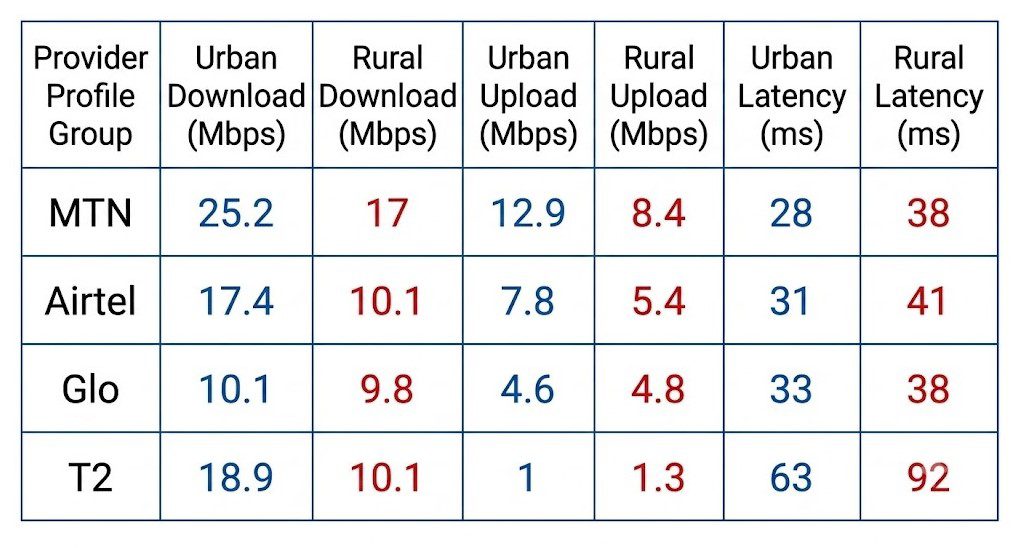
The leading telecom operator delivered a slight regional balance with a focus on nationwide depth. Urban versus rural download speeds over the period averaged 25.2 Mbps and 17 Mbps respectively, while upload speeds came in at 12.9 Mbps and 8.4 Mbps. MTN's consistency across both locations shows why it remains the nationwide leader.
Airtel Nigeria
Airtel stood along the middle line, with lower performance than MTN. The operator recorded urban download speeds of 17.4 Mbps against 10 Mbps in rural areas, while upload speeds were clipped at 7.8 Mbps in cities versus 5.4 Mbps in rural Nigeria. Considering the number of subscribers it serves, Airtel showed overall low performance, with an average connection delay of 36 ms.
Globacom
The operator experienced several constraints. Its urban download speed was as low as 10.1 Mbps — a figure comparable to Airtel's rural record and well short of MTN's — while rural download speed closed in at 9.8 Mbps. Upload speeds were dragging at 4.6 Mbps versus 4.8 Mbps, showing only a slight gap between the two regions and an apparent attempt to balance internet delivery.
T2 Mobile (9mobile)
The operator demonstrated strong download performance, at 18.9 Mbps in urban areas and 10.1 Mbps in rural areas. Upload speeds, however, were marred by connection fluctuations, falling as low as 1 Mbps in urban areas against 1.3 Mbps in rural areas. Delay time of connection averaged 77.5 ms. Latency — the delay before data starts to move — is the metric that shapes how responsive browsing, video calls and gaming feel, and it is where the operator spread in the report is widest, running from Airtel's 36 ms to 9mobile's 77.5 ms.
A persistent digital divide
The digital divide continues to define the geographical gap, ensuring that millions of Nigerians in rural areas remain third-class citizens in terms of quality internet access. The data confirms that living in a major city centre yields a faster and more responsive connection than living along rural or semi-urban corridors.
Despite this separation, rural performance appears to be gradually catching up, perhaps at a slow pace. The report shows that rural network speeds improved modestly by roughly 0.2 Mbps per month over the 17-month study — a steady, positive trajectory, though sustained long-term performance will be needed to deliver average satisfaction.
Rural corridors versus city centres
Compared with urban settlements that have concentrated populations, Nigeria's rural plain corridors span vast agricultural regions and northern transit routes. Across the 17-month report, these areas saw average download speeds of 13.0 Mbps, upload speeds of 6.0 Mbps, and a high connection delay (latency) of 39 milliseconds (ms).
A typical Nigerian city, by contrast, is built on financial connection. Nigerians in cities such as Lagos, Abuja, Port Harcourt, Edo, Ibadan and others benefit from high tower density and technology deployments. This drove download speeds to 19.2 Mbps, upload speeds of 9.8 Mbps, and a connection delay of 31 ms.
5G, 4G LTE and the legacy networks
Overall, 5G internet connection remains restricted to dense city clusters (Lagos, Abuja and Port Harcourt), where it shows a high speed of 181.5 Mbps. That narrow footprint reflects a rollout that is still in its early years: commercial 5G only arrived in Nigeria in 2022, after the NCC auctioned 3.5 GHz spectrum in late 2021. While the 5G coverage gap continues to pose a serious digital division, 4G LTE remains the nationwide backbone at 15.7 Mbps download speed and remains essential for digital inclusion.
At the other end, 2G and 3G are gradually phasing out, at a slow pace, to free up spectrum for expanded 4G and 5G coverage — a transition operators in several other African markets have already begun scheduling as they refarm legacy spectrum toward newer technologies.
Nigeria and its telecom operators need to balance the game, or at least reduce the connection gap between geographical locations. For subscribers, the definition of a good internet experience is streaming or surfing without dragging. The report's monthly dataset hands the NCC a measurable baseline: whether rural speeds hold their roughly 0.2 Mbps monthly climb, how quickly refarmed 2G/3G spectrum widens 4G coverage, and when 5G stretches beyond its three-city clusters are the questions a follow-up study of the same kind can answer.

