Nigeria's Inflation Eases to 15.43% in July as Food Prices Surge Month-on-Month
Key Takeaways
- •Nigeria’s headline inflation fell to 15.43% in July 2026, down from 15.91% in June.
- •Month-on-month inflation eased to 1.57% from 1.66% in the previous month.
- •Food inflation rose 5.56% month on month in July, up from 3.75% in June.
- •Adamawa, Katsina and Zamfara recorded the highest year-on-year food price increases, while Borno posted a slight decline.
- •The Central Bank of Nigeria may weigh the softer headline inflation against rising food costs as it considers future policy moves.
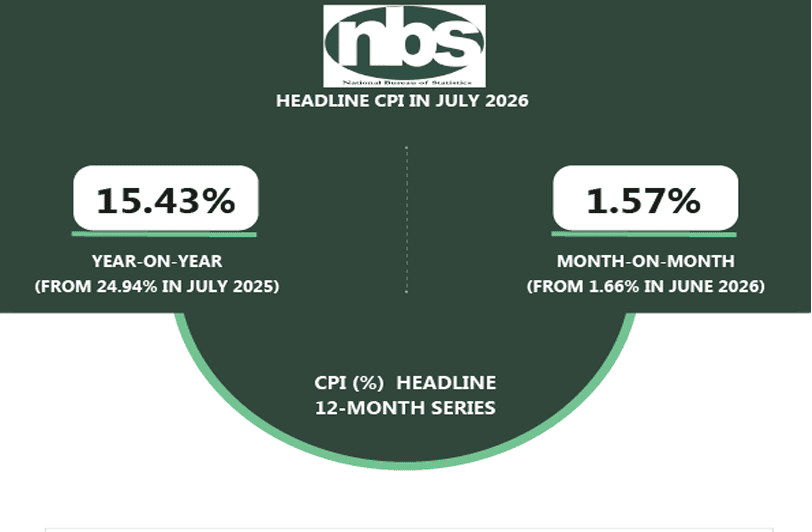
Nigeria's headline inflation rate fell to 15.43% in July 2026, down from 15.91% in June, according to the Consumer Price Index report released on Monday by the National Bureau of Statistics (NBS) (post on X). The month-on-month inflation rate also eased slightly, coming in at 1.57% compared with 1.66% in June.
Headline rate extends 2026 downtrend
The decline continues a gradual downward trend in overall inflation that has been developing throughout 2026. It also extends a longer cooldown from the 34.80% peak of December 2024 — Nigeria's highest inflation reading in nearly three decades — a period during which the NBS rebased the consumer price index to a 2024 base year with an updated basket of goods and services. It is a figure the Central Bank of Nigeria's (CBN) Monetary Policy Committee will closely monitor as it considers whether conditions are appropriate for a rate cut later this year; the committee has held its benchmark interest rate at 27.50% since November 2024, the highest level since the policy rate was introduced in 2006.
The headline number, however, tells only part of the story. Beneath it, food inflation has moved sharply in the opposite direction.
Food prices accelerate month-on-month
In July, food inflation was reported at 20.31% year-on-year, down from 26.20% the previous year, showing some improvement over twelve months. On a month-to-month basis, however, food prices surged by 5.56% — a significant jump from 3.75% in June — indicating that food prices are rising more quickly for consumers.
The NBS noted that the price hikes affected a variety of essential food items, including rice, water yam, plantain, fresh pepper, onions, carrots, tomatoes, garri, beef, eggs, guinea corn, ginger, crayfish, and plantain flour. These items are staples for many Nigerian households and directly affect their monthly food budgets. Food carries the largest single weighting of any category in Nigeria's consumer price index, which is why movements in these staples register so immediately in household spending.
State-level picture
Adamawa recorded the highest year-on-year increase in food prices at 51.36%, followed by Katsina at 30.84% and Zamfara at 30.65%. These significant increases highlight the challenges posed by insecurity and disruptions to agriculture in Nigeria's northwest and northeast regions, where farmers are frequently targeted by armed groups — a region that serves as one of the country's main sources of grains, legumes and tubers.
Conversely, Borno was the only state to register a slight year-on-year decline in food prices, at -0.31%. Nasarawa and Kebbi recorded rates of 6.88% and 12.50%, respectively. In Lagos, food inflation reached 13.48%, ranking among the highest alongside Adamawa at 17.02% and Borno at 13.26%. Some states, including Jigawa, Kebbi, and Bauchi, recorded actual monthly decreases.
Pressure on household budgets
For context, the national minimum wage was set at ₦70,000 per month in July 2024, leaving many workers with little buffer against a 5.56% single-month jump in food prices. Overall, while the general inflation rate may be easing, rising food prices month-to-month remain the bigger concern for households. Families, including those in Lagos, are facing higher grocery bills compared with June, adding financial pressure despite broader macroeconomic improvements. The NBS's next monthly CPI release and the CBN's coming policy meetings will indicate whether the divergence — a cooling headline rate alongside accelerating food costs — persists.

