Africa's $101 Billion Crypto Boom: Superteam Nigeria Lead Nzube Ezudo Says Nigeria's Decline Is Not a Loss of Interest
Key Takeaways
- •Sub-Saharan Africa received $101 billion in on-chain crypto value in the year to June 2026, a 13.4% increase that made it the world's fastest-growing crypto market.
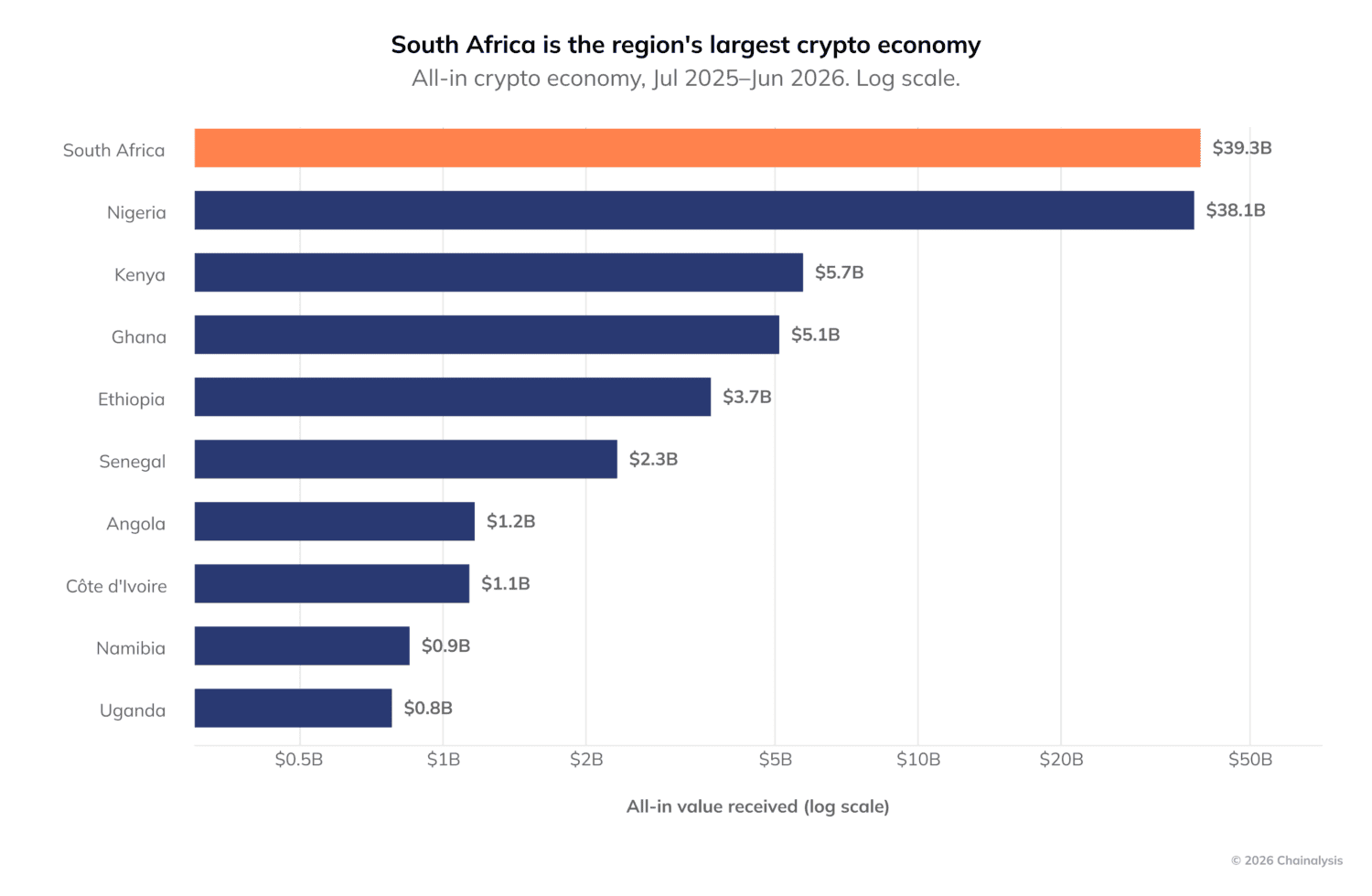
- •South Africa's crypto market expanded 52% to $39.3 billion, while Nigeria's contracted 3% to $38.1 billion despite ranking third on the Chainalysis grassroots adoption index.
- •Peer-to-peer stablecoin inflows in the region grew more than sixfold to $14.6 billion between 2022 and 2026, while Bitcoin inflows fell 60% over the same span.
- •Nigeria's decline reflects regulatory tightening and a steadier naira, with licensed domestic exchanges now capturing half of the country's centralized exchange inflows, up from 27% in 2025.
- •On September 1, 2026, 21 global financial institutions, including Bank of America, Citi, Goldman Sachs and Africa's Standard Bank, committed to issuing a dollar stablecoin targeted for the first half of 2027.
Nigeria's crypto economy contracted in the year to June 2026, even as South Africa's expanded by half. The easy conclusion would be that Nigerians have lost interest. Experts reading the data argue otherwise: stablecoin adoption is deepening — adding volume in one market and reshuffling it in the other.
Sub-Saharan Africa received $101 billion in on-chain value between 1 July 2025 and 30 June 2026, according to Chainalysis' 2026 Geography of Cryptocurrency Report. That represented 13.4% growth, enough to make the region the fastest-growing crypto market in the world despite remaining the smallest. Peer-to-peer stablecoin inflows across the region grew more than sixfold over that span, from $2.3 billion in 2022 to $14.6 billion in 2026, while Bitcoin inflows fell 60%, from $36 billion to $14.6 billion.
To explain why traditional lenders and informal merchants are converging on the same rails, Technext interviewed Nzube Ezudo, a former corporate banker who now leads Superteam Nigeria, the Nigerian chapter of the global Superteam talent network within the Solana ecosystem.
One continent, two speeds of formalisation
South Africa and Nigeria together drive more than three-quarters of Sub-Saharan Africa's crypto activity, yet the two heavyweights moved in opposite directions. South Africa's market expanded by 52% to $39.3 billion, helped by $8.34 billion in domestic business-like payments — a category that grew faster than the country's $1.29 billion in institutional inflows. Nigeria recorded $38.1 billion, a 3% decline, even as it placed third on the Chainalysis grassroots adoption index and its users sent $25.2 billion to crypto services.
In Ezudo's view, the divergence reflects regulatory sequencing rather than fading Nigerian demand. South Africa has treated crypto as a regulated financial product for several years: exchanges are licensed, banks will deal with them, and businesses can run crypto through their books without fear.
"When institutions and merchants get that comfort, volume follows. That is what a 52% jump looks like," he says. "Nigeria's drop is not a loss of interest. Nigerians are still among the most active crypto users in the world. What changed is the urgency and the routing."
Against the backdrop of the foreign exchange shocks of 2024, a steadier naira cooled panic-driven hedging. Tighter regulation and tax reporting simultaneously reshaped how value moves. Decentralised exchange activity fell by 45% and cross-border peer-to-peer flows dropped 17%, while domestic centralised exchanges now capture half of Nigeria's centralised exchange inflows, up from 27% in 2025 and just 7% in 2022.
Part of that shift is genuine and healthy, in Ezudo's assessment, because licensed local platforms provide better naira liquidity and faster payouts. He suspects the remainder has moved out of public view — into over-the-counter desks, merchant networks settling off-chain, and WhatsApp and Telegram trading groups.
"In South Africa you are seeing formalisation that adds volume. In Nigeria you are seeing formalisation that reshuffles volume," he says. "Over time, I expect Nigeria to see the same institutional lift that South Africa is enjoying now. The goal should be to make the regulated route so cheap and easy that there is no reason to leave it."
One Nigerian exception stands out. Regionally, stablecoins are doing more of the work, yet Chainalysis found that Bitcoin still accounted for 92% of Nigeria's small domestic wallet transfers below $10,000 — $923 million of $1 billion — against 22% in the rest of Sub-Saharan Africa. The country's formal services are growing, but its peer-to-peer habit remains distinctly Bitcoin-driven.
Beyond the two giants, smaller West African markets delivered striking gains. Ghana's crypto economy grew 80% to $5.1 billion, while Senegal's surged 215% to $2.3 billion. Ezudo shares some of the scepticism those figures invite.
"Percentages from a small base tell you less than people think," he says. "Senegal at $2.3 billion is still a young market, so a few active corridors or OTC desks can move the number a lot."
The drivers, though, are not purely speculative. Ghana has spent two years building a regulatory framework, and once businesses know the rules, real payments start to move. Senegal sits inside the CFA franc zone, so its growth stems less from currency collapse and more from demand for cheaper, faster payments across West Africa and with the diaspora.
"My test for sustainability is simple: does the volume survive a quiet market? If these numbers hold while prices go sideways next year, it is adoption. If they fade, it was a moment," Ezudo says. "I am leaning towards adoption because stablecoins, not volatile tokens, are doing more of the work."
Across the $101 billion regional market, most volume still represents savings and value preservation, Ezudo concedes. Merchant settlement is the smaller slice, but the fastest-growing one — and the point where he believes the story changes from crypto as a savings account to crypto as a payment rail. Active intra-African crypto payment corridors nearly doubled in a year, from 80 to 152, while their total value more than tripled, from $34.3 million to $116.5 million.
"When your currency loses a large share of its value within a couple of years, holding dollars on-chain is a rational decision, not a speculative one," he says. "I would also push back on the term capital flight. A small business protecting its working capital is not fleeing. It is surviving."
On-chain data cannot settle how much of that corridor volume is trade and how much is family remittance, and Ezudo does not pretend otherwise.
"A wallet does not announce whether it is a trader in Kano paying a supplier in Accra or someone sending money home to family," he says. "My read from the ecosystem is that most of it is still small businesses and informal traders using P2P rails, which blurs the line between remittance and trade. That is actually the story: the informal economy is where intra-African trade lives, and it is adopting first."
Scaling that volume further is not, in his argument, a blockchain problem. It requires three fixes:
- Local off-ramps: cheap, instant conversion into mobile money and bank accounts in every corridor, not just the big four markets.
- Business tooling: invoicing, reconciliation and receipts that a company's accountant and tax authority will accept.
- Compliance built in: identity and travel rule checks that let banks and regulators gain comfort without killing speed.
"Chains like Solana already settle in under a second for a fraction of a cent," Ezudo says. "The blockchain is not the bottleneck anymore. The last mile is."
Why traditional finance crossed over
Three developments broke the dam for traditional finance, Ezudo says. First, the customers left: businesses were already settling invoices in USDT and USDC because correspondent banking was slow, expensive and shrinking, as global banks pulled out of African corridors. Second, regulation arrived, and compliance teams stopped saying no by default. Third, the global signal changed — once Visa, major United States banks and payment companies began building on stablecoins, the reputational risk of touching them flipped into the risk of being left behind.
"Banks watched fee income walk out the door," he says. "Dollar stablecoins are the compromise because they solve the problem banks actually have, which is dollar liquidity and settlement speed, without asking anyone to take a view on Bitcoin's price. To a bank's risk committee, a regulated, fully reserved dollar token looks like a faster payment instrument, not a speculative asset. That is a conversation they can have."
The clearest marker of the shift came on 1 September 2026, when 21 global financial institutions, among them Bank of America, Citi and Goldman Sachs, committed to establish a company to issue a United States dollar stablecoin targeted to reach the market in the first half of 2027. Standard Bank, Africa's largest lender, is the only African institution in the group. Within the region, Chainalysis also notes growing experimentation with local currency stablecoins in South Africa, Ghana, Kenya and Tanzania — including a cedi-backed model under examination by the Bank of Ghana that would let beneficiaries receive cedis through bank accounts or mobile money without holding crypto themselves.
None of this means banks will swallow the remittance market outright. Diaspora communities sent $888 million to the region through crypto remittances during the period, $645 million of it from North America, while the World Bank put the average cost of sending $200 to Sub-Saharan Africa at 7.9 per cent — the highest of any region. Ezudo expects convergence rather than replacement: banks serving as the licensed rails and liquidity partners, startups keeping the customer.
"A bank running a pilot does not change its cost structure or its customer experience overnight," he says. "The startups at risk are the ones whose only edge was regulatory arbitrage. The ones with a real product will be fine."
Self-custody is a memory, not an ideology
Even as institutions move in, personal wallets received 32.3% of all value entering Sub-Saharan Africa — the highest share in the world — and 70.9% of that value arrived through cross-border P2P transfers. Ezudo reads that pattern as self-defence learned from experience, not evasion.
"Many people here have lived through frozen accounts, sudden withdrawal limits, exchange shutdowns, or a payment provider being banned overnight," he says. "After that, holding your own keys is not ideology. It is common sense. That is a payment behaviour, not a hiding behaviour."
For builders, his advice is not to force users back into custodial accounts but to make self-custody safer and easier, with recovery options, better wallet design and compliant on-ramps.
Central banks are right to worry, Ezudo says: if a large share of savings and trade moves into dollar tokens, monetary policy loses some of its reach. Nigeria began coordinating its rules in July 2026, when President Bola Tinubu signed an Executive Order on Virtual Asset Coordination, creating a council chaired by the Central Bank of Nigeria to harmonise how regulators treat virtual assets, including stablecoins.
"But the stablecoins are a symptom, not the cause," he says. "People reached for dollars when local currency was unstable or hard to move. They were doing it with cash dollars and parallel markets long before crypto. Banning the tool does not remove the demand. It just pushes it somewhere less visible."
His prescription is to regulate stablecoin activity, encourage local currency stablecoins for domestic and regional trade, and plug these rails into national payment systems.
"The best defence of the naira or the cedi is a stable currency that is easy to use," Ezudo says. "If central banks get that right, stablecoins can carry their currencies instead of replacing them."
The checkpoints in that argument are already on the calendar: the bank consortium's dollar stablecoin is targeted for the first half of 2027, Nigeria's virtual asset council was created in July 2026 with the task of harmonising how regulators treat stablecoins, and the Bank of Ghana's examination of a cedi-backed model is under way. By Ezudo's own standard, the test is whether these volumes survive a quiet market — the condition under which the year's $101 billion reads as durable adoption rather than a moment.

