Neocloud Stocks Slide as Elice IPO Plunges 33% in Market Debut
Key Takeaways
- •Elice raised about $151 million in its IPO and saw its retail tranche heavily oversubscribed, yet its shares still fell roughly 33% on the October 20 debut, signaling investor pushback against neocloud valuations.
- •Valuation resistance is spreading across the sector, with Australia's Firmus withdrawing its IPO in favor of a private offering and Nscale's investors privately pressing to lower its $33 billion listing target to about $16 billion.
- •Publicly traded neoclouds have surrendered large gains, as CoreWeave dropped to $63 from $186, Nebius fell to $174 from a June high of $300, and IREN slid to $27.7 from $76, with bitcoin miners-turned-AI players like Riot Platforms, HIVE Digital, and MARA Holdings seeing similar declines.
- •A Gartner report warned of impairments worth billions of dollars, estimating AI data center owners need $8.5 trillion in revenue by the end of 2030 while expecting only $3.6 billion over the period, with neoclouds among the most exposed because hyperscalers have more diverse offerings.
- •Heavy depreciation, intensifying competition from new entrants securing major Anthropic deals such as Nscale's $45 billion agreement and RUM Group's $13 billion pact, and bubble warnings from investors like Ray Dalio and Michael Burry add to the sector's pressures.
Neocloud stocks came under renewed selling pressure on October 20 after Elice, a leading South Korean AI infrastructure and neocloud provider, plunged roughly one-third in its market debut, deepening the concerns that have been weighing on CoreWeave, Nebius, and IREN.
Neoclouds are a newer generation of cloud providers built around renting out GPU capacity for AI workloads — a narrower business than the diversified hyperscalers such as Amazon, Microsoft, and Google, which earn revenue across a much broader range of cloud services.
Elice raised approximately $151 million in its initial public offering, and its retail tranche was heavily oversubscribed, but its shares still fell by about one-third on the first day of trading.
Investor Pushback Builds After Elice IPO Flop
At the center of the sell-off was the debut of Elice Inc., which went public on Oct. 20 after raising $151 million. The 33% drop is being read as a sign that investors are pushing back against the high valuations that neocloud operators are seeking as they list. Listings like this one matter to the broader sector because they are among the few points at which the open market, rather than private negotiations, sets the price of a neocloud.
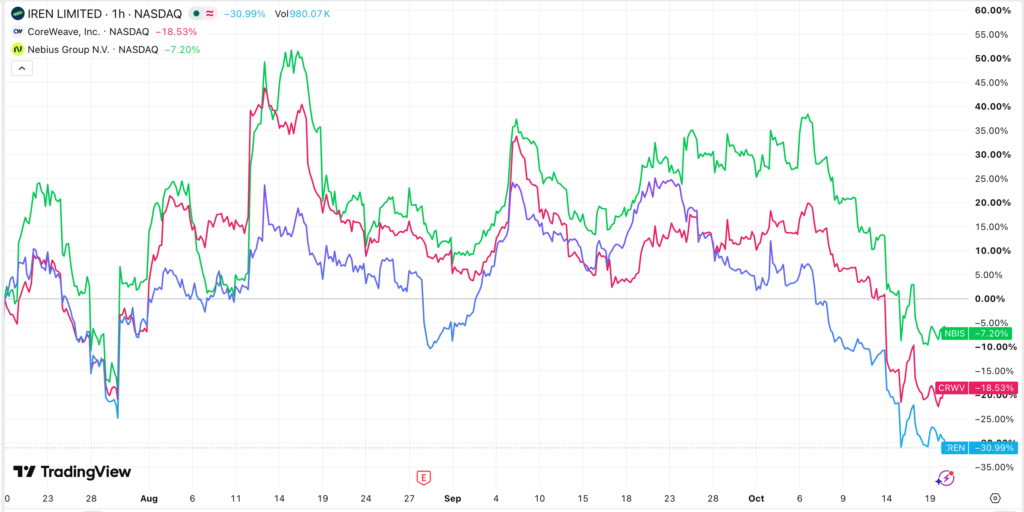
CRWV, Nebius, and IREN stocks have slumped this year | Source: TradingView
The disappointing listing followed a string of similar setbacks. A few weeks earlier, the Australian company Firmus withdrew its IPO after investors criticized its valuation. Management subsequently decided to launch a private offering, to be followed by another IPO in New York.
Investors are also resisting Nscale, a British company that is planning to go public at a $33 billion valuation. According to media reports, its investors are privately pressing the company to lower the valuation target to about $16 billion. Whether Nscale goes ahead at its original target, trims it, or follows Firmus into a private offering will offer another gauge of how deep this valuation resistance runs.
Listed Neoclouds Are Struggling Too
The pushback is unfolding as publicly traded neocloud companies have already given back large gains. CoreWeave, which is backed by Nvidia, went public last year and climbed to $186 within a few months; the stock has since fallen to $63, erasing billions of dollars in value. Nebius, which emerged from Russia's Yandex, soared to $300 in June before dropping to $174, while IREN has tumbled to $27.7 from a high of $76.
Bitcoin mining companies that have pivoted to the AI data center industry, including Riot Platforms, HIVE Digital, and MARA Holdings, have experienced similar declines.
Depreciation and Rising Competition
Several factors underpin this year's slump. A recent Gartner report warned that the companies will need to announce impairments worth billions of dollars in the coming years. The report cited the fact that AI data center owners will need to generate $8.5 trillion in revenue by the end of 2030, while Gartner expects these companies to make no more than $3.6 billion in revenue over this period. Gartner also noted that neocloud companies will be among the most affected, because hyperscalers have more diverse offerings.
CoreWeave, Nebius, and IREN are also reporting heavy depreciation, a trend that may continue over time. Depreciation is a closely watched line item for these companies because it captures how quickly expensive GPU fleets lose value as newer hardware generations arrive, and it is judged against revenue every quarter. In its last earnings report, CoreWeave recorded revenue of $2.5 billion against depreciation of $752 million. Nebius posted revenue of $582 million with depreciation of $259 million, while IREN reported revenue of $137 million against depreciation of $66 million.
Competition in the industry is also rising. Nscale recently received a $45 billion deal from Anthropic, and it is also in talks with Anthropic for a similar deal. In addition, most Bitcoin mining companies have moved into the sector, and RUM Group, formerly known as Rumble, has entered the industry as well, securing a $13 billion deal with Anthropic.
There are also concerns that the AI bubble will burst soon. Ray Dalio has warned that the bubble could burst as soon as this year because of rising interest rates, and Michael Burry, the investor who predicted the housing bubble, has also warned that the bubble will burst. Such a development would also affect these neocloud companies.
This article is for informational purposes only and does not constitute financial or investment advice. Technology and AI infrastructure stocks can experience substantial volatility and capital losses. Investors should conduct independent research and consult a qualified financial adviser before making investment decisions.

