Nebius (NBIS) Is Listed on edgeX: AI Cloud Capacity, NVIDIA Demand, and the NBIS Trading Thesis
Key Takeaways
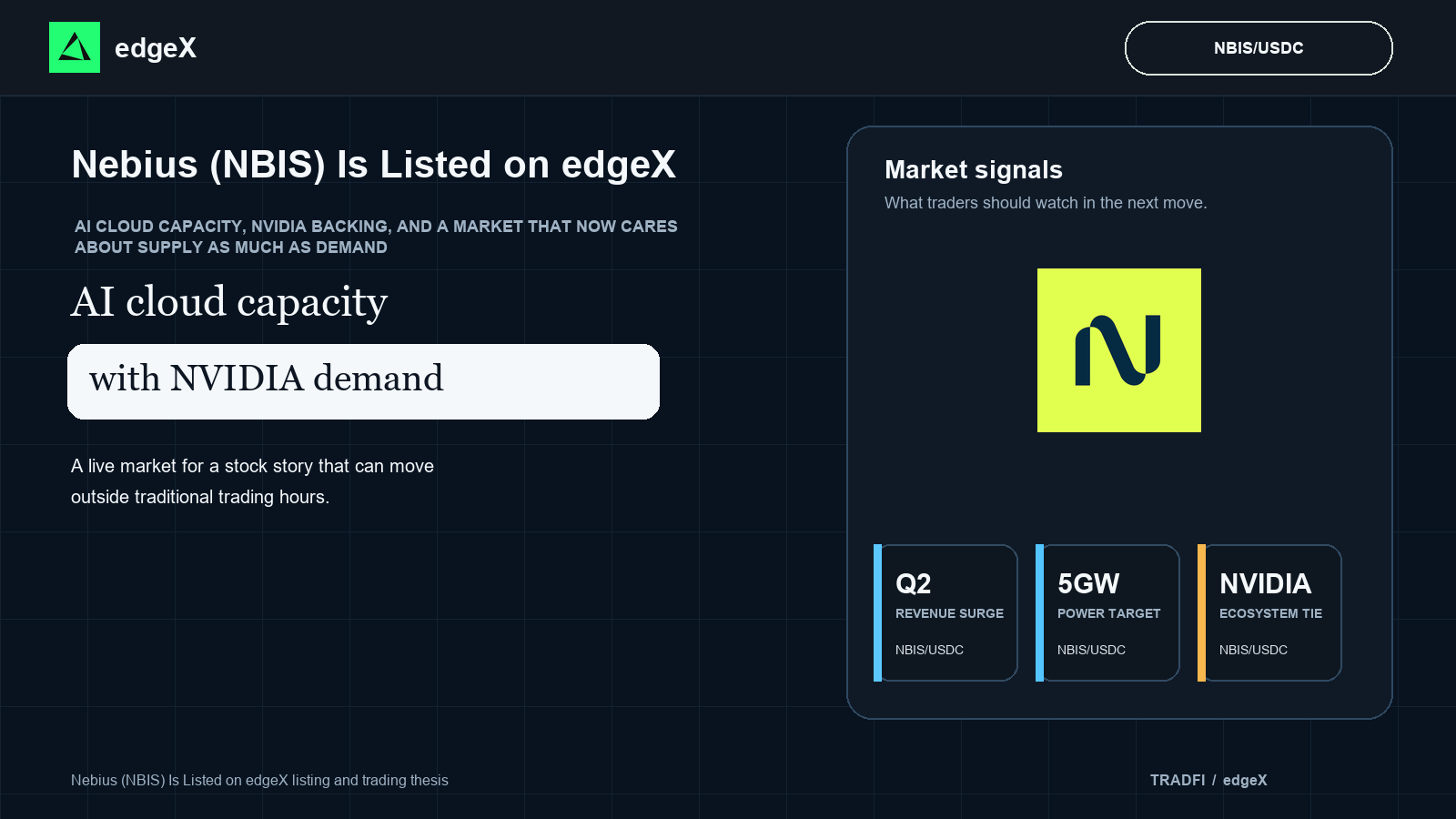
- •Nebius reported Q2 results on August 13 that beat revenue expectations, securing four deals exceeding $1 billion in contract value and approximately $9 billion in expected prepayments for the year.
- •The company raised its year-end contracted-power target to 5 gigawatts, reflecting a shift in the industry where securing electricity at scale has become as critical as securing AI chips.
- •Nebius was formed from the international businesses of Yandex following the separation of Russian and non-Russian operations, and re-listed on Nasdaq under the NBIS ticker as a pure-play AI infrastructure company.
- •NVIDIA disclosed a stake in Nebius earlier in the summer, reinforcing investor perception that the company is a credible player in the competitive AI cloud market alongside CoreWeave and Lambda.
- •The NBISUSDC perpetual listed on edgeX is a derivative product that does not confer ownership rights, dividends, or shareholder privileges in Nebius.
Quick Answer
Nebius is an AI infrastructure company, not a consumer internet brand. It sells GPU-heavy cloud capacity, data-center buildout, and AI platform services to customers that need training and inference at scale. edgeX lists NBISUSDC so traders can express a long or short view on that capacity story around the clock. The latest catalyst is the company's August 13 Q2 report, which sent the stock higher on a huge revenue beat, stronger EBITDA, and a bigger year-end contracted-power target.
Trade the NBIS/USDC perpetual on edgeX.
https://x.com/edgeX_exchange/status/2088085855961567378
NBIS Arrives on edgeX as AI Cloud Capacity Becomes the Scarcity Trade
Nebius has become one of the clearest ways to trade the AI infrastructure bottleneck. The company is not trying to be the next consumer app or the next software platform with an AI label attached. It is trying to own the scarce inputs that matter when model builders need GPU clusters, power, networking, and cloud capacity faster than hyperscalers can provide them.
That is why the NBISUSDC perpetual belongs on edgeX. The story trades like a high-beta AI cloud name, but the underlying debate is more specific: can Nebius turn rapid capacity expansion into durable earnings power before the market decides the AI cloud cycle has normalized?
What Nebius Actually Sells
Nebius describes itself as an AI infrastructure company. In practice, that means it provides the compute layer that customers use to train and run AI models, with NVIDIA GPUs, software tooling, and data-center infrastructure stitched into a single offering. That business model matters because AI demand is increasingly less about general cloud usage and more about who can source enough power and hardware to meet real customer workloads.
The company is betting on full-stack capacity, not a narrow product
The attraction of Nebius is that it owns more of the stack than a typical resale cloud company. It is building owned and co-located AI sites, securing power, and offering a platform that can be used for training, inference, and applied AI workloads. That can create more pricing power than a simple hosting business if the company remains one of the few places where customers can actually buy the capacity they need.
But the same structure can turn into a capital trap if demand cools. The market is not paying for "AI cloud" in the abstract anymore. It wants to know whether the company can fill the power, whether customers prepay, whether utilization stays high, and whether margins improve as the fleet scales.
| Driver | Bullish evidence | What would weaken the thesis |
|---|---|---|
| Power and capacity | More contracted power, faster site buildout, and visible utilization | Delays, power bottlenecks, or underused capacity |
| Customer demand | Multi-year commitments, prepayments, and broader enterprise adoption | Heavy reliance on a small number of AI customers |
| Product mix | More inference and applied-AI workloads with repeat usage | One-off training bursts that do not recur |
| Economics | Rising adjusted EBITDA and better operating leverage | Growth that stays capital intensive without margin relief |
| Market structure | NVIDIA support and ecosystem credibility | Concentration risk and tighter financing conditions |
Why the Latest Q2 Surge Matters
The latest Nebius catalyst is not subtle. On August 13, the company reported a huge second-quarter jump in revenue, and market coverage from MarketWatch and Investopedia described the result as a blowout that lifted shares sharply. The point is not just that the company beat estimates. It is that the market used the release to reprice Nebius as a real contender in the AI cloud supply chain.
That matters because AI investors have spent much of 2026 trying to answer a simple question: is the issue demand or capacity? Nebius is a capacity story. If customers are still willing to prepay, if the company can keep signing major deals, and if contracted power continues to rise, the bull case becomes easier to defend.
The market now cares about supply discipline
The most important detail in the recent reporting was not only revenue growth. Coverage from MarketWatch said Nebius had four deals above $1 billion in contract value and roughly $9 billion of expected prepayments for the year. Investopedia said the company raised its year-end contracted-power target to 5 gigawatts. Those are the kind of numbers that tell investors the business is not just renting GPUs; it is locking in a long-run industrial buildout.
That also means the stock can become sensitive to every sign of momentum slowing. If prepayments weaken, if power targets slip, or if customer concentration rises too much, the market can move from enthusiasm to skepticism very quickly.
How the Market Reads the NVIDIA Connection
Nebius has benefited from its relationship with NVIDIA, and that matters for sentiment. The AI cloud market still leans on NVIDIA's ecosystem for credibility, hardware access, and investor confidence. When NVIDIA disclosed a stake in Nebius earlier in the summer, it strengthened the idea that Nebius is more than a random neocloud name.
That link is useful, but it is not a guarantee. The market will not pay for the logo alone. It will pay for a reliable path from GPU access to recurring customer revenue and ultimately to better economics. Nebius is interesting because it sits at that intersection: technical credibility on one side, operating leverage on the other.
The best bullish evidence is not hype; it is repeatability
The strongest version of the thesis is simple. Nebius keeps converting demand into new capacity, customers keep prepaying, and the business gets more efficient as the buildout scales. In that scenario, the stock can behave less like a story stock and more like a supply-constrained infrastructure name.
The weakest version is just as clear. If the market is only reacting to one big quarter, or if revenue growth depends on a few giant contracts that do not repeat, the stock can rerate in the opposite direction as quickly as it rallied.
What Could Strengthen or Break the NBIS Thesis
The bullish case strengthens if the company keeps showing that its power pipeline, site expansion, and customer commitments are all moving in the same direction. More contracted power, broader enterprise demand, and sustained revenue acceleration would tell traders the market is not just chasing a single headline.
The case weakens if growth becomes too concentrated, if financing pressure increases, or if customer demand shifts from true ongoing need to temporary AI spending enthusiasm. Because Nebius is a capital-heavy business, the market will care as much about execution quality as it does about headline growth.
The main risk is not demand disappearing; it is demand arriving too slowly
Nebius does not need the AI market to vanish for the stock to underperform. It only needs the pace of capacity monetization to lag the pace of spending. If the company builds faster than it fills, the market will eventually stop rewarding the narrative and start focusing on dilution, debt, and utilization.
That is what makes NBIS a useful edgeX listing. It is a real operating story, but the timetable matters. Traders are not just betting on AI. They are betting on how quickly scarce infrastructure can be turned into visible economics.
Why Customer Mix Matters More Than Headline Demand
One reason Nebius is harder to value than a normal cloud stock is that not all AI customers are equally useful. A hyperscaler that wants burst capacity can produce a huge contract headline, but that does not automatically tell traders whether the business will enjoy stable utilization or strong margins. A smaller enterprise customer can be less dramatic on announcement day and still become a better long-run signal if usage is steadier and broader.
That is why the market should care about customer mix, not only about the top line. The best version of the Nebius story would combine large anchor customers with a wider base of recurring inference demand. Training demand can be spectacular, but it is often spiky. Inference demand is usually less glamorous, yet it can create a steadier revenue base if enterprises keep serving live applications.
Prepayments help only when they translate into durable usage
The reporting around prepayments is important because it suggests customers are serious enough to reserve capacity ahead of time. But prepayments should not be treated as the finish line. They are strongest when they point to future utilization that remains high after the initial buildout. If prepayments simply finance one heavy burst of demand and then cool, traders will eventually question the quality of that revenue.
Nebius therefore has to show more than a good quarter. It has to show that its contracts are leading to a business model with repeat traffic, efficient deployment, and enough customer breadth that a single pause does not reset the whole equity story.
A Scenario Framework for NBIS
In a bullish scenario, Nebius keeps turning its power and GPU pipeline into actual revenue faster than the market expected. Contracted power rises, more customers prepay, utilization remains healthy, and the company proves it can keep scaling while adjusted EBITDA improves. In that setup, the stock can still be volatile, but the market begins treating it more like scarce AI infrastructure than like speculative cloud capacity.
In a base scenario, the company continues growing quickly, but the market becomes more selective. One quarter is strong, the next is more mixed, and the stock starts trading around evidence of how efficiently management can deploy each new site. Traders would still have a live AI story, but one that rewards discipline rather than momentum alone.
In a bearish scenario, capacity expansion runs ahead of monetization. Customer commitments look less broad than the headlines suggested, financing conditions tighten, or buildout timing slips. That would not require AI demand to disappear. It would only require the market to decide that Nebius is spending too early for returns that are arriving too late.
Another useful test for the next quarter is whether Nebius starts looking less dependent on exceptional announcements. If the company can keep producing solid contract, utilization, and customer-quality evidence without needing one dramatic reveal each time, the market will have more reason to believe the business is settling into an operating rhythm rather than an excitement cycle.
Trade NBIS Perpetuals on edgeX
edgeX gives traders around-the-clock access to selected stock perpetuals through a self-custodial venue. The NBISUSDC perpetual lets eligible users express a long or short view on Nebius without waiting for the next traditional-session open.
What traders still need to check
NBISUSDC is a derivative, not ownership of Nebius shares. Traders should verify current leverage, funding, liquidity, fees, index methodology, contract specifications, and regional availability on the live market page before acting.
Why perpetual structure changes the timing
Nebius can move hard on earnings, analyst notes, or AI-capacity headlines long before a traditional market session gives traders a new close. A perpetual venue is useful here, but it also means funding and liquidation can matter as much as direction.
What to watch next
The next set of NBIS signals will likely come from capacity expansion, customer commitments, and any follow-up commentary on how fast the company can turn its power pipeline into revenue. If those metrics keep improving, the market will keep treating Nebius as a leading AI cloud beneficiary rather than a one-quarter wonder.
Frequently Asked Questions
What is Nebius?
Nebius is an AI infrastructure company focused on GPU-heavy cloud capacity, AI platform services, and the data-center buildout needed to support training and inference workloads.
Why is NBIS getting so much attention now?
The August 13 Q2 report showed a massive revenue surge and reinforced the idea that AI cloud capacity is a scarce and valuable asset rather than just a generic cloud service.
Does NBISUSDC represent ownership in Nebius?
No. It is a perpetual derivative listed on edgeX. It does not provide shares, dividends, or shareholder rights.
What is the biggest risk for NBIS traders?
The biggest risk is that the company expands capacity faster than it monetizes it, which would pressure margins, financing, and sentiment.

