NEAR Protocol in 2026: An Ecosystem Walkthrough Focused on AI Infrastructure
Key Takeaways
- •NEAR AI offers verifiable private inference using Intel TDX and NVIDIA GPU trusted execution environments, with an OpenAI-compatible API and listed clients including the Government of Bermuda, NVIDIA, Intel, Brave, and Venice.
- •The network averaged block times below 600 milliseconds with 421 active validators and 5.46 billion total transactions since its 2020 mainnet launch, though live throughput was only 6 TPS at the time of review.
- •NEAR's $221 million DeFi TVL represented roughly 3.7% of its more-than-$6 billion market capitalization, and RHEA Finance APYs above 500% reflected liquidity-mining incentives rather than sustainable yields.
- •The token has no supply cap and emits approximately 5% annually, while daily chain fees of $5,481 fell far short of offsetting inflation and only 15,590 holders were reported for a top-20 asset.
- •NEAR Intents, a flagship cross-chain intent-settlement product, experienced an exploit during the review, but the funds were reportedly returned and the protocol carries a 4.5/5 CertiK rating.
NEAR Protocol ($NEAR) Review 2026: An Ecosystem Walkthrough
Reviewed October 9, 2026. A first-person examination of NEAR's ecosystem, chain statistics, wallet experience, DeFi layer, token economics, and NEAR AI product.
NEAR Protocol has increasingly appeared in discussions about “AI + crypto,” although its positioning was not something I had examined closely. I spent several hours reviewing the project through near.org/ecosystem, the blockchain explorer, a wallet, the DeFi ecosystem, and the new NEAR AI product. The following is an account of what I found.
1. NEAR's AI Pivot Is Visible Immediately
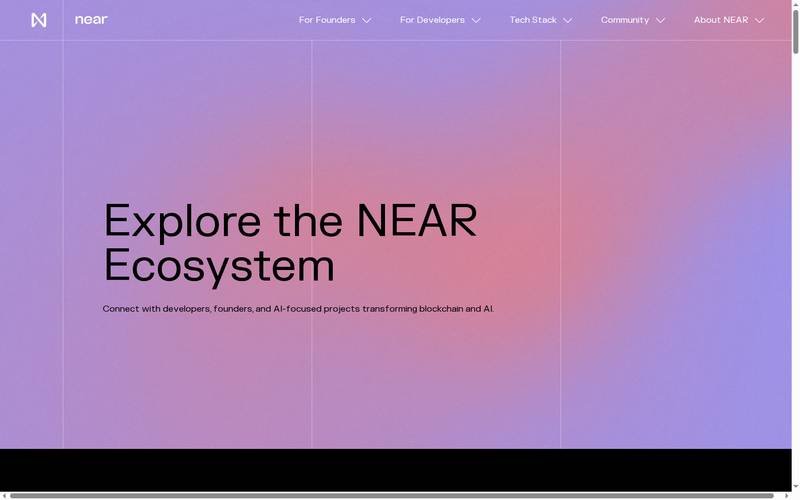
The first thing that stands out on the NEAR ecosystem page is not blockchain technology but artificial intelligence. The page opens with a purple-gradient hero message: “Explore the NEAR Ecosystem, Connect with developers, founders, and AI-focused projects transforming blockchain and AI.”
Source: near.org/ecosystem, October 9, 2026.
The framing reflects where NEAR wants to sit in 2026. The project is no longer leading primarily with fast transactions or low fees. Its messaging emphasizes AI infrastructure, “the currency of agents,” private inference, and on-chain AI coordination.
Whether that represents genuine traction or a rebranding effort is a separate question. The visual identity also signals a deliberate shift from the colorful DeFi-focused aesthetic associated with many chains in 2022 and 2023. The deep purple palette, clean sans-serif typography, and minimal design feel more corporate and may appeal to enterprise buyers. That positioning is consistent with the client list associated with NEAR AI.
2. The About Page Returns a 404
After visiting the homepage, I looked for the About page to understand who built NEAR and how the project describes itself. Navigating to near.org/about returned a 404 page-not-found message.
Source: near.org/about, October 9, 2026.
A broken About page is a meaningful onboarding problem. Developers evaluating blockchains, journalists researching the project, and people conducting due diligence commonly look for this information early. NEAR's basic project context was instead scattered across blog posts and the NEAR Foundation's Medium publication, with no single consolidated page.
For a project that has raised $533.7 million, the omission is notable. It may have been related to a recent site migration or redesign cycle, but that does not eliminate the friction for users attempting to learn about the project at that moment.
3. Chain Statistics: Fast Finality but Modest Live Throughput
I used nearblocks.io to examine the network's operational statistics.
Source: nearblocks.io, October 9, 2026.
The displayed figures were:
- NEAR price: $4.70, down 12.78% on the day
- Total transactions: 5.46 billion
- Live TPS: 6
- Gas price: 0.0001 / TGas
- Active validators: 421
- Average block time: 0.5941 seconds
- Block height: 219,172,541
- Market capitalization: $6,148,263,450
An average block time below 600 milliseconds is fast. NEAR's Nightshade sharding architecture is theoretically designed to scale to 1 million transactions per second, while the live on-chain figure at the time of review was 6 TPS. The difference between theoretical capacity and actual use is worth noting. It does not by itself indicate a problem, since most Layer 1 networks operate below their maximum capacity, but it shows that current demand has not reached the network's performance ceiling.
The historical transaction count is substantial. NEAR recorded 5.46 billion transactions since its mainnet launch in 2020, and the chain was continuing to operate at block height 219,172,541. The 421 active validators represent a meaningful decentralization base, although the network is less distributed than Ethereum and is not supported by only a handful of nodes.
Gas costs were also low. At 0.0001 per TGas, many routine transactions cost fractions of a cent. That is useful for applications where users are not expected to think about transaction fees.
4. Wallet Onboarding Was Relatively Smooth
The recommended wallet I reviewed was MyNearWallet.
Source: app.mynearwallet.com, October 9, 2026.
The landing page displayed the message, “NEAR is here. Securely store and stake your NEAR tokens and compatible assets.” It offered two clear options: Create Account and Import Existing Account.
NEAR's account model differs from that of many blockchains. Instead of a hexadecimal address such as 0x4a3...f92, users can have a human-readable account name such as yourname.near. This can make wallet addresses easier for newcomers to understand and share.
The tradeoff is that creating an account requires a small storage deposit. That cost may be covered by a faucet or an exchange during initial setup, but it can surprise users who expect wallet creation to be free.
I did not fund the wallet or complete a transaction. The aim was to evaluate the onboarding experience without going through the full know-your-customer process required by an exchange. Up to that point, the process was straightforward, with a clean, mobile-responsive interface and no unnecessary complexity around the seed phrase.
5. DeFi APYs Require Careful Interpretation
NEAR's main decentralized exchange, formerly Ref Finance and later rebranded as RHEA Finance, was the next stop. The interface was accessed through app.ref.finance.
Source: app.ref.finance, October 9, 2026.
The displayed headline figures were:
- NEAR-USDC pool: 632.07% APY and $2.54 million TVL
- NEAR-USDI pool: 512.86% APY and $4.18 million TVL
APYs above 500% are unlikely to represent organic yield. They are more consistent with liquidity-mining incentive rates, in which tokens such as NEAR or REF are distributed to early liquidity providers to attract capital and build total value locked.
This is a common method for bootstrapping liquidity in DeFi ecosystems. It can work temporarily, but the pool sizes were relatively modest. As more capital enters to pursue the displayed rates, the effective yield for existing participants can decline quickly. For example, a user depositing $50,000 into the NEAR-USDC pool could see the rate fall as additional liquidity arrives.
Such pools may interest experienced liquidity providers who understand token-emission cycles, but the figures should not be interpreted as safe or sustainable returns. A NEAR-USDC position also carries impermanent-loss risk, which can become significant during a day when NEAR falls 12.8%.
6. DefiLlama Shows a Modest DeFi Footprint
I cross-referenced the DeFi data with DefiLlama's NEAR page.
Source: defillama.com/chain/near, October 9, 2026.
The figures were:
- Total value locked: $221.26 million, down 12.57% on the day
- 24-hour chain fees: $5,481
- 24-hour chain revenue: $3,836
- 24-hour decentralized-exchange volume: $47.11 million
- 24-hour application revenue: $84,067
- Active addresses over 24 hours: 82,447
- Total raised: $533.7 million
- NEAR price: $4.58
A TVL of $221 million places NEAR in a complicated position relative to a network with a market capitalization above $6 billion and a top-20 market ranking. Solana and Avalanche, for example, have DeFi TVLs measured in billions. NEAR's $47 million in daily DEX volume represents real activity, but it is below the level associated with the largest DeFi hubs.
The 82,447 active addresses over 24 hours provide a more encouraging measure of usage. The network is not inactive, and users were transacting daily. However, the difference between address activity and capital deposited in DeFi protocols suggests that users may be transacting without committing substantial funds to yield or lending applications. That could be consistent with a future in which some NEAR users execute agent transactions rather than farm yield, although the available figures do not establish that explanation.
The $533.7 million raised by the project is another notable figure. Andreessen Horowitz, Tiger Global, and other investors provided significant capital. That funding gives NEAR resources to continue executing, but it does not by itself demonstrate ecosystem adoption.
7. NEAR AI Offers a More Specific Product Proposition
The part of the ecosystem I had not previously examined was NEAR AI, available at near.ai. The phrase “blockchain + AI” has been used broadly, but NEAR AI presented a more specific technical proposition than I expected.
Source: near.ai, October 9, 2026.
Its headline states: “Private AI inference you can verify. Run AI on data you can't afford to expose. TEE-hosted open-weight models with hardware-signed proof. Intel TDX + NVIDIA GPU TEE. Open source \u0026 auditable. OpenAI-compatible API.”
The product uses Trusted Execution Environments, or TEEs, combining Intel TDX with NVIDIA's GPU TEE. NEAR AI says users can run inference on sensitive data and receive a hardware-signed proof for each response. The stated purpose is to provide a verifiable record that the computation took place inside a secure enclave rather than being accessible to the operator or another party.
The listed clients and partners include the Government of Bermuda, Abound, NVIDIA, Intel, Brave, and Venice. The presence of NVIDIA and Intel suggests that the hardware integration is intended to be more than a purely conceptual partnership. A national government using the infrastructure is also presented as a proof point.
The OpenAI-compatible API is a practical adoption strategy. Developers who have already built against the OpenAI API could theoretically move to NEAR AI with limited code changes while adding the stated TEE-based privacy properties.
A short review could not establish the product's model quality, price competitiveness against private-inference services from AWS and Azure, or production latency. Those factors would be important in determining whether enterprise usage scales. Publicly verifiable production usage, inference volume, latency, pricing, and fee revenue would provide useful follow-up measures, but this review did not establish them.
8. Market Data and Token Economics
Market information was checked against CoinGecko and CoinMarketCap.
Sources: coingecko.com/en/coins/near and coinmarketcap.com/currencies/near-protocol, October 9, 2026.
CoinGecko reported the following on October 9, 2026:
- Price: $4.68, down 12.8% on the day
- Rank: No. 21
- Market capitalization: $6.144 billion
- Fully diluted valuation: $6.144 billion, the same as market capitalization because all supply was circulating
- 24-hour volume: $1.686 billion
- TVL: $132.287 million
- Perpetual futures open interest: $2.473 billion
- Circulating supply: 1.308 billion NEAR
- Maximum supply: unlimited
CoinMarketCap reported:
- Price: $4.68, down 12.95%
- Rank: No. 17
- Market capitalization: $6.13 billion
- Volume: $2.05 billion
- Holders: 15,590
- CertiK rating: 4.5/5
NEAR has no hard supply cap. The protocol emits approximately 5% in new tokens annually to fund validator rewards, making the model inflationary. For token holders, that means ecosystem growth and demand would need to outpace dilution to maintain purchasing power relative to fixed-supply assets.
An inflationary model is not automatically negative; Ethereum is also technically inflationary, although its burn mechanisms can offset part of the issuance. NEAR does not have a comparable burn mechanism operating at a meaningful scale. The $5,481 in daily chain fees reported by DefiLlama was far below the level required to offset 5% annual inflation on a network with a $6 billion market capitalization.
The 15,590 holder count reported by CoinMarketCap is low for an asset ranked in the top 20 by market capitalization. Bitcoin has millions of holders, and many mid-cap tokens report six-figure holder counts. A low reported count can indicate concentration among venture investors, funds, and large holders, which may contribute to volatility when large positions are sold. CoinMarketCap's methodology can undercount holders whose assets are held on centralized exchanges, so the figure should be interpreted with that limitation in mind.
Perpetual futures open interest of $2.473 billion was nearly 40% of market capitalization. That represents a large derivatives market relative to the asset's size. During a 12.8% daily decline, liquidations in perpetual contracts can amplify selling in the spot market. Some of the observed price movement may therefore have been derivatives-driven.
9. NEAR Intents Experienced an Exploit and Recovery
During the review, CoinMarketCap's feed displayed the headline, “NEAR Intents Exploit Funds Returned To…”
NEAR Intents is one of the flagship products in NEAR's 2026 roadmap. It is a cross-chain intent-settlement layer that allows users to specify an outcome, such as swapping one asset for another, while solvers compete to fulfill the request. This model is intended to simplify the user experience compared with traditional decentralized-exchange interactions.
An exploit occurred: a vulnerability was found and funds were taken. The headline indicated that the funds were returned. That is a favorable resolution to a security incident of this type, which can follow a white-hat discovery or a negotiated return.
The CertiK rating of 4.5 out of 5 indicates strong audit practices according to that rating, and the recovery itself is a positive trust signal in the sense that the ecosystem responded and recovered the funds rather than writing them off. However, the incident remains an important risk disclosure. New and complex products, particularly cross-chain intent systems, carry smart-contract risk, and the novel architecture may not fit established security patterns completely.
10. Main Friction Points
Several issues stood out during the review.
Broken About Page
The 404 page is a fixable but unnecessary first-impression problem for a project of NEAR's size.
Unlimited Supply
Approximately 5% annual inflation is a structural consideration rather than a software defect. Sustained growth would be needed to offset dilution. If NEAR's AI positioning does not generate substantially greater fee revenue or a meaningful burn mechanism, the effect compounds over time.
DeFi TVL Relative to Market Capitalization
The $221 million TVL figure against a market capitalization above $6 billion is difficult to overlook. The source review compared NEAR with chains where DeFi TVL represents roughly 10% to 30% of market capitalization; NEAR's ratio was approximately 3.7%. That could mean the ecosystem is still early, or that NEAR is moving away from a DeFi-centered use case toward AI workloads, making TVL a less complete measure of activity. Both interpretations remain possible.
Small Reported Retail Holder Base
The 15,590 holders reported by CoinMarketCap may indicate concentration for a top-20 token. Large holders may have longer investment horizons, but coordinated selling by funds or other major holders could also affect market conditions. The possibility of undercounting exchange-held balances should be considered.
DeFi Incentive APYs
The 632.07% and 512.86% APYs shown on RHEA Finance were incentive rates rather than established, sustainable yields. New users entering the ecosystem based only on those figures could be disappointed if token emissions decline or additional liquidity reduces the effective rate.
11. What NEAR Is and Is Not Positioned For
The review suggests that NEAR is primarily aimed at AI infrastructure developers who need a fast, inexpensive Layer 1 with a privacy-preserving compute layer through NEAR AI and TEEs. For developers building AI-agent applications that require verifiable private inference, the project has a more specific proposition than many other blockchains. The Intel and NVIDIA relationships and the Government of Bermuda workload are presented as evidence supporting that positioning.
NEAR also offers sub-600-millisecond finality, low gas costs, human-readable accounts, and a developer ecosystem that is growing without appearing saturated. Those characteristics contribute to a competitive development experience.
The available TVL data does not support describing NEAR as a mature DeFi hub. Users seeking deep liquidity, established money markets, and sustainable yield opportunities would not find the same breadth available on the largest DeFi networks. The very high APYs displayed by some pools primarily represented incentive emissions.
NEAR is also not a privacy coin. Its TEE-based AI inference is designed to provide privacy for computation, but transactions on the base chain remain public. The base layer therefore does not satisfy a primary use case centered on fully private transactions.
Finally, NEAR's unlimited supply model does not provide a scarcity-based foundation for passive token ownership. Token demand would need to come from actual use of the ecosystem, including running workloads, paying for AI inference, and other network activity. If demand does not grow at scale, inflation works against holders.
Bottom Line
In 2026, NEAR Protocol is a well-funded blockchain with fast block times, low gas costs, human-readable accounts, and a sharding architecture designed for scale. The project is pursuing a genuine shift toward AI infrastructure rather than presenting only a general “blockchain plus AI” message.
NEAR AI is the ecosystem's most differentiated product. Its TEE-based private inference model, hardware-signed proofs, OpenAI-compatible API, and listed enterprise and government clients give the project a specific proposition that warrants further evaluation.
The ecosystem also has clear weaknesses. Onboarding includes a broken About page, DeFi TVL remains modest relative to the chain's valuation, the token supply is inflationary without a burn mechanism operating at meaningful scale, and the reported retail holder base is unusually concentrated for a top-20 asset. The NEAR Intents exploit further demonstrates the smart-contract risks associated with new and complex infrastructure, even though the funds were reportedly returned.
AI infrastructure is NEAR's strongest positioning in 2026. Whether a “blockchain for AI agents” category can generate the fee revenue and user growth associated with a market capitalization above $6 billion remains unresolved.
All data was captured on October 9, 2026. Prices and statistics are point-in-time snapshots and may change. This article is not financial advice.

