NEAR Surges 89% in Five Days as Price Approaches Key Resistance at $4.75–$4.85
Key Takeaways
- •NEAR climbed approximately 89% in five days, from near $2.30 on September 16 to about $4.35 on September 21, moving toward a resistance zone at $4.75–$4.85.
- •A CoinDesk report on September 21 stated that daily ZEC volume through NEAR Intents rose sixfold in the prior week, but it did not include the starting or ending volumes, exact dates, or underlying dataset.
- •The Zcash integration with NEAR Intents existed roughly a year before the rally, so the new element was the reported increase in usage rather than a fresh product launch.
- •Routed ZEC swaps do not require end users to hold NEAR, meaning the evidence supports a usage narrative but does not mechanically explain the 89% price increase.
- •The daily RSI stands near 83 and NEAR trades more than 100% above its 50-day moving average near $2.12, with $3.40–$3.50 identified as the first key support zone.
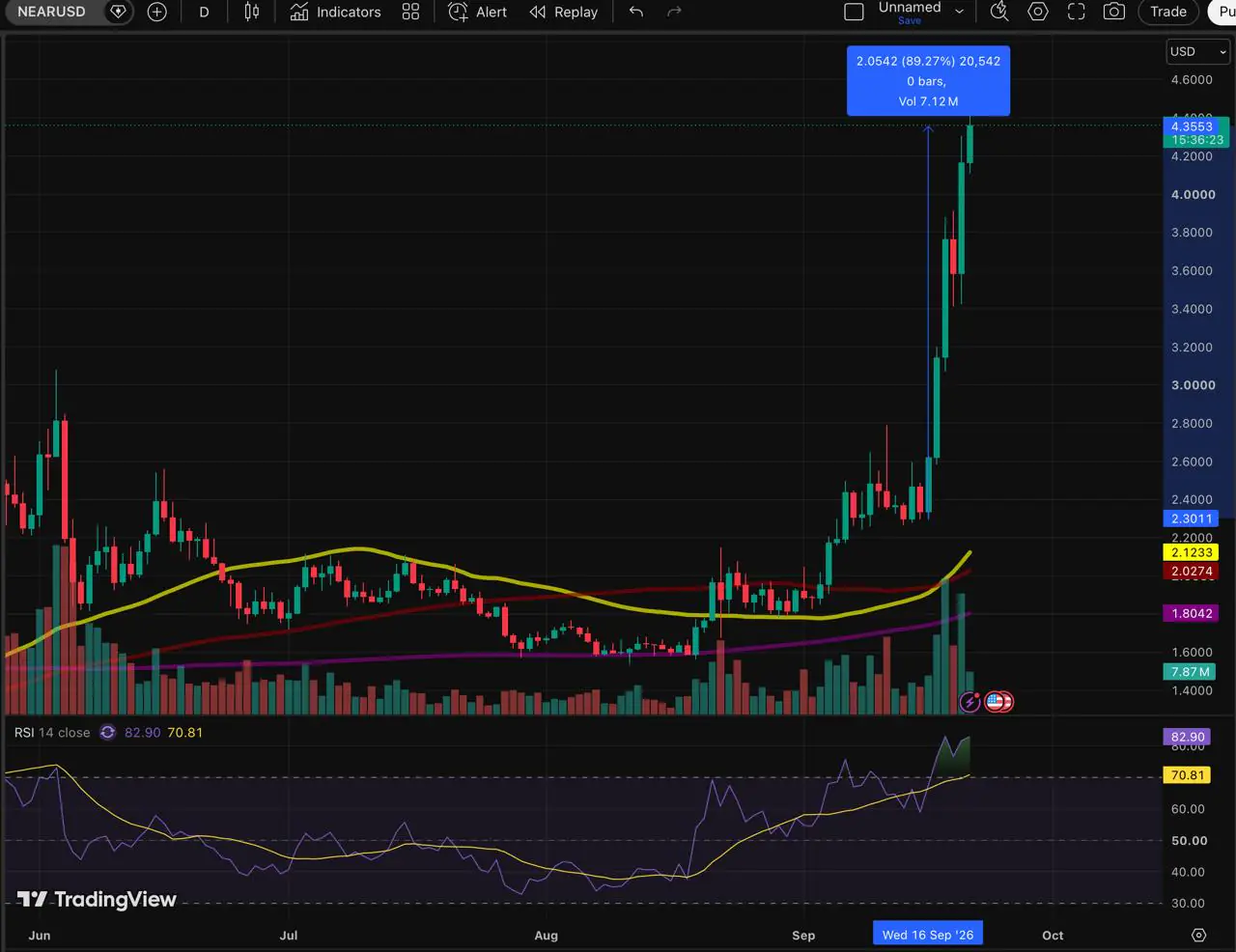
NEAR climbed approximately 89% in five days to trade near $4.35 on September 21, moving toward a major resistance zone between $4.75 and $4.85 as attention turned to rising ZEC routing activity through NEAR Intents.
The token had gained more than 20% over 24 hours and roughly 89% from its September 16 price near $2.30, according to the TradingView NEAR/USD daily chart captured on September 21. The advance carried NEAR through $3, $3.50 and $4 with little time spent consolidating between those levels. Volume bars on the Coinbase chart also increased during the final stage of the move.
A report linking NEAR's performance with increased ZEC routing was published on September 21, after the price had already advanced substantially. Its publication may have added attention and momentum, but it cannot serve as the starting point for the entire five-day rally. It also does not establish what traders may have known about the activity before the report appeared.
What changed was the traffic, not the integration
NEAR Intents lets a user specify what they want to exchange and receive. Independent market makers known as solvers compete to complete that request across the required networks. The wallet handles those steps in the background, removing the need for the user to bridge assets manually. NEAR describes Intents as infrastructure for competing solvers to fill swaps and other cross-chain requests.
The connection with Zcash, however, predates the latest rally by roughly a year, building on Zashi features such as a decentralized off-ramp for shielded ZEC and decentralized swaps with an on-ramp. Zashi has since become Zodl, with the wallet continuing under the Zcash Open Development Lab, according to Zodl's project history. The integrations were therefore not September product launches. The new element was the reported increase in their use.
The sixfold figure remains second-hand
A CoinDesk report published on September 21 said daily ZEC volume through NEAR Intents had risen sixfold during the previous week, connecting the increase with wallets including Zodl and Vizor.
The report did not include the starting volume, the ending volume, the exact comparison dates or the underlying dataset. The figure should therefore remain attributed to CoinDesk rather than presented as an official measurement newly released by NEAR, Zodl or Vizor.
What the report changes: it points to rising use of an existing product. What it does not prove: that ZEC swaps created enough direct demand for NEAR to explain an 89% price increase.
A routed swap is not automatically a NEAR investment
A ZEC swap completed through Intents does not require the end user to become a long-term NEAR holder. Solvers and service providers handle much of the execution, while the wallet hides the network steps from the person making the trade.
Higher volume can still benefit the network. It can bring more settlement activity, attract liquidity providers and demonstrate that NEAR can coordinate trades across separate blockchains. Visible usage can also cause traders to reconsider how they value that infrastructure, particularly during a period of broader altcoin participation.
That would be an indirect market reaction. Neither the integration announcements nor the September 21 report measures how much NEAR was bought to support the additional ZEC flow. The evidence therefore supports a usage narrative, not a mechanical explanation for the price move.
Evidence that would strengthen the connection:
- Absolute ZEC routing volume remains elevated.
- Additional wallets begin using NEAR Intents.
- Settlement activity and network fees increase.
- Those gains continue after ZEC volatility cools.
The chart is approaching its harder test
NEAR's next historical resistance sits around $4.75–$4.85. That is the area from which the token began a major decline in late January 2025. Because the earlier reversal covered several candles, the range is more useful as a resistance zone than a single trigger price.
Traders often watch old breakdown areas because holders trapped in the previous decline may sell when price returns near their entry levels. A daily close above $4.85, followed by continued trading above the zone, would show that buyers had absorbed that supply. A brief move through it followed by a close back below would leave the breakout unconfirmed.
Momentum is already stretched before that test. The daily RSI is near 83, above the conventional overbought threshold of 70, while NEAR trades more than 100% above its 50-day moving average near $2.12. Neither reading requires an immediate decline, but both show how quickly price has separated from its recent trend.
- Resistance: $4.75–$4.85 — the breakdown area from January 2025 and the next test for the rally.
- Support: $3.40–$3.50 — the area where buyers stopped the September 19 pullback.
The steep advance makes the next pullback more informative than another intraday high. Holding $3.40–$3.50 would preserve the first clearly tested support created during the rally. Losing it would not erase every gain, but it would show that the latest repricing moved faster than buyers were willing to defend.
The next evidence must come from activity, not headlines
The Zcash integrations show that NEAR Intents has moved beyond a technical demonstration. The remaining question is whether the reported traffic represents a durable source of activity or one exceptional week amplified by ZEC's own rally.
Persistent routing volume, higher settlement activity and a defended $3.40–$3.50 support zone would show that the move outlasted its first burst of attention. Without those confirmations, the connection between Intents usage and NEAR's near-90% gain remains plausible—but unproven.
This article is provided for informational purposes only and does not constitute financial or investment advice. Cryptocurrency prices, technical indicators and protocol-volume data can change rapidly.
Source: Coindoo

