NAVER Q2 2026 Earnings: Record Revenue Meets an AI Investment and Margin Test
Key Takeaways
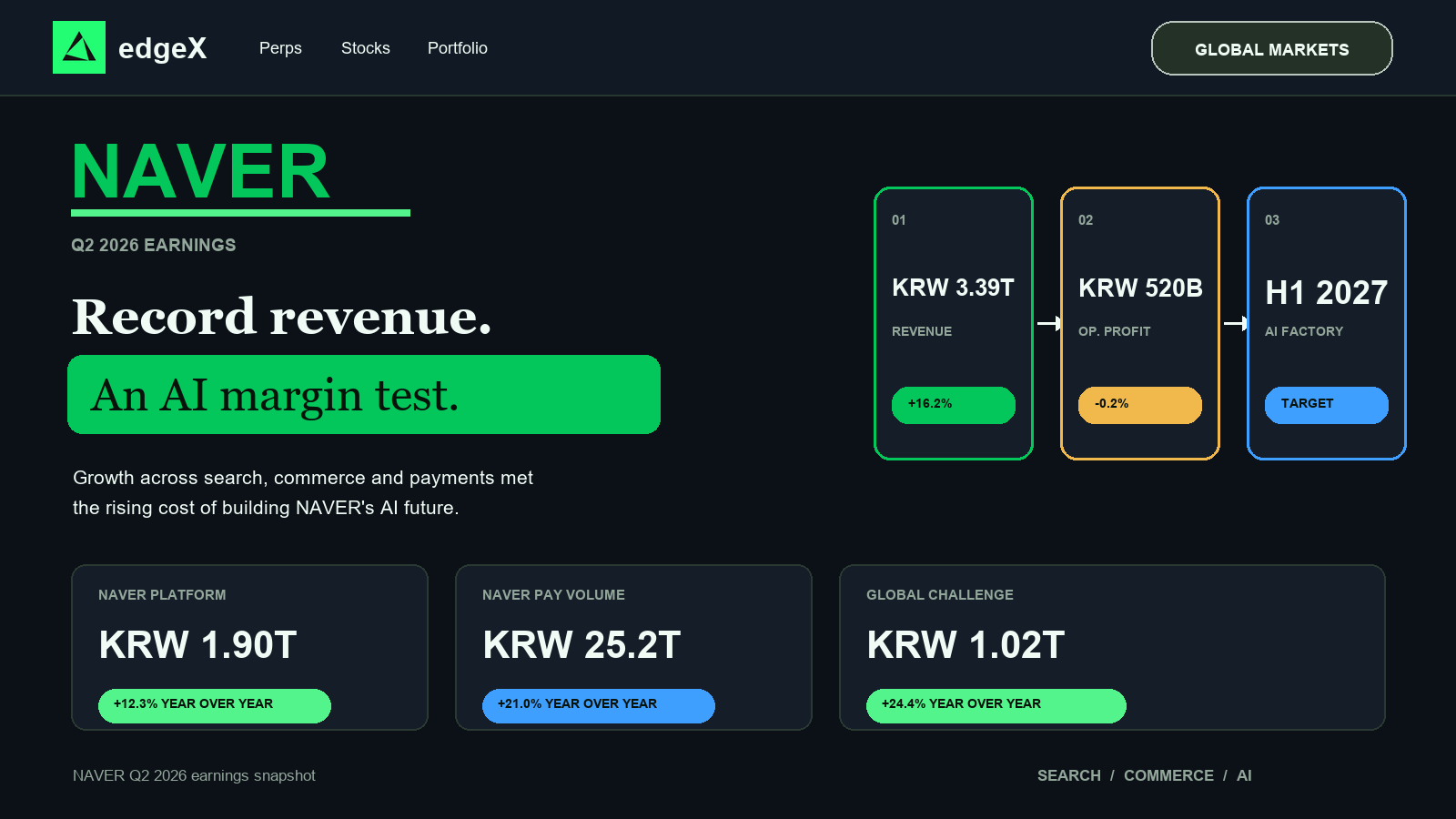
- •NAVER achieved record quarterly revenue of KRW 3.3888 trillion in Q2 2026, up 16.2% year over year, with all major business groups posting double-digit growth.
- •Operating profit declined 0.2% to KRW 520.3 billion as increased spending on AI infrastructure, GPU depreciation, marketing, and World Cup broadcasting rights offset revenue gains.
- •NAVER's AI Briefing ads, launched in late July, showed early promise with more than 30% higher click-through conversion and over three times the purchase conversion rate compared to existing search ads.
- •The planned Nvidia AI factory is expected to begin generating revenue in the first half of 2027 at 55 megawatts, scaling toward 100 megawatts by end of 2027 and 200 megawatts in 2028.
- •Global Challenge revenue grew 24.4% to KRW 1.0159 trillion, led by a 74.9% surge in consumer-to-consumer revenue from platforms including Wallapop, Poshmark, and Soda.
Quick Answer
NAVER's Q2 2026 earnings were a growth-and-investment trade-off. Revenue reached a quarterly record of KRW 3.3888 trillion, supported by search, commerce, payments and global consumer-to-consumer businesses. Operating profit edged down 0.2% to KRW 520.3 billion as the company spent more on AI infrastructure, marketing and content. The investment case now turns on whether NAVER can convert its AI products, commerce ecosystem and planned Nvidia AI factory into higher-margin revenue before those costs become a persistent drag.
NAVER’s Record Revenue Did Not Settle the Profit Debate
NAVER's second-quarter report delivered the kind of top-line growth investors usually welcome: record revenue, double-digit expansion across each major business group, and a payments platform that continues to process more of Korea's digital commerce. Yet operating profit was essentially unchanged from a year earlier. That gap is the point of the quarter.
The company is no longer being judged simply as a Korean search business. NAVER is trying to monetize an integrated stack of search, commerce, fintech, content, global resale platforms and AI infrastructure. Q2 showed that demand across the stack is real. It also showed that the company is paying now for a more ambitious version of that stack.
For investors, the question is not whether NAVER can grow revenue. It is whether more of that growth can reach operating profit while management funds GPU capacity, AI products, commerce incentives and global expansion. The answer will shape whether the stock is valued as a mature platform with a modest AI premium or as an emerging AI-and-commerce infrastructure company with a longer investment cycle.
The Numbers Behind NAVER Q2 2026 Earnings
NAVER reported results for the quarter ended June 30, 2026. Revenue exceeded Q1's KRW 3.2411 trillion and set a new quarterly high, while operating profit remained nearly flat.
| Metric | Q2 2026 Result | Investor Read |
|---|---|---|
| Revenue | KRW 3.3888 trillion | Record quarterly revenue; up 16.2% year over year |
| Operating profit | KRW 520.3 billion | Down 0.2% year over year as investment costs rose |
| NAVER Platform revenue | KRW 1.9022 trillion | Up 12.3%; search, ads, commerce and service growth |
| Financial Platform revenue | KRW 470.7 billion | Up 16.0%; NAVER Pay volume rose 21.0% |
| Global Challenge revenue | KRW 1.0159 trillion | Up 24.4%; C2C growth was the main contributor |
| NAVER Pay payment volume | KRW 25.2 trillion | A larger transaction layer across the ecosystem |
The revenue figure matters because it reflects broad participation rather than one isolated product. The operating-profit figure matters because it prevents an easy extrapolation from that growth. NAVER is expanding into businesses with different margin profiles and is front-loading investment in infrastructure that may not produce material revenue until 2027.
The NAVER Platform Is Still the Core Earnings Engine
The NAVER Platform business generated KRW 1.9022 trillion of revenue, up 12.3% from a year earlier. Advertising revenue increased 7.5%, while service revenue gained 31.3%, supported by NAVER Plus Store, membership and N Delivery. That mix is important: advertising remains a cash-generative core, but commerce-related services are taking a larger role in the growth story.
AI Briefing Ads Offer an Early Monetization Signal
NAVER introduced AI Briefing ads in late July, after the quarter closed, so their performance should not be treated as a Q2 revenue contribution. Still, management's early data offered a useful indicator of the monetization direction. The company said the ads generated more than 30% higher click-through conversion and more than three times the purchase conversion rate of existing search ads.
Those figures are early product observations rather than a long-term revenue forecast. But they address an important investor concern: whether generative AI changes search economics by pushing users away from traditional ad inventory. NAVER's approach is to place commercial intent inside an AI-generated answer experience. If it works at scale, AI can improve the value of search inventory instead of merely raising inference costs.
Commerce Is Doing More of the Heavy Lifting
The 31.3% growth in service revenue points to the growing weight of commerce. NAVER Plus Store, membership benefits and delivery services can deepen user engagement and create more transaction data across the platform. They can also require promotions, logistics spending and merchant incentives, which is why faster service growth should not be assumed to be immediately margin-accretive.
The strategic logic is sound. Search discovers demand; commerce converts it; payments capture the transaction; membership and delivery aim to keep the user inside the ecosystem. The financial test is less automatic. Investors need to see whether repeat purchases, advertising tools and merchant services eventually improve unit economics faster than acquisition and fulfillment costs rise.
Payments and Global C2C Expanded the Addressable Market
Financial Platform revenue rose 16.0% to KRW 470.7 billion, while NAVER Pay payment volume climbed 21.0% to KRW 25.2 trillion. That spread suggests the payments business is expanding both as a service and as connective tissue for the broader platform.
NAVER Pay Is Becoming a Broader Transaction Layer
Payment volume is not revenue, and payment volume is not profit. The measure nevertheless matters because it shows how often customers and merchants use NAVER in a transaction. A larger payments footprint can support advertising attribution, merchant tools, loyalty offers, financial products and commerce conversion.
The opportunity is to turn payment flow into a higher-value relationship with users and sellers. The risk is that payments becomes a low-margin necessity used to defend the commerce ecosystem. The next quarters should clarify whether NAVER Pay's rising volume drives a favorable mix of payment fees, credit products, merchant solutions and platform retention.
Wallapop, Poshmark and Soda Add Growth but Complexity
Global Challenge revenue increased 24.4% to KRW 1.0159 trillion. Consumer-to-consumer revenue rose 74.9%, while enterprise revenue gained 21.3% on AI and Digital Twin business-to-business sales. Content revenue increased just 0.5%, underscoring the uneven nature of the portfolio.
NAVER’s global C2C businesses, including Wallapop and Poshmark, give the company exposure to recommerce beyond Korea. They also bring foreign-exchange effects, local competition, marketing needs and operational complexity. Strong C2C growth is encouraging, but the investor question is whether it converts into durable profitability rather than simply higher gross merchandise activity and promotional spending.
AI Infrastructure Is the Margin Question
The 0.2% decline in operating profit did not erase NAVER's profitability. It did, however, reveal the cost of the next phase of its strategy. The company pointed to AI-infrastructure investment, including GPU depreciation, World Cup broadcasting rights and commerce marketing as pressures on the quarter.
Why Operating Profit Was Flat Despite 16.2% Revenue Growth
High-growth platform companies can absorb investment when new spending creates a visible path to future revenue or a stronger competitive moat. NAVER has elements of both: AI search products can defend and monetize user attention; GPU capacity supports proprietary models and enterprise services; commerce spending can reinforce a broader transaction network.
The difficulty is timing. Revenue from search ads and commerce is present today. Depreciation and marketing costs are present today. The full revenue contribution from large AI-infrastructure projects lies further out. That creates a period in which investors must decide whether flat operating profit is disciplined investment or evidence that revenue is becoming more expensive to generate.
The Nvidia AI Factory Is a 2027 Option, Not a Q2 Profit Driver
NAVER and Nvidia are targeting an AI factory that management expects to begin producing revenue in the first half of 2027 at 55 megawatts. The target is 100 megawatts by the end of 2027 and 200 megawatts in 2028, with a longer-term ambition for gigawatt-scale infrastructure.
This is potentially meaningful optionality, particularly if NAVER can serve Korean enterprises and public-sector customers while drawing on Nvidia's ecosystem. It should not be placed in the current earnings base. The key unknowns are customer commitments, pricing, utilization, operating costs and how much upfront capital NAVER must deploy. Management has described a structure intended to limit the initial capital burden, but the model needs to prove it can scale without diluting returns.
What the Korean Market Is Likely to Test Next
The next debate around NAVER is likely to center on conversion rather than capability. The company has established that it can build AI products, grow commerce, process more payments and expand global C2C activity. Investors will now look for evidence that those pieces reinforce one another financially.
First, AI search needs to demonstrate repeatable advertising yield, not only promising engagement statistics. Second, NAVER Plus Store and N Delivery need to show that higher transaction activity lifts contribution margins over time. Third, NAVER Pay must turn volume into an expanding economic share of each transaction. Finally, the AI factory needs customers and utilization milestones that make a 2027 revenue start more than a strategic aspiration.
Korean technology stocks are often re-rated when an investment cycle becomes a revenue cycle. NAVER's Q2 result suggests that transition has begun in certain products, but not yet across the full cost base.
The Bull Case, Bear Case and Middle Path for NAVER
The bull case is that NAVER’s ecosystem compounds. AI Briefing ads improve commercial conversion, commerce and payments increase the value of user activity, C2C platforms add global scale, and the Nvidia AI factory opens a new enterprise-revenue category. In that scenario, Q2's margin pressure is the temporary cost of creating more durable growth engines.
The bear case is that AI raises compute costs faster than monetization, commerce remains promotion-heavy, and global C2C expansion produces scale without commensurate profitability. The AI factory could then become a capital-intensive project with a long payback period, while the core search business faces a more expensive competitive environment.
The middle path is gradual execution. NAVER keeps delivering solid revenue growth, operating profit recovers only as new products mature, and the AI factory becomes a real but later-stage contributor. That outcome would still support a credible long-term platform story, but it would require investors to be patient with quarterly margins.
What NAVER Investors Should Watch Next
The next earnings report should be read as a dashboard rather than a single headline. Watch advertising yield in AI search, service-revenue growth and spending intensity in commerce, NAVER Pay volume and monetization, C2C profitability, and the trajectory of GPU depreciation and other operating costs.
For the AI factory, the most useful disclosures will be commercial: customer wins, contracted capacity, financing structure, utilization expectations and revenue timing. The first-half 2027 target matters because it gives the market a concrete milestone. Until then, the project is a strategic option whose value depends on disciplined execution.
NAVER's Q2 report strengthened the case that its ecosystem can grow through several channels at once. It also made the margin test impossible to ignore. The company has moved beyond proving demand; it now needs to prove that investment-led growth can produce a larger, more resilient profit engine.
Trade Global Markets on edgeX
AI earnings, Korean technology sentiment, currency moves and global risk appetite increasingly shape markets around the clock. edgeX gives eligible traders self-custodial access to crypto, tokenized-stock and real-world-asset perpetual markets.
Trade the Broader Market Context
NAVER’s quarter is part of a larger market conversation about AI spending, technology valuations and Asian risk appetite. Traders can use edgeX to follow and express views on markets available on the platform, while checking the live product list for current instruments and availability.
Know the Instrument Before You Trade
Perpetual futures are derivatives, not direct ownership of the underlying shares or assets. They do not convey voting rights, dividends or other shareholder rights. Funding, liquidity, fees, leverage and contract specifications can differ by market and should be verified on edgeX before placing an order.
Manage Leverage and Execution Risk
Leverage magnifies both gains and losses and can result in liquidation. Self-custody does not remove market, smart-contract, liquidity or execution risk. Traders should use position sizing and risk controls appropriate to a highly volatile derivatives market, and should confirm eligibility in their jurisdiction.
Frequently Asked Questions
When did NAVER release its Q2 2026 earnings?
NAVER released its second-quarter 2026 earnings materials on August 7, 2026. The quarter ended June 30, 2026.
What was NAVER’s Q2 2026 revenue?
NAVER reported revenue of KRW 3.3888 trillion, a record quarterly level and an increase of 16.2% from a year earlier.
Why was NAVER’s operating profit flat?
Operating profit was KRW 520.3 billion, down 0.2% year over year. NAVER cited AI-infrastructure spending, including GPU depreciation, World Cup broadcasting rights and commerce marketing as cost pressures.
How large was NAVER Pay’s payment volume?
NAVER Pay processed KRW 25.2 trillion of payment volume in Q2, up 21.0% from a year earlier.
When could NAVER’s Nvidia AI factory generate revenue?
Management expects initial revenue in the first half of 2027 at 55 megawatts of capacity. That target is forward-looking and depends on execution, customers and utilization.
Can readers trade NAVER shares on edgeX?
This article does not claim that NAVER shares or a NAVER-linked contract are available on edgeX. Check the live edgeX product list for currently available instruments and their specifications.
Is the NAVER share price in this article live?
No. Check KRX, a broker or a real-time market-data service for the latest quote before making a trading decision.
