Unseasonable Heat Lifts Natural Gas Futures to Fourth Straight Weekly Gain, but Relief May Be Near
Key Takeaways
- •Prompt-month natural gas futures posted a fourth consecutive weekly gain, supported by strong cooling demand, tightening storage balances, and recovering LNG feedgas flows.
- •Two-week weather models are showing record cooling degree days, underscoring unusually intense heat heading into September.
- •The storage surplus that has weighed on the market for months is narrowing, while El Niño conditions are pressuring the winter price strip.
- •California's natural gas-fired generation hit a three-year high in late August as a Southwest heat wave and weak solar output strained the grid.
- •NGI cautions the rally could soon fade because the late-summer heat driving prices is expected to be temporary.
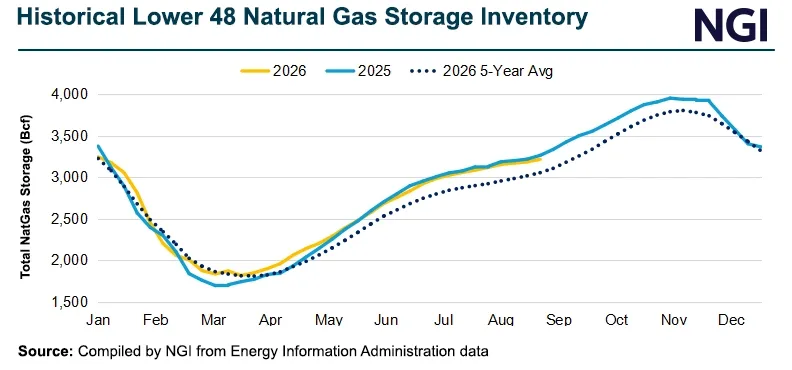
Prompt-month natural gas futures climbed to a fourth consecutive weekly gain on Friday, supported by strong late-summer cooling demand, tightening storage balances and recovering LNG feedgas flows, according to Natural Gas Intelligence. The title of the original report notes the rally "could soon wear out its welcome," reflecting expectations that the late-summer heat driving prices higher is a temporary force.
The late-summer heat has been a key driver of the rally. Two-week weather models are showing record cooling degree days (CDDs), a measure of cooling demand derived from temperatures, underscoring the unusual intensity of the heat heading into September. At the same time, the storage surplus that has weighed on the market for months is narrowing, while El Niño conditions are weighing on the winter price strip. LNG feedgas volumes — the gas piped to export terminals for conversion into liquefied natural gas — have also strengthened, adding another source of demand on top of domestic consumption.
For context, the US natural gas market sits at the intersection of weather-driven cooling and heating demand, storage levels tracked against five-year averages, and a growing LNG export sector that links domestic prices to global demand. Related NGI reporting this week illustrates how these forces are playing out regionally: storms were set to ease Southeast air-conditioning demand over Labor Day weekend, while California's grid leaned heavily on gas-fired generation during a Southwest heat wave, and macroeconomic softening raised questions about demand durability.
The article was reported by Andrew Baker, who joined NGI in 2018 to cover Mexico's newly liberalized oil and gas sector and has since expanded his coverage to the rest of North America. Previously, Baker covered Latin America's hydrocarbon and electric power industries from 2014 to 2018 for Business News Americas in Santiago, Chile. He holds a B.A. in journalism and mass communications from the University of Minnesota.
Related NGI coverage points to the broader market backdrop:
-
Labor Day Storms Cool Southeast, Ease Natural Gas Pipeline Restrictions (September 4, 2026): Southeast air-conditioning demand was set to drop sharply over the Labor Day weekend as thunderstorms swept down the Atlantic coast, easing strain on natural gas pipelines operating under operational flow orders (OFO) as spot prices climbed above $7/MMBtu.
-
Stubborn Inflation, Erratic Hiring — What It Means for Natural Gas Demand (September 4, 2026): Despite a resilient job market in August, a broadly softening US economy and slower global activity could cool natural gas demand just as end-of-summer cooling needs fade.
-
California Natural Gas Generation Roars Back as Summer Tests Battery Buffer (September 4, 2026): Natural gas-fired generation in California surged to a three-year high in late August as a Southwest heat wave and a slump in solar output forced the state's grid to lean harder on thermal plants, sending regional spot prices sharply higher after months of abundant supply.
-
New England's January Natural Gas Prices Retreat From $22 as Egress Advances (September 4, 2026): Forward curves at key New England natural gas hubs are pricing substantial relief in subsequent years following an exceptional winter premium in the coming heating season.
-
Will Resilient Summer Demand Buck Up Natural Gas Futures? (September 4, 2026): Natural gas futures ticked up early Friday as market participants digested a narrowing but still substantial storage surplus, choppy yet seasonally solid production, robust late-summer cooling demand and strong LNG volumes.
-
Spot Natural Gas Prices Soar as OFOs Abound (September 3, 2026): Strong cooling demand and pipeline operational constraints drove dramatic regional price spikes in the physical natural gas market on Thursday.
Source: Natural Gas Intelligence
