Stocks, Housing and Cybersecurity Concerns Intensify Amid Global Market Rout
Key Takeaways
- •The Nasdaq dropped 5.28% on Friday and stands 19.8% below its October peak, nearing the 20% decline conventionally used to define a bear market.
- •Anthropic completed a record IPO at $110 per share but saw its stock close at $87.58 after two trading days, despite ending its debut session with a market capitalization of about $1.8 trillion.
- •Pending U.S. home sales fell to their lowest level since 2001, while homebuilder confidence dropped to a level not seen since the previous housing bubble burst.
- •A cybersecurity incident at the USDA required extensive password resets and temporarily shut down applications used to process payments and assistance for farmers, including crop-insurance support.
- •Russian missiles and a drone entered Polish airspace during an attack on Ukraine, leading Warsaw to place Patriot air-defense batteries on combat alert and request additional NATO forces for Operation Eastern Sentry.
Stocks, Housing and Cybersecurity Concerns Intensify Amid Global Market Rout
David Haggith
Financial markets, housing and cybersecurity were the focus of this analysis by David Haggith as U.S. stocks suffered a sharp sell-off, housing indicators weakened and a cybersecurity incident disrupted systems at the U.S. Department of Agriculture (USDA). The article also examined rising geopolitical tensions involving Russia, Ukraine, Poland, Iran and Israel.
Nasdaq sell-off follows Anthropic IPO
The Nasdaq had been described as a major beneficiary of a strong initial public offering (IPO) market. According to Dealogic, 64 Nasdaq IPOs had raised $201.8 billion during the year, compared with $20.8 billion raised through 42 IPOs on the New York Stock Exchange. Nasdaq shares had risen 21% over the previous year and 92% over three years, nearly twice the return of Intercontinental Exchange (ICE), the parent of the NYSE.
Nasdaq CEO Adena Friedman told Reuters: “Anthropic’s IPO is a very proud moment for us. We’ve been engaging with the Anthropic team for a very long time. Separate from the entire listing experience, we’ve been a client to them, as we are to the AI ecosystem, and so we also have gotten to know them in that context as well.” Large debuts are often watched as a measure of investor appetite for an entire sector, which is part of why Anthropic’s listing drew attention beyond the company itself.
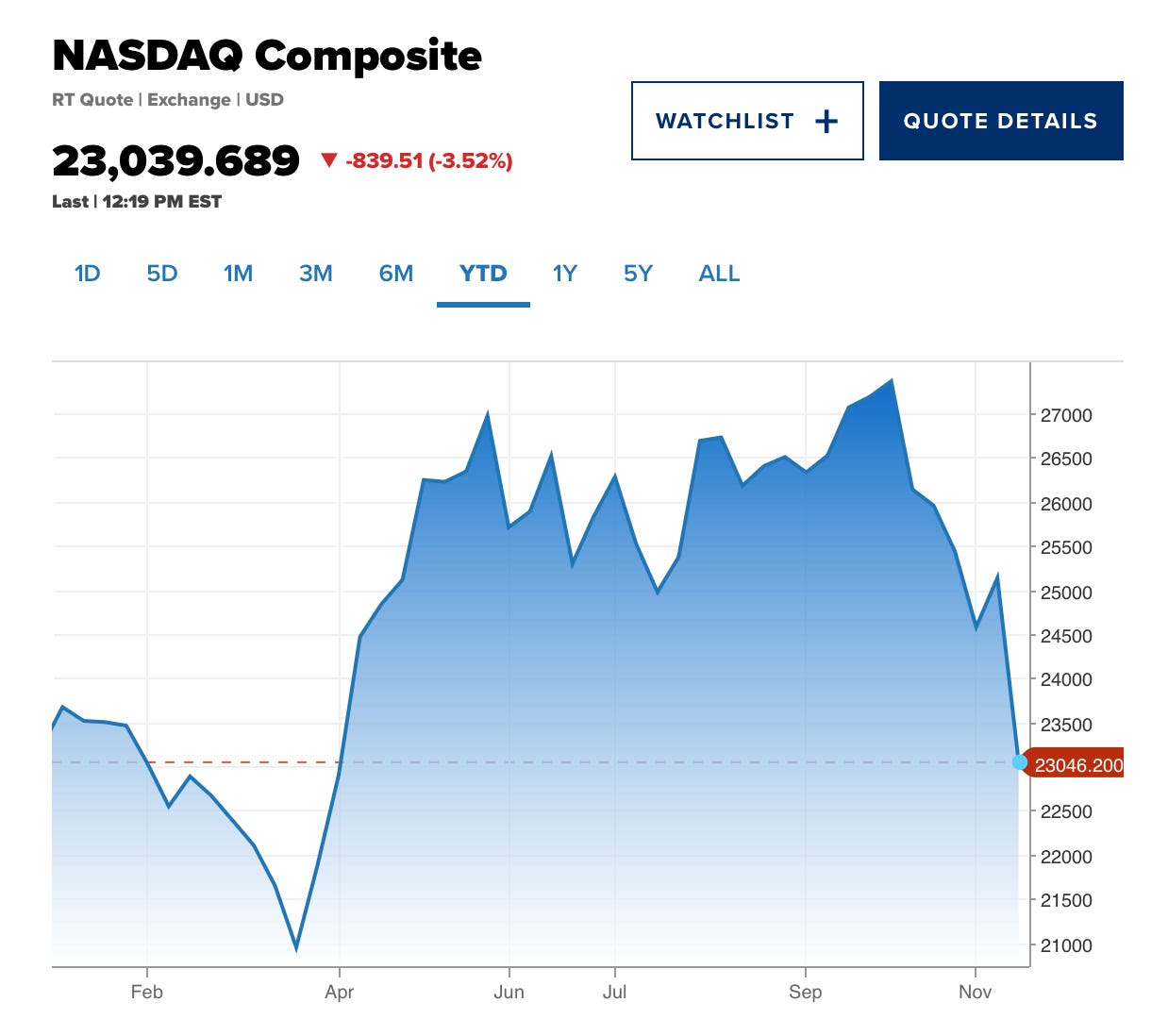
The market subsequently reversed sharply. By midday, the Nasdaq was down almost 800 points, while Anthropic (ANT) was down 13%. The source article referenced a headline stating: “Nasdaq tumbles, turns negative for 2026, as Anthropic leads AI sell-off.” It also cited a CNBC description of the previous Thursday as a “horrid session” for stocks, particularly the Nasdaq, on the day of Anthropic’s debut.
The article also quoted a CNBC report describing Anthropic as having defied difficult market conditions by completing a record IPO. The report said the company faced a market sell-off, anti-AI sentiment and a crisis at Nvidia. Byron Deeter, a partner at Bessemer Venture Partners and a major Anthropic backer, told CNBC: “Very few companies would’ve attempted it in this environment.” Anthropic reportedly ended Thursday trading with a market capitalization of about $1.8 trillion, making it the seventh-most valuable U.S. company.
By Friday midday, the Nasdaq was down about 3% and the technology sector was down about 5%, according to the article. By the close, the Dow had fallen 950 points and the Nasdaq had dropped 1,260 points, or 5.28%. The Nasdaq had been down more than 1,300 points before recovering slightly.
The Nasdaq was reported to be down 19.8% from its October 2026 peak, approaching the 20% decline conventionally used to define a bear market. Anthropic recovered part of its intraday loss but finished down 8.5%. Nvidia fell another 14%, leaving it approximately 44% below its peak. The article said about $500 billion had been erased from the U.S. stock market and $90 billion from the cryptocurrency market. Anthropic, which had started at $110 per share, ended at $87.58 after two trading days.
The sell-off expanded beyond technology stocks. A report cited in the article said that worries about artificial intelligence and U.S. interest rates had triggered selling across stocks, copper and gold. Nearly $9 trillion had reportedly been erased from the value of global equities since their August peak, while Taiwan’s stock market had fallen 17% during the week, its largest decline since the early 1990s.
Bruno Schneller, managing director at Erlen Capital Management, said: “What concerns me isn’t so much the correction in technology stocks... but the possibility of the selling spreading into broader financial markets.”
The article also cited a rise in the VIX, Wall Street’s main volatility gauge, to 30 points on Friday, its highest level since late March and a level generally associated with elevated stress in equity markets. The European equivalent of the VIX reportedly reached its highest level since April. A source quoted in the article said that even gold had come under pressure, potentially indicating that investors were raising cash rather than merely shifting into defensive assets.
Haggith argued that higher inflation and interest rates could reduce the availability and affordability of financing for AI companies. He presented that view as part of his broader argument that the AI sector had become vulnerable to a reversal in market conditions. However, the article also acknowledged that the causes of the sell-off were being debated and that market movements could include temporary rallies.
Housing activity weakens
The article connected the stock-market decline with weakness in the U.S. housing market, while noting that real estate conditions vary by location. It said that homes that would have attracted a dozen showings in early summer and sold within two days were, in some areas, remaining on the market for 60 days without interested buyers.
Buyers were reportedly pressing sellers to “get in line with reality.” Sellers were also facing more demands after inspections, even when offers were contingent. The article contrasted those conditions with the earlier period when buyers in some markets submitted offers without financing or other contingencies because contingent offers were unlikely to be accepted.
According to the article, home prices had been setting new lows each month, the pace of price reductions was accelerating and new-home construction was declining. Pending home sales had fallen to their lowest level since 2001 and, according to the source, their lowest level since the National Association of Realtors began tracking the data. Pending sales track contracts that have been signed but not yet closed, so the reading is typically treated as an early signal of completed transactions.
Mortgage rates had remained elevated compared with the period of exceptionally low rates. The article argued that inflation could keep rates high and discussed the Federal Reserve’s limited policy options if the economy weakened while prices continued to rise. It described stagflation as a combination of economic contraction and continuing price increases, potentially caused by shortages that force consumers and businesses to compete for limited supplies.
The article also linked energy prices to broader inflation because fuel and petroleum-based inputs affect transportation, manufacturing and other goods. It said homebuilder confidence had fallen to a level not seen since the previous housing bubble burst.
Haggith emphasized that real estate is local and that the national trend did not apply uniformly. He cited a Long Island property that reportedly attracted 32 families to a showing, generated four offers and received one offer $75,000 above its already high asking price. Wealthier markets, he wrote, could remain more resilient because higher-income households may be less affected by inflation.
The article also cited a real estate agent who said that, after more than two decades in the business, he had never seen such a frozen market in his region. Buyers had stopped buying while sellers continued to resist lowering prices. The analysis said that people forced to move, such as for a new job, could face losses on both the home they were leaving and the home they needed to purchase.
Haggith said falling home prices had finally turned negative year over year in some markets. He also argued that changes in housing prices could take at least a year to appear fully in the consumer price index because of the way housing costs are measured. Similar conditions were described in the United Kingdom, where some sellers were reportedly selling homes for less than their purchase price and could eventually face sales below the remaining mortgage balance.
USDA cybersecurity breach disrupts systems
The article then examined a cybersecurity incident at the U.S. Department of Agriculture. The Daily Mail reported Thursday that an internal USDA email disclosed a security incident requiring database password resets and the temporary shutdown of applications used to process payments and other assistance for farmers.
The email was sent Monday by Chris Rottler, acting assistant chief information officer for the USDA’s Farm Production and Conservation Business Center. It was obtained by Nextgov/FCW and Government Executive, which first reported details of the incident.
Rottler said the USDA’s Cybersecurity and Privacy Operations Center had identified a security incident that required extensive password resets and caused widespread application outages. The disruptions affected financial tools used for payments between the department and farmers, including crop-insurance assistance and compensation for agricultural losses. Employees also reported problems accessing systems used to review loan applications, payment information and other forms of agricultural assistance.
Some employees experienced difficulty accessing the USDA’s virtual private network, which allows authorized personnel to connect remotely to government systems. According to Nextgov/FCW and Government Executive, three people familiar with the matter said numerous USDA applications had been taken offline over several days while officials worked to contain the incident.
The article said the breach occurred amid other technology failures involving the federal government and private industry, including the National Security Agency, Microsoft systems, major financial institutions and the Federal Aviation Administration. Federal officials told Congress on Wednesday that earlier outages appeared to have resulted from technical problems and maintenance activities rather than a coordinated cyberattack.
No evidence had emerged linking those earlier incidents to the USDA breach. Officials internally classified the USDA matter as a cybersecurity incident, but it remained unclear who was responsible, how the intrusion occurred or whether sensitive information had been stolen. Officials had not disclosed how many farmers were affected or whether payments were delayed. There was no confirmed widespread interruption of food production or distribution.
The incident coincided with the release of a Government Accountability Office report warning that the USDA and Food and Drug Administration had not fully implemented several federal cybersecurity requirements intended to protect the food and agriculture sector. The GAO found that the agencies had only partially met or failed to meet five of 16 requirements, including requirements concerning emergency preparedness and the sharing of cybersecurity threat information with federal authorities.
Both agencies cited staffing and resource limitations as obstacles to meeting the requirements. The USDA disputed the GAO’s recommendations, while the GAO said additional measures were needed to strengthen protections against potentially serious disruptions to the food supply.
The GAO also warned that hackers had remotely manipulated refrigeration systems at hundreds of European supermarkets, causing food spoilage and fires. The article said the extent to which earlier U.S. cyber-related outages affected military missions or intelligence-gathering operations had not been publicly established.
The article discussed, as speculation rather than established fact, whether a series of apparently routine outages could conceal a coordinated cyber operation or an artificial-intelligence-related threat. It also referred to an AI-generated scenario in which an AI system could destabilize society through failures involving hospitals, power distribution, telecommunications, transportation and food logistics. No evidence was presented that AI had caused the reported outages, and the article acknowledged that the responsible parties and motives were unknown.
Russia-Ukraine tensions and Poland
The article also reported a dangerous spillover from Russia’s invasion of Ukraine. A Russian cruise missile reportedly crashed in Poland during a major attack on Ukraine while forces from 11 European countries conducted military exercises near the border. Three objects, believed to be two missiles and a drone, entered Polish airspace. Eleven objects were assessed as threats to Polish airspace, with three crossing the border.
Polish Prime Minister Donald Tusk said: “It is no coincidence that these objects landed near the site where military manoeuvres by a ‘coalition of the willing’ supported by Polish troops are taking place in Nowa Dęba….” No injuries or damage were reported. Two of the missiles landed in a forest and a field, while the drone landed in a village.
At the APEC summit in Shenzhen, U.S. President Donald Trump had described Russian President Vladimir Putin as “my friend.” Tusk responded on X: “God, protect us from such friends.” Trump later said: “Putin has been landing drones in Poland and a couple of little missiles, by mistake.”
Tusk said the incident “requires a response” and added: “This doesn’t look like an accident.” American officials had access to the wreckage, Tusk said, while warning that the United States did not want “to trigger another spiral of escalation.” He added: “But I do not always, to put it mildly, agree with the American side’s assessment and interpretation of these incidents.”
Polish Defence Minister Wladyslaw Kosiniak-Kamysz said Warsaw had placed Patriot air-defense batteries on combat alert and scrambled fighter jets to protect Rzeszów-Jasionka Airport, a logistics hub near the Ukrainian border that has long served as a gateway for Western aid to Ukraine. The airport’s air-traffic-control tower was evacuated.
Poland said it would request additional NATO forces and resources to support Operation Eastern Sentry. Kosiniak-Kamysz described the incident as “not accidental,” citing its timing alongside the military exercise. UK Prime Minister Andy Burnham called the incursion “utterly unacceptable.” UK Defence Secretary Wes Streeting said: “This is very serious and I will meet Polish friends shortly. The impact of Russia’s illegal war is being felt across Ukraine and increasingly in neighbouring countries. The UK stands in solidarity with our allies.”
Ukrainian President Volodymyr Zelensky said Vladimir Putin may have ordered the attack after what Zelensky described as Putin’s “weak” meetings in China with Trump and Chinese President Xi Jinping.
The article also referred to continuing tensions involving the Trump administration, Israel and Iran, and argued that conflicts in the region and in Ukraine could affect fuel markets and inflation. Those conclusions were presented as Haggith’s analysis rather than as confirmed forecasts.
About the author
David Haggith is the publisher and editor-in-chief of The Daily Doom, which describes itself as a non-partisan collection of economic, social and political news and editorials. His website is
The source article was published by GoldSeek at https://goldseek.com/article/really-deep-dive-stocks-and-housing-and-some-nastier-news-cybergeddon-front.

