Nadex Self-Certifies SHIB Event Contract With CFTC, Shiba Inu Price in Focus
Key Takeaways
- •Nadex self-certified the SHIB strike event contract with the CFTC on November 10, placing the product within the agency's oversight framework for listed derivatives.
- •The exchange's public notice lists the contracts for November 13 or later, while the CFTC filing cites November 14 or later, and neither document confirms that trading has launched.
- •Each contract pays a fixed $1 to the winning side, settles in cash, and is judged by the average SHIB benchmark price over the 60 seconds before expiration, drawn from multiple crypto exchanges.
- •The filing covers expirations ranging from 15 minutes to weekly, requires no SHIB ownership, and includes a liquidity commitment from at least one market maker.
- •Nadex filed similar strike contracts for XRP, Solana, Stellar, Dogecoin, Litecoin, Hedera, Ondo, and Polkadot, and had previously listed SHIB event contracts in November 2023.
TL;DR
- Shiba Inu price will underpin a Nadex event contract, and the exchange self-certified the product with the CFTC on November 10.
- Nadex's notice cites November 13 or later for listing, while its CFTC filing gives November 14 or later; neither document confirms a launch.
- The contracts settle in cash and pay $1 to the winning side, with the outcome based on a 60-second average of the SHIB benchmark price.
- SHIB derivatives let traders express different price views, but the contracts do not necessarily create buying demand for the token.
Shiba Inu price is in focus after Nadex filed a new event contract tied to the meme coin. The U.S. derivatives exchange self-certified the product with the Commodity Futures Trading Commission (CFTC) on November 10, and the filing describes a swap linked to SHIB at a specified date and time. SHIB is one of several tokens covered in the exchange's latest round of proposed price-linked products. Event contracts of this type are fixed-payout instruments: their value at expiration depends on whether a stated condition about the price is met, rather than on how far the price travels.
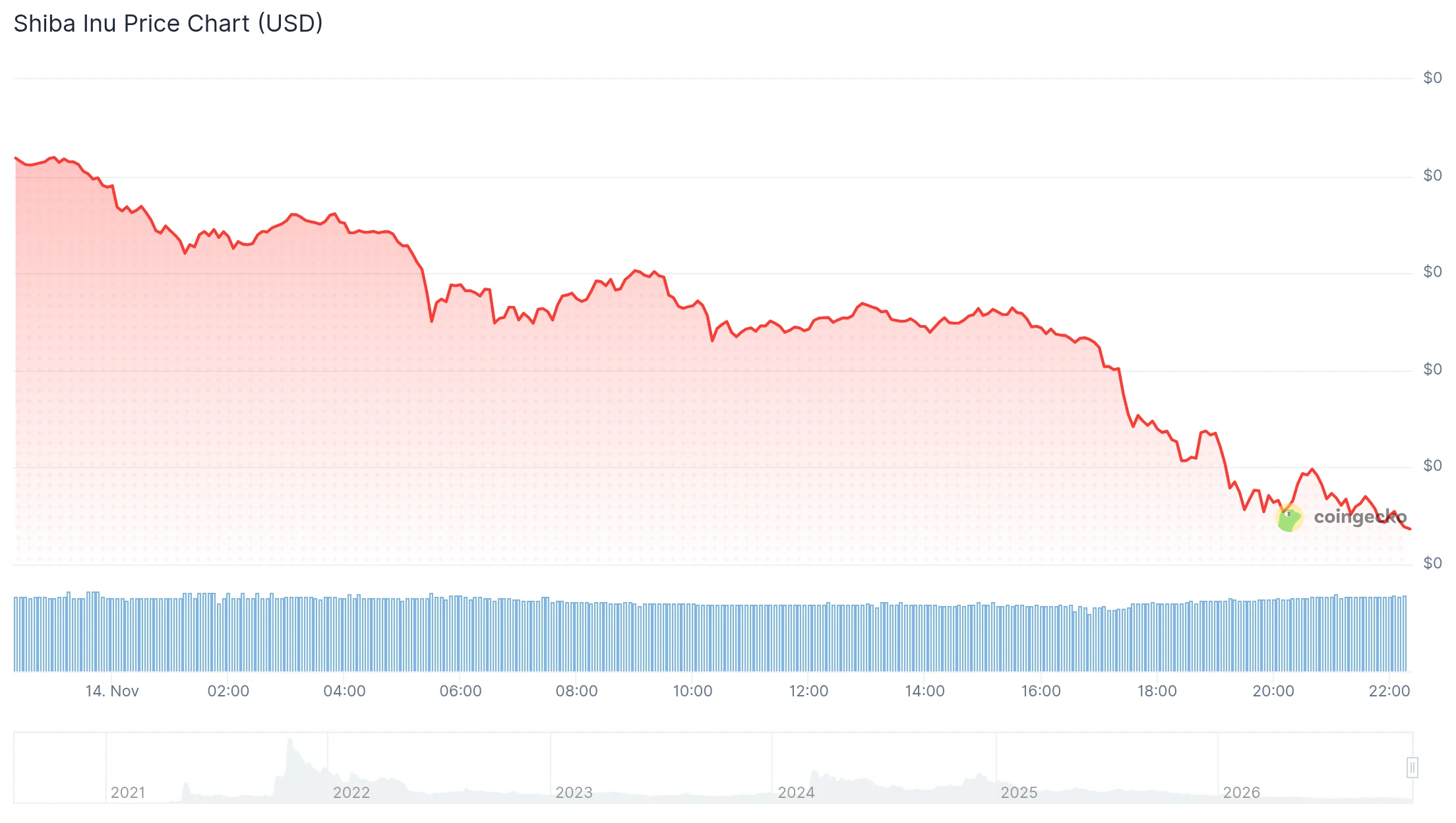
Exchange documents give different earliest listing dates, and the notice alone does not confirm that trading has started. According to CoinGecko data, the Shiba Inu price closed at $0.00000425 on November 13, down from $0.00000446 on November 10.
Different Listing Dates and Self-Certification
Nadex, formally the North American Derivatives Exchange, operates as Crypto.com Derivatives North America. Its public notice says the contracts will be listed on or after November 13, while its CFTC submission gives November 14 or later as the intended listing date.
Self-certification means the exchange has certified that the product complies with applicable rules. CFTC guidance says exchanges can list self-certified products without obtaining prior agency approval. The filing itself does not establish whether the contracts are now trading, so until the exchange lists the markets, the two dates function as the earliest possible start points rather than a confirmed schedule. The structure places the product inside the CFTC's oversight framework for listed derivatives.
How the Shiba Inu Event Contract Works
The product lets traders take a position on whether the Shiba Inu price will finish above a chosen level, known as the strike price. The exchange will determine the outcome using the average benchmark price during the 60 seconds before expiration, with the benchmark drawing on price data from multiple crypto exchanges.
If the benchmark finishes above the strike, the buyer receives $1 per contract. Otherwise, the seller receives $1 per contract. A trader's net result also depends on the entry price and fees.
For example, a buyer paying $0.40 could receive $1 if the condition is met, a $0.60 gain before fees. If the condition is not met, the buyer would lose the $0.40 paid, plus any fees. In other words, the fixed $1 payout sets the maximum gain per contract, while the buyer's downside is limited to the entry price paid, plus fees.
The filing describes Shiba Inu price contracts with 15-minute, hourly, four-hour, daily and weekly expirations. The contracts settle in cash and do not require traders to own SHIB. Nadex says at least one market maker has committed to supplying liquidity, though that commitment does not guarantee strong trading volume.
Nadex's Previous SHIB Derivatives
Nadex has offered SHIB derivatives before. CFTC records show the exchange self-certified an earlier Shiba Inu event contract in April 2026, and the exchange said it had previously listed SHIB event contracts in November 2023. The April contract used a different pricing benchmark.
What the Filing Could Mean for SHIB and Wider Markets
The new product could give traders another way to take a position on the Shiba Inu price. However, buying an event contract does not necessarily involve buying the token, so the filing alone does not establish how much demand could reach the spot market.
Traders can also express opposing views through derivatives. Some may use the contracts to hedge existing holdings, while others may speculate on short-term moves. Any effect on the Shiba Inu price would depend on trading activity and how participants manage their exposure. The concrete checkpoint for a launch is the stated listing window — on or after November 13 per the notice, or November 14 per the CFTC filing — with any confirmation of a live market coming from the exchange itself.
Nadex submitted similar strike contract filings for several other cryptocurrencies, including XRP, Solana, Stellar, Dogecoin, Litecoin, Hedera, Ondo and Polkadot. The applications point to a wider range of proposed crypto products on the exchange.
Other platforms have also expanded their offerings. Kalshi has listed SHIB perpetual futures, while Robinhood has offered crypto perpetual futures in Europe. Perpetual futures have no fixed expiry, unlike the event contracts described in the Nadex filing.
The filing is also separate from an exchange-traded fund. T. Rowe Price's listed Active Crypto ETF includes SHIB among assets eligible for investment. Its September 30 filing did not list SHIB among the fund's holdings, which could change over time. The multi-asset ETF is not a dedicated SHIB fund. Unlike a fund holding assets, the event contracts create no ownership of SHIB, and their cash settlement means activity in them does not automatically translate into token purchases.
This article originally appeared on Blockonomi.

