N1 Exchange Review 2026: A Beginner’s Guide to Perpetuals on a Trading-Focused Layer 1
Key Takeaways
- •N1 Exchange operates on N1, a Layer 1 blockchain built specifically for trading, with its orderbook, RFQ execution and margining embedded as native network modules rather than application-layer contracts.
- •The platform listed 39 perpetual markets at the time of review, supports up to eight separate trading accounts per wallet, and charges Tier 1 CLOB fees starting at 0.01% for makers and 0.035% for takers.
- •N1's website reports more than $3.7 billion in processed volume and over 24,000 active traders, while DeFiLlama captured roughly $1.3 million in 24-hour perpetual volume during the review period.
- •The project raised a $5 million seed round co-led by Founders Fund and dao5 in September 2023, but no native token or token-generation event has been confirmed, and its 1.987 billion Season 1 Points carry no guaranteed monetary value.
- •The network currently runs on Proton with a curated operator and has not yet adopted shared security or a native validator set, and the review observed jurisdiction-based restrictions preventing perpetual trading access.
N1 Exchange Review 2026
Published: 18 October 2026
Author: Editorial Team
Last verified: 18 October 2026
N1 Exchange is an onchain perpetual-futures venue built on N1, a Layer 1 blockchain designed specifically for trading. This review examines its orderbook and RFQ markets, fees, margin system, security model, points program, supported markets, device experience and beginner workflow.
The guide is intended for traders seeking an onchain perpetual venue with a native orderbook, as well as beginners who want to understand N1 before connecting a wallet or depositing funds. Onchain perpetual venues form a distinct segment of crypto infrastructure, and the differences that matter between them come down to execution architecture, market breadth and how much of the trading stack sits at the protocol level rather than in application code.
What Is N1 Exchange?
N1 is a Layer 1 blockchain built specifically for trading. N1 Exchange is its onchain perpetual-futures venue, with a native orderbook, RFQ markets and margining embedded at the network layer rather than assembled solely from application contracts. That architectural choice ties the platform’s security profile to the validator and operator arrangement examined later in this review.
The result is a trading terminal that more closely resembles a professional derivatives exchange than a simple swap interface. Users trade price exposure rather than the underlying asset, and accounts remain dependent on collateral, funding, margin, oracle data and liquidation rules.
N1 began as Layer N in 2023, adopted the N1 name in December 2024 and announced the acquisition of 01 Exchange in July 2026. The project’s official history is described on N1’s About page.
At the time of the review, N1’s official website reported more than $3.7 billion in processed volume and more than 24,000 active traders. These are platform-reported counters and should be treated as changing dashboard metrics rather than independently audited performance figures.
Device Experience
Desktop: 1440 x 810
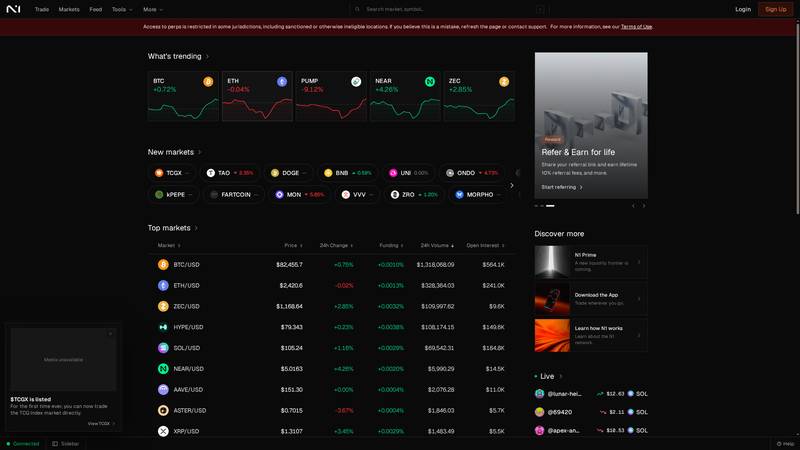
The desktop homepage displays top navigation, trending-market cards, new markets, an announcement rail and a market table. A red eligibility banner remains visible across the top of the interface.
The layout makes effective use of the available width. Market cards appear above the table, while the right-hand column contains announcements and discovery links. The overall presentation resembles a market terminal rather than a single-purpose trading form.
The desktop view is best suited to initial research, scanning markets and comparing price, funding, volume and open interest before opening a trading screen.
Tablet: 1024 x 576
At tablet width, the dashboard remains usable, although the market table and announcement column compete for horizontal space. Navigation remains visible and the trending cards are readable.
The main compromise is information density. Some tables require additional scrolling, and the announcement rail occupies space that could otherwise display market data. The tablet layout is suitable for monitoring a shortlist of markets or checking a position away from a desk, but it is less suitable for reviewing a complex order under time pressure.
Phone: 430 x 242
The phone layout condenses navigation into Home, Trade, Feed, Analytics, Portfolio and Rewards. The design is clean, but the captured view is dominated by a restricted-access message.
The bottom navigation is easy to understand, while market comparison and order review require more screen space than this viewport provides. The phone view is therefore better suited to quick status checks and navigation. A larger screen is preferable when reviewing leverage, margin or liquidation details.
The live app displayed a notice that perpetual access is restricted in some jurisdictions. No wallet was connected, no funds were deposited and no order was submitted during the review.
Core Features
Native central limit orderbook
N1’s central limit orderbook, or CLOB, markets use price-time priority. Resting orders provide liquidity, incoming orders take liquidity, and the orderbook shows price, size and total notional on both sides.
RFQ execution
RFQ markets use a different process. A trader submits a request containing the side, size, price bound and, optionally, a timeout. Designated market makers can then return firm quotes. The two execution modes are described in the N1 Execution Modes guide.
Network-native margining
N1 accounts are cross-margin portfolios. The network calculates initial and maintenance requirements across positions. Official documentation describes support for up to eight separate trading accounts per wallet.
Discovery markets
N1 is not limited to major cryptocurrency pairs. TCGX is a trading-card-index perpetual covering 160 card variants from Magic: The Gathering, Pokemon, One Piece Card Game and Disney Lorcana. Listings of this kind add index-construction risk on top of standard perpetual mechanics, since the tradable instrument depends on how the underlying index is defined.
Session keys and mobile access
A connected Solana wallet authorizes a session key, allowing traders to avoid signing every order manually. N1 advertises dedicated iOS and Android applications through its download page.
Supported Markets
The official markets page showed 39 perpetual markets at the time of review. Maximum leverage varies by market, and the application displays funding, volume and open interest beside the trading interface.
The official markets page is the appropriate source for current listings. Market data changes, and the page labels its quotes as indicative rather than executable.
Fees
N1 charges per fill according to the account’s fee tier, the market type, the execution mode and whether the account is acting as a maker or taker. A CLOB rate should not automatically be assumed to apply to RFQ trading. When weighing N1 against the alternatives discussed later in this review, like-for-like fee comparisons should match the maker or taker role and the execution mode on each venue.
The published fee schedule, dated 15 August 2026, notes that RFQ rates may differ. An external withdrawal normally costs 1 USDC, while internal transfers between N1 trading accounts do not incur that fee. The official fee documentation contains the published schedule.
Example: a 10,000 USDC fill
At Tier 1, a 10,000 USDC taker fill costs 3.50 USDC. The same notional amount filled as a maker costs 1.00 USDC. The example excludes funding, slippage, withdrawal costs and any RFQ-specific rate.
Order Types and Execution
The Order Types documentation explains the mechanics of the available orders. Before login, the live BTC/USD terminal displayed Buy/Long, Sell/Short, Market, Limit, Atomics, Cross and 20x controls.
Funding, Accounts and Points
Solana deposits use the Proton bridge, while other supported routes can use Unifold. Deposits are credited to the wallet’s default trading account. Moving funds to a subaccount requires a separate internal transfer.
N1 supports up to eight trading accounts per wallet. Each account has separate balances, positions, orders, margin and fee tier. This separation can help isolate strategies, but it also adds account-management complexity for beginners.
N1 Points are distributed weekly during Season 1. The published program describes a fixed total of 1,987,000,000 Points, with Levels and Momentum showing progression. The rules and boost parameters remain subject to change, so Points should not be treated as guaranteed financial value.
The official documentation covers deposits and withdrawals, subaccounts and N1 Points.
Funding and Backers
Layer N, the project’s former name, announced a $5 million seed round in September 2023. According to the official announcement, the round was co-led by Founders Fund and dao5, with participation from Amber Group, Kraken Ventures, SALT, Mirana Ventures, GSR and others. The backer mix, which pairs venture funds with trading and market-making firms, is consistent with the project’s execution-focused positioning.
Independent project databases report a broader $7 million total raise that includes a later $2 million community sale. Because the broader figure is not stated in the official seed announcement, it should be treated as a secondary-source estimate rather than as one confirmed financing total. The independent CoinLaunch project analysis provides that alternative figure.
Team and Company Background
Null Studios is described as a core contributor to N1. The official team page says its founders have known one another since high school, entered crypto in 2019 and have built low-latency onchain trading and orderbook systems since 2020.
The founding team publicly associated with Layer N includes Dima Romanov, David Cao and Sheheryar Parvaz. N1’s security page also identifies Null Studios as the core contributor and lists Founders Fund, IMC, Amber and GSR among the backers.
This background is relevant to the product’s stated focus. N1 is not presenting itself as a general-purpose chain that later added a trading application. Its team history and architecture are both centered on execution, liquidity and margining. Further information is available through About the team and N1’s project history.
Token Status and Points
The sources checked for this review do not show a public confirmation of an N1 native token, a token-generation-event date or final tokenomics. N1 Points are an active participation program, but Points are not the same as a token, an equity claim or a guaranteed airdrop.
The live Rewards page did not display a public points balance. Instead, it showed “Sign in required” before rewards could be viewed. This is consistent with the documentation describing a private user Points balance rather than a public leaderboard.
The official Points documentation describes 1,987,000,000 Season 1 Points: 75 million distributed over 26 live weeks and 37 million across two retroactive weeks. The launch announcement says the program is intended to unlock future rewards, but it does not publish a token-conversion ratio.
Independent airdrop trackers also describe any N1 airdrop as unconfirmed. Accordingly, Points should not be assigned assumed monetary value, and users should not trade or provide liquidity on the assumption that a future token distribution will occur. The official Points rules and the independent airdrop status page provide additional context.
Roadmap and Delivery Status
The official launch post presents a roadmap focused on RFQ markets, Points, deeper liquidity and future products. Because it is a roadmap statement, individual items should be checked against the live application.
The roadmap describes an effort to use one balance across more markets through CLOB, RFQ, portfolio margining and Vaults. The distinction between what the launch post described and what users can access at a given time remains important. Developments that would make the roadmap easier to evaluate as they arrive include Vaults, expanded RFQ market breadth and the network’s stated move toward shared security and a native validator set.
The Day One launch post should be considered alongside the live N1 app. In the review capture, perpetual access remained restricted by jurisdiction.
Independent Onchain Data
Official dashboards and independent analytics measure different scopes, so their numbers should not be combined without qualification. N1’s homepage displayed $3.72 billion in processed volume. When checked, DeFiLlama’s N1 chain page showed approximately $1.3 million in 24-hour perpetual volume and $15.37 million over seven days.
The DeFiLlama N1 dashboard showed $1.14 million in 24-hour perpetual volume in the captured view and plotted recent volume history. Because the metric is time-sensitive, the capture represents an observed snapshot rather than a permanent figure.
DeFiLlama’s separate 01 Exchange page reported $2.832 billion in cumulative perpetual volume on N1. That is a historical protocol metric and is not the same as the N1 homepage’s current counter or the chain page’s recent measurement window.
The difference between lifetime counters and recent volume is not automatically a contradiction because the products, time periods and data definitions differ. It does, however, show why a review present both official claims and independent snapshots rather than repeat a single headline number.
How to Use N1 Exchange
Step 1: Open the app and check eligibility
Go to app.n1.xyz. Before connecting a wallet, read the eligibility banner and open the Terms of Use. Availability depends on jurisdiction.
The homepage provides a market overview, but the access banner appears before any trading action.
Step 2: Choose a market
Open Markets or search for a symbol such as BTC/USD. Before entering the trading terminal, compare the mark price, index price, funding, 24-hour volume, open interest and maximum leverage for the market.
The BTC/USD terminal combines the chart, orderbook, trades, funding, open interest and account controls on one screen.
Step 3: Select direction, execution mode and leverage
Choose Buy/Long or Sell/Short, then review the Market, Limit, Atomics and Cross options along with the leverage selector. The live BTC/USD screen showed 20x in the order ticket, but each market has its own limit.
These controls determine the direction, execution mode and leverage of the proposed trade.
Step 4: Review margin and risk fields
Before signing, review size, reduce-only status, take-profit and stop-loss availability, order value, initial margin, liquidation price, fees and slippage. When the account is not connected, the terminal leaves these fields blank.
The risk panel is where margin and liquidation information should be checked before collateral is committed.
Step 5: Log in, connect and confirm
Only after reviewing the market and risk fields should a user select Log in and authorize the wallet or session key. The account, network, size and fees should then be confirmed.
In this review, the jurisdiction restriction prevented the login flow from continuing. The final observed state was “Not connected to N1”: Login was available, but no account, margin or liquidation price was populated.
Margin and Liquidation Risks
N1’s margin system defines initial, cancel and maintenance fractions. The documentation provides a 10x illustrative column consisting of 10% initial margin, 6.25% cancel margin and 5% maintenance margin.
Liquidation begins by cancelling orders that increase risk and reducing positions. In more distressed accounts, positions can be transferred to the backstop near the index price, and liquidated users pay a liquidation fee.
These are account-level rules, not a promise that a position can withstand a fixed percentage move. Funding, fees, index-price changes, market liquidity and the market’s own margin fraction all affect the result. The margin guide and liquidation guide describe the relevant mechanisms.
Security and Trust Disclosures
N1’s security model differs from that of a typical smart-contract DEX. The official security page says that the orderbook, RFQ and margin systems are native modules secured by validators. It also says that the network currently runs on Proton with a curated operator.
The principal considerations disclosed by N1 include:
- Wallet control: A Solana wallet owns the trading accounts and authorizes actions.
- Session-key risk: A session key can act without a signature for every order until it expires or is revoked.
- Settlement risk: Validators monitor proposed blocks and can halt withdrawals after a bad update.
- Oracle risk: Index prices, confidence bounds and outage behavior affect margin and liquidation.
- Leverage risk: Perpetuals can lose all collateral when adverse movement reaches an account’s risk limits.
N1’s own disclosure says the network is still moving toward future shared security and a native validator set. “Validator-secured” therefore does not mean that the system has the same maturity or decentralization profile as a long-running public chain. The N1 security page and settlement documentation provide further details.
APIs and Agent Access
N1 provides REST and WebSocket APIs, signed actions, a TypeScript client and a Nord Agent Kit. Developers can read markets, orderbooks, trades and account state, then place and manage orders programmatically.
The agent tooling is a notable product distinction, but it also increases the importance of session security and action scoping. Developers should begin with read-only market data, protect signing keys and test on devnet before submitting live actions. The developer guide is the recommended starting point.
N1 Compared With Alternatives
The comparison in this review uses four named alternatives: Hyperliquid as a crypto-native orderbook venue, dYdX as an appchain derivatives venue, Ostium as a venue with broader real-world-asset perpetual exposure, and a centralized exchange as an account-based alternative.
N1’s principal distinction is not simply that it is another perpetual DEX. It is attempting to make the orderbook, RFQ execution and margining network-native while also offering unusual discovery markets such as TCGX.
The trade-offs include a younger ecosystem, jurisdiction restrictions and a more complex account model. For readers comparing venues across the category, the practical questions are consistent: who controls the account, how fees vary by role and execution mode, how broad the market list is and how margin is calculated — all addressed in the sections above.
Conclusion
N1 is a trading-focused Layer 1 with a derivatives terminal, native orderbook, RFQ execution and unusual markets such as TCGX. The interface exposes information that active traders commonly review, including the orderbook, funding, volume, open interest, margin and liquidation fields.
The experience is not frictionless for beginners. Wallet and session-key permissions, cross-margin accounts, market-specific leverage and liquidation rules require more understanding than a simple swap. The live application also restricted perpetual access in the jurisdiction tested during the review.
N1 is designed for users interested in infrastructure built around trading rather than a general-purpose chain. Before depositing funds, users should confirm eligibility, fees, margin requirements and withdrawal terms and should begin with read-only research.
Frequently Asked Questions
Is N1 Exchange a centralized exchange?
No. N1 Exchange is an onchain perpetual-futures venue built on the N1 network, with wallet-controlled trading accounts. The current network still uses a curated operator, which is a separate decentralization consideration.
What is the difference between CLOB and RFQ markets?
CLOB markets match orders against resting orders. RFQ markets send a private request to designated market makers for a firm quote. A market uses one execution mode at a time.
How much does N1 charge?
Tier 1 CLOB rates start at 0.01% for makers and 0.035% for takers. RFQ rates can differ by tier and execution mode. External withdrawals normally cost 1 USDC.
Can beginners trade TCGX safely?
Users must understand the risks first. TCGX is a leveraged perpetual on a trading-card index, not ownership of the cards themselves. Index methodology, liquidity, funding and liquidation risks all apply.
Last verified: 18 October 2026. The screenshots show the public N1 application and terminal. No wallet connection, deposit, order or transaction was performed.

