MyTrade Founder Liu Zhou Fined $10,000 for Crypto Wash Trading Conspiracy
Key Takeaways
- •Liu Zhou was fined $10,000 after pleading guilty to conspiracy to commit market manipulation and wire fraud related to crypto wash trading.
- •MyTrade operated a bot-driven wash-trading service under the label 'Volume Support,' allowing clients to set daily volume targets through a dashboard.
- •The scheme was exposed through an undercover law-enforcement operation that created NexFundAI, a government-designed Ethereum token used as bait on Uniswap.
- •The case is among the first criminal sentences against a crypto market maker for wash trading, establishing that such services can result in felony charges rather than only civil penalties.
- •The broader October 2024 DOJ enforcement sweep charged eighteen individuals and entities, seized more than $25 million in cryptocurrency, and deactivated wash-trading bots across roughly sixty tokens.
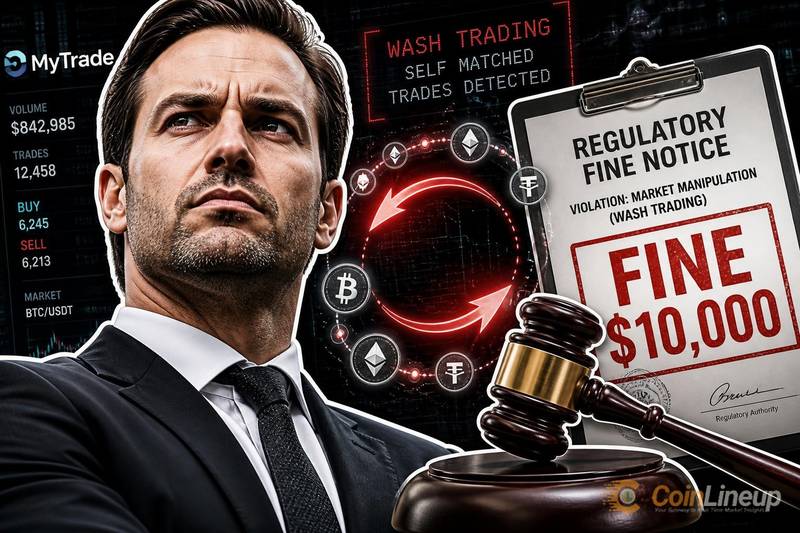
Liu Zhou, founder and primary operator of cryptocurrency financial services firm MyTrade, was fined $10,000 after being sentenced in Boston federal court on August 6, 2026, for his role in a crypto market-manipulation conspiracy involving wash trading, according to the U.S. Attorney's Office for the District of Massachusetts. The case is one of the first to result in a criminal sentence against a crypto market maker specifically for wash trading, establishing a precedent that volume-inflation services can trigger felony charges rather than only regulatory penalties.
Zhou had pleaded guilty in October 2024 to conspiracy to commit market manipulation and wire fraud, as detailed in the DOJ announcement.
How the Wash-Trading Service Operated
Prosecutors said MyTrade MM allowed clients to set daily wash-trade targets through a dashboard that described the service as "Volume Support." The firm then used bots to execute the trades. Wash trading involves buying and selling the same asset to create the appearance of market activity that does not reflect genuine demand — a practice that has been prohibited under U.S. commodities and securities law for decades in traditional financial markets.
The scheme was uncovered through an undercover law-enforcement operation that created NexFundAI, an Ethereum-based token that traded on Uniswap before authorities disabled it. The operation's use of a government-created token as bait marked a notable tactic in crypto enforcement, effectively turning a decoy asset into a trap for firms offering manipulation services. The broader enforcement action was announced by the DOJ here.
Regulators Frame Wash Trading as Market Manipulation
Wash trading inflates reported volume by routing trades between accounts controlled by the same party, creating misleading signals of liquidity and demand. Traders who interpret that volume as genuine interest can be drawn into thinly traded tokens. False volume erodes the price-discovery function that markets rely on, which is why prosecutors characterize the practice as manipulation rather than a technical infraction.
"Wash trading has long been outlawed in the financial markets, and cryptocurrency is no exception," said Joshua S. Levy of the U.S. Attorney's Office, in the broader crackdown announcement.
The enforcement effort mirrors other recent DOJ crypto cases, including the agency's move to charge the founder of Few and Far in a separate matter.
Broader October 2024 Enforcement Sweep
The sentencing closes one thread of an October 2024 operation that the DOJ described as its first criminal action against crypto market makers for wash trading. In that sweep, prosecutors said they seized more than $25 million in cryptocurrency and deactivated bots responsible for wash trades across roughly 60 cryptocurrencies. Eighteen individuals and entities were charged in total.
For exchanges and token teams, the case signals that market-making arrangements offering "volume support" can carry criminal liability, not merely civil risk. The outcome also provides a concrete reference point for projects evaluating third-party market-making agreements: services promising specific volume targets may warrant heightened scrutiny given prosecutors' willingness to pursue felony charges.
Market Context
The sentencing was announced during a subdued market environment. Ethereum, the blockchain behind the NexFundAI token, traded near $1,908.39 at research time, roughly flat over 24 hours, according to CoinGecko. Broader sentiment was risk-off, with the Fear & Greed Index at 25, in "Extreme Fear" territory.

