Elon Musk’s ‘Global Bankruptcy’ Warning Meets JPMorgan’s First Bitcoin Forecast
Key Takeaways
- •Elon Musk said on the Dwarkesh Podcast in February 2026 that the United States is '1000%' certain to go bankrupt without a major productivity jump from AI and robotics.
- •US national debt surpassed $40 trillion in late 2026, with interest payments on the debt reported to exceed military spending.
- •JPMorgan Asset Management included Bitcoin in its Long-Term Capital Market Assumptions report for the first time in October 2026, projecting a 10% annualized return through 2036 that outpaces its forecasts for large-cap US stocks and bonds.
- •Tesla holds 11,509 BTC and SpaceX holds 18,712 BTC, a combined position of approximately 30,221 BTC reportedly acquired at low average costs.
- •No single statement by Musk has been conclusively tied to an immediate Bitcoin price move, despite his companies holding a substantial position in the asset.
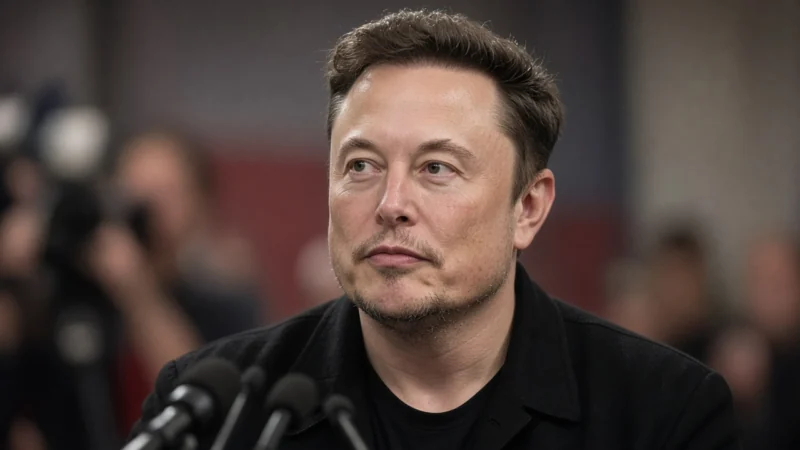
Elon Musk has a new item on his worry list. The Tesla and SpaceX chief — described by Forbes as the world’s first trillionaire — has paired his long-running warnings about financial collapse with fresh fears about an artificial intelligence-driven nightmare. His latest message is a warning of “global bankruptcy.”
Forbes suggests it could become a game-changer for the Bitcoin price, and the warning lands just as JPMorgan Asset Management publishes a Bitcoin forecast that the publication called “extraordinary.” The pairing is worth unpacking: one is a loud, personal warning about fiscal fragility; the other is an institutional modeling exercise about where Bitcoin belongs in a decade-horizon portfolio.
Musk’s math: robots or ruin
Appearing on the Dwarkesh Podcast in February 2026, Musk put his confidence level well past the usual scale: “We are 1000% going to go bankrupt as a country and fail as a country without AI and robots.”
In Musk’s view, the United States cannot outgrow its debt with today’s economy. Only a major jump in productivity from AI and robotics, he argues, would allow the country to cover what it owes — and without that jump, the bill eventually wins.
The scale of the challenge is already visible in the numbers. US national debt passed $40 trillion in late 2026, according to the research findings, and interest payments on that debt are reported to exceed military spending. Interest is the unforgiving part of that arithmetic: it is owed regardless of how the economy performs, which is why a step-change in productivity rather than ordinary growth sits at the center of his argument.
This is where Musk’s two fears meet. He frames AI as both a possible threat and the only realistic escape hatch from the debt spiral.
JPMorgan puts a number on Bitcoin
JPMorgan Asset Management included Bitcoin in its Long-Term Capital Market Assumptions report for the first time in October 2026. That annual report is where the firm lays out its expected returns for major asset classes over the coming decade, and the headline figure is a projected 10% annualized return for Bitcoin through 2036 — an average yearly pace over the period, not a straight-line path. The research findings note that this outpaces JPMorgan’s forecasts for traditional holdings such as large-cap US stocks and bonds.
The reasoning rests on supply. Bitcoin’s issuance is capped, while the broader money supply keeps expanding. That logic lines up neatly with how Musk talks about Bitcoin: he has described it as “based on energy” and contrasted it with fiat currency, which governments can print without a hard limit.
Musk’s companies are already holding the bag
Tesla holds 11,509 BTC, while SpaceX holds 18,712 BTC, according to the research findings. Together that comes to approximately 30,221 BTC, reportedly acquired at low average costs.
That gives Musk a direct stake in how markets interpret his warnings. Few public figures warning about fiscal collapse also run two companies sitting on a large position in the asset most often pitched as a hedge against it. To be fair, there is no evidence that his statements are designed to move the market — but anyone reading his posts should know where the corporate treasuries sit.
Why the debt story and the Bitcoin story keep crossing paths
The connection between government debt and Bitcoin is not new. Bitcoin’s original design was a response to concerns about centralized money and unchecked issuance — themes that have long tied the asset to fiscal debates. Every fiscal scare reopens the same underlying question: what money is worth when its supply is set by policy rather than by a fixed schedule.
The research findings are explicit that no single Musk statement has been conclusively tied to an immediate Bitcoin price move. That gap between rhetoric and any measurable reaction is worth keeping in mind whenever headlines pair the two.
What this means for investors
The most significant development here is arguably JPMorgan’s, not Musk’s. A formal return assumption from JPMorgan Asset Management is a different kind of signal. Long-term capital market assumptions feed into how advisers and institutions think about portfolio construction, and Bitcoin showing up in that framework signals that it is being treated as an asset class worth modeling rather than a curiosity. Musk’s warning, by contrast, is commentary — influential commentary given his companies’ holdings, but commentary all the same.
A 10% forecast is also not a guarantee. Forecasts of this kind are long-range estimates, and a decade is plenty of time for assumptions to break.
For now, the practical watch list is short: track US fiscal policy and debt-servicing costs, monitor whether other large asset managers follow JPMorgan in publishing Bitcoin assumptions, and keep an eye on any changes to Tesla’s and SpaceX’s holdings.
Edited by Vivian Nguyen. Source: CryptoBriefing.

