Fox News owner Rupert Murdoch is turning on Trump after Nov. 3 defeat, report says
Key Takeaways
- •Murdoch-owned outlets including the New York Post and the Wall Street Journal are explicitly urging Republicans to move beyond Trump after the party's Nov. 3 election defeat.
- •Fox News lost roughly one-third of its viewers in October compared with the same month a year earlier, a decline linked to a Republican audience split between Trump loyalists and disillusioned conservatives drawn to independent personalities like Tucker Carlson and Megyn Kelly.
- •Trump called into Fox News to dispute unfavorable polling, asserting he holds 99 percent approval among Republican voters, while anchor Bret Baier responded that Fox polls proved accurate on election night.
- •Commentator Oliver Darcy argued Murdoch shares responsibility for the election loss because Fox voices such as Sean Hannity and Mark Levin encouraged Trump's decision to attack Iran, which was followed by skyrocketing prices.
- •Key open questions include whether Fox's ratings slide will continue, whether the Post and the Journal will sustain their editorial line, and how the gap between Trump's claimed approval and unfavorable surveys resolves.
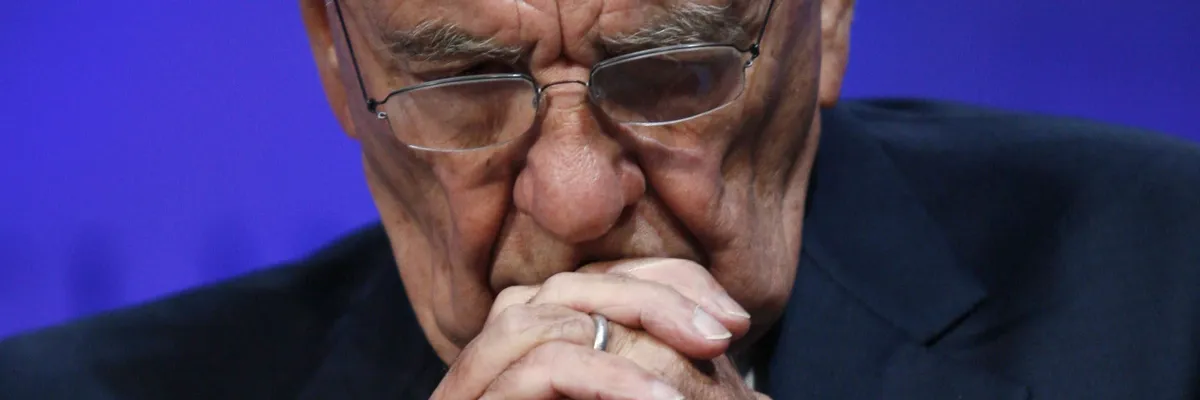
President Donald Trump appears to be losing one of his most powerful media promoters: right-wing media magnate Rupert Murdoch, according to a new report.
The reassessment is already underway, according to Status's "Power Lines," the program hosted by veteran journalists Oliver Darcy and Jon Passantino (watch on YouTube). Darcy said both the New York Post and the Wall Street Journal — Murdoch-owned publications — are now explicitly urging Republicans to look beyond Trump following the party's shellacking at the ballot box on Nov. 3.
The signal carries weight because of where it originates: Murdoch owns Fox News in addition to the Post and the Journal, meaning the shift spans a cable network, a New York tabloid and a national financial daily that together sit at the center of right-leaning media — just as Republicans are sorting through the Nov. 3 defeat.
The two journalists connect Murdoch's shift to Fox News's eroding audience. They noted that the network lost roughly a third of its viewers in October compared with the same month the previous year. Their argument: a divided Republican coalition creates a ratings problem. Loyal Trump supporters want favorable coverage, while disillusioned conservatives increasingly gravitate toward independent personalities such as Tucker Carlson and Megyn Kelly, who are willing to criticize Trump when he is wrong. For a business that depends on ratings, an audience splitting between loyalists and defectors compounds the October decline.
They agreed that Murdoch, a shrewd businessman, is studying the actual data from his network and its online readership.
"Rupert's looking at the cold, hard data and knowing that the audience wants this and is now calling on the Republican Party to just basically throw Trump overboard, ignore him, and let's figure out where to go now," Darcy said.
The move is also financially convenient, he added. By joining the anti-Trump bandwagon now that Trump is no longer good for ratings, Murdoch can cast him aside for commercial reasons.
Trump pushed back on Tuesday night, calling into Fox News to lash out at hosts for reporting on his weak polling numbers. According to Trump, he holds a 99 percent approval rating among Republican voters, which should outweigh unfavorable surveys. Anchor Bret Baier responded that the Fox polls Trump frequently attacks had proved accurate on election night — Fox polls tend to be close to accurate.
"Well, I don't know about that," Trump said, without addressing the point. The brief exchange underscored the friction at the center of the report: a network whose own polling diverges from the favorable narrative its most loyal viewers prefer.
"There was a blue wave forming, and we've seen in other reporting this week that the White House and Donald Trump — these people were all acutely aware of what was going on in the country and could not figure out what to do — and that's obviously because, in many ways, MAGA was p----- just like the rest of the country about the war and the price and the cost of living," Passantino said.
Darcy argued that Murdoch "should also look in the mirror" over the election loss. He cited Tucker Carlson's claim that if Fox had not been so supportive of the Iran war, Trump likely would not have gone to war at all.
"So, he gets involved in a foreign war, prices skyrocket, and while obviously Donald Trump is the commander-in-chief — he's the one who made the decision to do this," Darcy said. "He was very much prodded along and encouraged by a lot of voices at Fox News. Sean Hannity, Mark Levin and others were itching for Donald Trump to attack Iran. And so when Tucker says, you know, that Fox deserves some of the blame — I think he's actually spot-on there."
The Murdochs could easily have instructed the team at Fox to dial down the war talk had they wanted to, Darcy noted.
"So, I think there's a little bit of blame that Rupert Murdoch should absorb as well here," he said.
Passantino agreed, saying Trump was "a little high on his own supply" because Fox News told him what to think.
Where it goes from here remains the open question: whether Fox's ratings slide continues, whether the Post and the Journal sustain their editorial line, and how the gap between Trump's claimed 99 percent approval and the surveys he attacks plays out.
This article originally appeared on Alternet.

