MTN SAIL graduates 500 AI-trained teachers, targets 4 million Nigerian students
Key Takeaways
- •The MTN SAIL Teachers Fellowship has expanded from an initial plan of about 150 teachers to roughly 10,000 educators trained across all 36 Nigerian states and the Federal Capital Territory.
- •The 500 newest graduates completed Nigeria's first structured training programme in AI-assisted teaching, developed in collaboration with Microsoft, after a three-month online course with continuous assessments.
- •The cohort was selected from the top 10 per cent of 5,000 public-school teachers who finished the fellowship's first major phase, reflecting a deliberate focus on the public education system.
- •Lagos Commissioner Tunbosun Alake cautioned that AI should enhance rather than replace effective classroom practice, emphasising inquiry-based learning as the core of teaching quality.
- •The programme projects that if each of the 500 teachers reaches an average of 80 students annually, the cohort could affect 400,000 Nigerian children in its first year and four million over ten years.
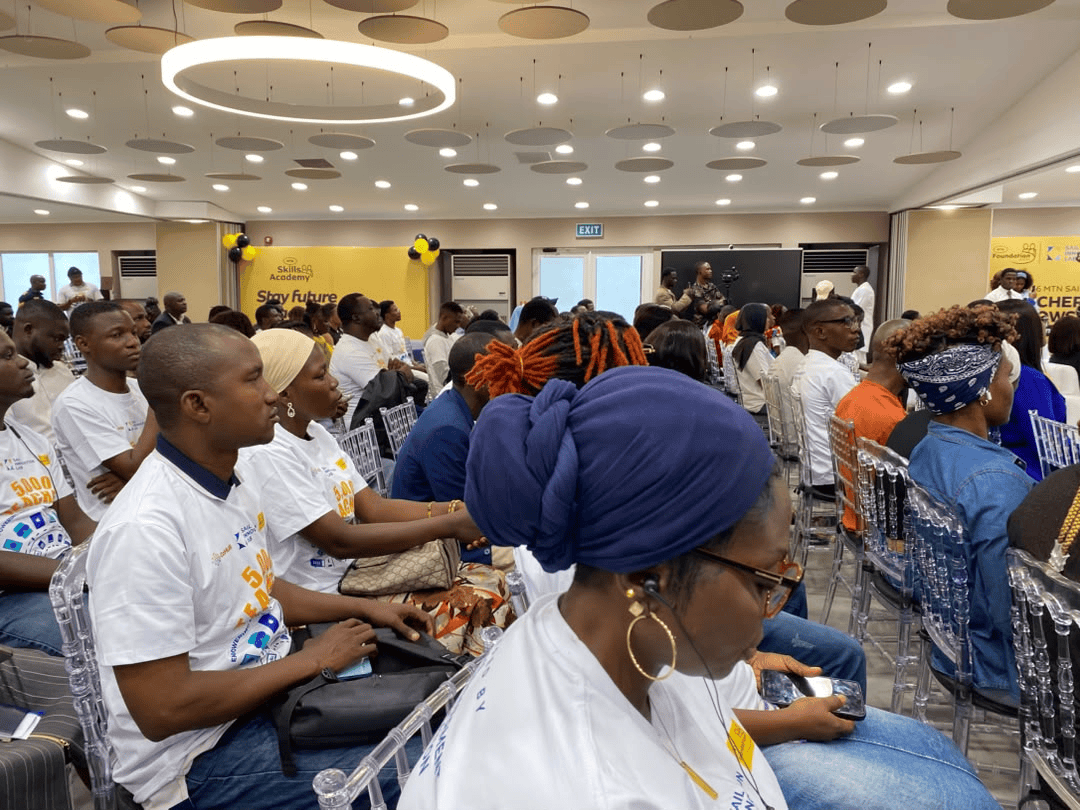
MTN SAIL Foundation has graduated its second cohort of teachers at MTN Plaza in Ikoyi, Lagos, marking the latest stage of a fellowship that has expanded from an initial plan to train 150 teachers to a programme that has reached about 10,000 educators across all 36 states of Nigeria.
This year’s cohort comprised 500 teachers who completed Nigeria’s first structured training programme focused on AI-assisted teaching. The programme was developed in collaboration with Microsoft and the MTN Foundation, with an emphasis on digital access and remote learning. Valedictorians travelled from different states to attend the ceremony, while most of the graduates participated through a live online stream.
The event featured Lagos State Commissioner for Innovation, Science and Technology Tunbosun Alake, Lagos State Commissioner for Education Jamiu Alli-Balogun, MTN Foundation Executive Director Odunayo Sanya and Feyisola Abiru, co-founder of SAIL Empowerment Foundation.
The MTN SAIL Teachers Fellowship began in 2022 with a focus on the role of teachers in delivering education policy. Its organisers said that policies affecting Nigerian children can make a meaningful difference in classrooms only when teachers have the necessary support and resources.
Initially launched in Lagos, the fellowship was designed to reach between 150 and 200 teachers. Sanya said the vision soon grew substantially.
“We don’t believe in being modest or doing small things. If we’re going to make an impact, we need to go big,” she said.
With support from the MTN Foundation, the programme expanded beyond its original objective of supporting 4,000 teachers. MTN’s network and data resources were used to support participants. During its first major phase, the fellowship reached 5,000 teachers from public primary and secondary schools in all 36 states and the Federal Capital Territory.
All participants came from public schools, a deliberate choice because, as Abiru noted, the vast majority of Nigerian children are educated in the public-school system.
The second phase selected the top 10 per cent of the 5,000 teachers who completed the first phase. The resulting group of 500 teachers took part in an intensive three-month online programme that included continuous assessments and practical classroom experience. They were the graduates recognised at the ceremony.
The fellowship has now trained around 10,000 Nigerian teachers in total. The latest cohort has an additional distinction: following Microsoft’s involvement in the partnership, the curriculum included a formal artificial-intelligence module. The 500 graduates were described as the first teachers in Nigeria to receive AI-assisted teaching training through a structured programme.
Alake said the programme gave Nigerian teachers a direct role in the global discussion about AI and education.
“There’s a global discussion right now about AI and education, and too often, Africa is simply discussed instead of being actively involved,” he said. “Today, 500 Nigerian teachers are part of that conversation, not as subjects, but as professionals in the field.”
He cautioned, however, that AI should not be treated as a substitute for effective classroom practice.
“AI isn’t a solution for the classroom. The real change comes from inquiry-based learning. When children are encouraged to ask questions and explore, they become irreplaceable by machines. Technology can enhance what’s already there, but it’s essential to prioritise effective teaching strategies,” Alake said.
Alli-Balogun said the Lagos education authorities intended to draw on the graduates’ expertise through further training.
“I want to connect with you,” he told the teachers. “We’ll be organising train-the-trainer sessions in my schools, and I’m committed to that. The more we invest in this, the better access we’ll have to quality education.”
Five teachers were recognised from among the 500 graduates for their commitment during the training and the impact they had already made in their classrooms. Each received a new laptop from the SAIL Foundation, intended as a practical teaching and learning tool rather than only a ceremonial award.
“This isn’t just a parting gift; it’s a tool,” Abiru said. “Use it to continue learning and to teach even better than you did yesterday.”
Sanya also encouraged the graduates to view themselves as “hyperscalers” rather than simply multipliers, reflecting the foundation’s expectation that they would extend the programme’s impact within their communities.
“You replicate rapidly,” she said. “As you return to your communities, remember that you are not just multiplying; you have a new role. You are hyperscalers.”
Based on the programme’s projection, if each of the 500 teachers reaches an average of 80 students per year, the cohort could affect 400,000 Nigerian children within its first 12 months. Over 10 years, that calculation amounts to four million young Nigerians reached by teachers who have received additional training and resources.
Alake described trained teachers as one of the most valuable technology investments a government can make.
“While an IT server manages a workload, a teacher can nurture 400 students over their career,” he said. “Each child carries what you’ve taught them into a future we are still imagining.”
The MTN Foundation said it has invested more than N34 billion in various initiatives over 22 years. Those programmes have reached 33 million people across 3,500 communities in 590 local government areas. The fellowship forms part of the foundation’s capacity-building work, and Sanya said its next objective was to reach all 774 local government areas in Nigeria.
The SAIL Innovation Lab and Sports Centre in Ibeju-Lekki is under construction and is expected to broaden the foundation’s activities when completed. SAIL has also developed into an independently governed institution, with a board of trustees overseeing its strategy separately from the founders.
For the 500 graduating teachers, the ceremony concluded one stage of the fellowship and began another. Some attended in person after travelling to Lagos, while others joined remotely. Equipped with new laptops and training in AI-assisted teaching, the graduates are expected to return to classrooms across Nigeria’s 36 states, where the programme estimates that 400,000 children could be reached during the coming year.
Source: TechNext24
