MTN Y’ello Street traces Nigeria’s journey from GSM beginnings to 5G
Key Takeaways
- •MTN Nigeria launched the Y'ello Street museum exhibition to mark its 25th anniversary, chronicling the country's telecommunications transformation since the first successful mobile call in May 2001.
- •The exhibition showcases artefacts ranging from early durable GSM phones like the Nokia 3310 to physical scratch cards and phone booths, reflecting a period when SIM cards and voice calls were luxury commodities.
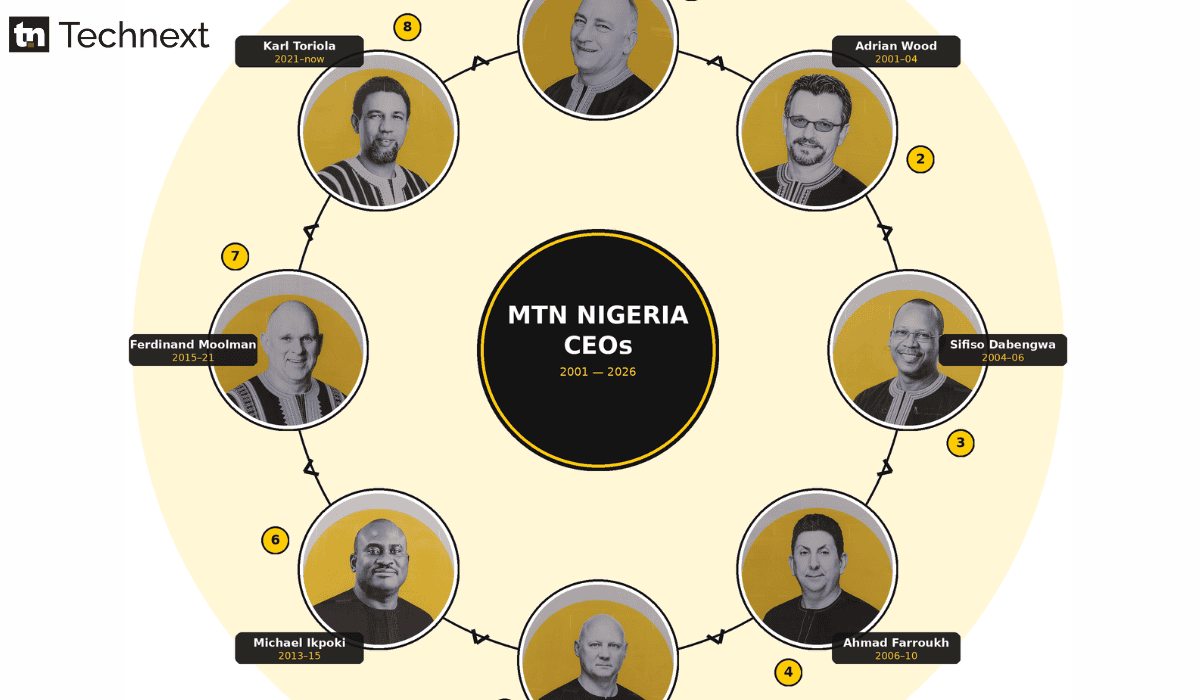
- •Eight chief executives have led MTN Nigeria, with early leaders including Karel Pienaar, who prepared the commercial launch, and Adrian Wood, who secured the historic 285 million dollar operating licence.
- •The display traces branding evolution from early slogans through the nostalgic 'Everywhere you go' campaign to the current 'What are we doing today' theme, mirroring the shift from voice-call dominance to high-speed digital connectivity.
- •MTN characterises the exhibition as more than a corporate retrospective, positioning it as a record of Nigeria's own technological and social development over the past quarter century.
Right from the entrance of the MTN Nigeria Plaza, the 25th-anniversary atmosphere was unmistakable. Inscriptions across the walls, boards, designs and colours chart how the operator has connected Nigerians from the early days of basic telephony to an era in which connectivity shapes the digital economy.
For Nigerians now in their mid-30s, early 40s and older, the exhibit recalls a time when owning a mobile phone or even a SIM card was a luxury. Voice calls were the main attraction, and 10MB of data could last for days — unlike today, when that amount may not be enough to load a page.
MTN Nigeria’s Y’ello Street is presented as a walk down memory lane.
When MTN Nigeria Chief Financial Officer Modupe Kadri delivered the opening remarks at the ceremony, the message was clear: Y’ello Street is a museum chronicling how life has changed since the historic successful call placed in May 2001.
More than an MTN showcase, the exhibition is described as a museum of Nigeria itself. The artefacts tell the story of what happens when technology meets people, and how people must adapt to keep pace with technological change.
As the operator has moved through that journey, Nigerians have also lived through their own years of becoming — from younger days to the present — alongside successive waves of innovation.
The exhibition begins with the people who shaped MTN Nigeria’s growth. It highlights the early work of Karel Pienaar, who laid the groundwork for the commercial launch, and Adrian Wood, who secured the historic $285 million licence. It also references the contributions of Michael Ikpoki and Ferdinand Moolman, among others, in a period marked by the struggle to expand connectivity.
The company’s eight chief executive officers illustrate the idea that progress is continuous. The display suggests that each leader helped move the organisation forward, and that current CEO Karl Toriola now stands on the path built by those who came before him.
The evolution of MTN’s branding is another major theme. “The better connection” is less widely remembered, but “Everywhere you go” still carries strong nostalgia for many Nigerians. “What are we doing today” reflects the 4G and 5G era, when technology is advancing faster than many people can imagine.
Everyone entering the Y’ello museum appeared to do so with a smile — not just from excitement, but from the feeling of being welcomed into history.
A manual typewriter, an old personal computer and a phone booth capture the slower, more deliberate pace of communication before the digital revolution. Yet they also point to the changes that were ahead.
Nearby are physical scratch cards, paper vouchers and call-centre references that recall a time when people who could not afford a phone could still reach loved ones. That access was supported by per-second billing, which charged Nigerians on a per-second basis.
The museum also displays early GSM phones known for their durability, long battery life and external stub antennas. Among them are the Nokia 3310, 3210, 5110 and 8210, along with Motorola devices and the Siemens C35 and S35.
The relics also reflect a period when getting a SIM card was a luxury and voice calls were highly prized. During that time, “flashing” — calling a number and hanging up before the recipient answered to signal a callback — became common because of high call charges.
The display then moves into the 2G and 3G eras, when connectivity increasingly became part of daily life. That shift was reinforced by the growing use of social media and messaging platforms such as Facebook, 2go, Eskimi, MSN Messenger and Yahoo! Messenger.
This period marked the transition from desktop-bound text chats and basic SMS to early mobile web browsing, feature-phone apps and the beginnings of smartphone social networks. Connection speeds were slow, and data was charged by the kilobyte and megabyte.
With 3G, mobile web pages and continuous data feeds became faster and more practical for the internet needs of the period. That made mobile access more useful for ordinary communication, not just for novelty, and helped set the stage for later habits that placed phones at the centre of work, social life and commerce.
The museum also features BlackBerry devices that popularised BlackBerry Internet Service, making push email and BBM status updates essential tools for many young people and internet users. The rise of mobile app stores then opened the door to dedicated software for social platforms.
No such display would be complete without XtraCool. The exhibit recalls the MTN XtraCool Plan, which offered free midnight calls from 12:30 am to 4:30 am and became part of a late-night culture of gossip, conversation and shared secrets for generations of young Nigerians.
There is also the “I Don Port” symbol, which helped popularise number portability and became tied to the “Saka” advertising rivalry between MTN and Etisalat, now T2mobile.
For MTN, the 2G and 3G era, captured under the “Everywhere you go” campaign, represents a period of network expansion and the introduction of mobile internet access. The Y’ello museum tracks the rise of SMS culture, basic web browsing and early smartphone adoption, all while MTN worked to expand its subscriber base across Nigeria.
The 4G and 5G sections show how far the industry has moved. Fast mobile broadband unlocked modern industries, social media ecosystems and digital jobs that did not exist when MTN began operations in 2001.
The shift was from simple telecommunications to a broader digital lifestyle defined by cloud computing, virtual work, ultra-fast streaming infrastructure and mobile money. It also marked a move from voice-call dominance to connectivity as the central service.
The exhibition reflects MTN’s transformation into a technology company powering real-time connectivity in an era where technology moves faster, matching the current high-speed landscape under the tag “What are we doing today”.
Leaving Y’ello Street leaves a broader reflection on how far Nigerians have come in their telecoms journey. It points to what has already been made possible, and to the possibilities that remain ahead. The foundation it documents is bigger than MTN alone; it is part of Nigeria’s national memory.

