MSCI revives proposal to remove Strategy and Metaplanet from stock indexes
Key Takeaways
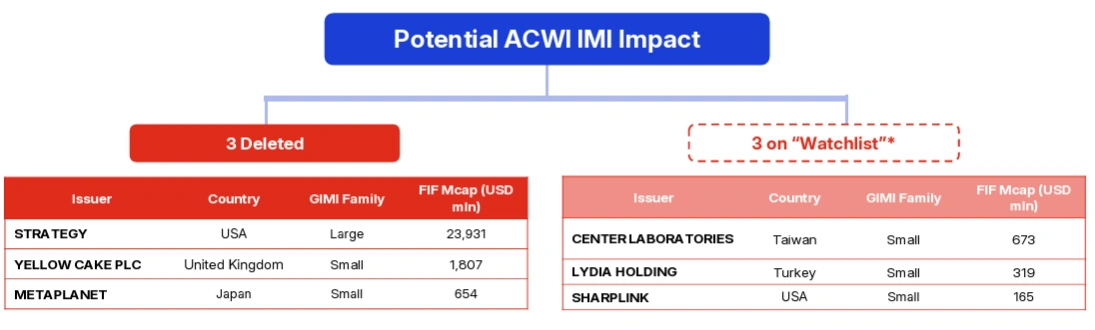
- •MSCI's August 2026 consultation names Strategy and Metaplanet among three firms that would be deleted from its Global Investable Market Indexes if the non-operating companies proposal is adopted, with uranium stockpiler Yellow Cake also facing definite exclusion.
- •Strategy, which holds 840,447 BTC worth roughly $53.18 billion, would have failed all five of MSCI's financial ratio tests based on its FY2025 filings, while Sharplink was watchlisted for failing the screen only once.
- •Inclusion in MSCI indexes could generate $2 billion to $2.8 billion in inflows, whereas exclusion would require index-tracking funds to sell shares they are no longer permitted to hold.
- •This is MSCI's second attempt in under a year, after it dropped a crypto-specific asset threshold in February in favor of a broader ratio-based screen that also captures non-crypto asset holders.
- •MSCI is accepting market feedback through September 30, 2026, with a decision expected around October 16 and any adopted changes taking effect at the November 2026 Index Review.
Corporate Bitcoin holders Strategy (NASDAQ: MSTR) and Metaplanet (TYO:3350) are back on MSCI's exclusion watchlist after the index provider revived a proposal that would remove both firms from its stock benchmarks.
The consultation, which begins this month, revives a 2025 headache for Strategy and Metaplanet. If MSCI resolves to exclude either or both of them from its Global Investable Market Indexes, the companies could face forced selling by index-tracking funds that would be required to offload their shares.
Is MSCI targeting Strategy and other reserve firms?
MSCI's August 2026 consultation paper does not specifically mention crypto reserve firms or the companies that run digital asset treasuries (DATs). It does, however, name Strategy and Metaplanet among the three firms that would definitely be deleted if the proposal passes, while Sharplink is one of three companies placed on the “Watchlist.”
The two crypto names arrived at the screen from different starting points. Strategy, formerly MicroStrategy, was a business-intelligence software maker that began converting its corporate treasury into Bitcoin in 2020 and is now the largest corporate holder of the asset. Metaplanet, a Tokyo-listed company, adopted Bitcoin as its core reserve asset in 2024, part of a wider wave in which dozens of publicly listed companies have announced digital asset treasury policies since that year.
According to MSCI, the proposal targets firms that fall under its “non-operating companies” designation — businesses built around stockpiling valuable assets rather than earning cash from a working business.
UK-based Yellow Cake, a company that stockpiles uranium, is the third name facing potential exclusion. Turkey's Lydia Holdings and Taiwan's Center Laboratories are the other firms on MSCI's watchlist.
How MSCI chose the firms to exclude
MSCI set out the red flags that could land a company on the delist watch. Firms whose operating assets make up more than 50% of total assets advance to the next level of scrutiny. The review then examines five financial ratios covering operating asset intensity, expense intensity, cash flow, fair-value changes, and how much a company leans on outside financing to grow. Companies that fail to clear at least four of those five hurdles face MSCI exclusion.
Michael Saylor's Strategy, which holds 840,447 BTC worth roughly $53.18 billion and has a free-float market value of $23.93 billion, would have tripped all five ratios on its FY2025 filings. The outside-financing ratio speaks directly to how the company has scaled, with successive Bitcoin purchases funded through repeated sales of convertible notes and new share issuance. Ethereum treasury firm Sharplink was placed on the public watchlist because it failed the screen only once. Two consecutive annual failures translate into exclusion.
What MSCI exclusion would mean for firms
MSCI inclusion could be worth anywhere between $2 billion and $2.8 billion in inflows for firms that make the cut. Those that get left out could face flows moving in the opposite direction, because funds that mirror MSCI benchmarks would have to dump shares they are no longer allowed to hold.
The stakes run wider than the passive funds that copy the benchmarks. MSCI's indexes anchor trillions of dollars in tracked assets, and many active managers are also measured against them, so membership in the Global Investable Market Indexes shapes how much of the market can hold these names at scale.
This is MSCI's second run at the problem in under a year. An October 2025 consultation went straight at “digital asset treasury” firms, targeting any company with at least half its assets in crypto. MSCI dropped the crypto-specific cutoff in February after investors questioned whether a plain asset test could tell an operating company apart from an investment vehicle. The new framework swaps that single threshold for the broader ratio-based screen, which is why it sweeps in a uranium holder alongside the Bitcoin firms.
Strategy has already argued its own case. In a December 2025 letter, the company insisted that it runs an active enterprise — building Bitcoin-backed credit instruments and operating analytics software — rather than sitting on a static pile of coins.
Feedback closes September 30
Nothing is settled. MSCI is collecting comments from market participants through September 30, 2026, with a decision expected around October 16. Any changes the index provider does adopt would take effect at the November 2026 Index Review, and MSCI has stressed that the consultation guarantees none of its proposals. Because the ratio screen would apply to annual filings, the dozens of listed companies running digital asset treasuries would face the same tests on future balance sheets if the framework is adopted. For now, neither Strategy nor Metaplanet has been removed.

