Moscow Exchange Plans Perpetual Futures for Bitcoin, Ether, Solana, XRP and TRX
Key Takeaways
- •Moscow Exchange plans to offer perpetual futures contracts based on Bitcoin, Ether, Solana, XRP and TRON, enabling traders to speculate on crypto prices without owning the underlying assets.
- •The announcement is a proposal rather than an operational product, as key details such as trading pairs, leverage limits and settlement terms have not been confirmed.
- •Perpetual futures carry no expiry date and stay aligned with spot prices through periodic funding payments exchanged between long and short position holders.
- •The plan builds on Moscow Exchange's earlier outline of crypto indexes tracking SOL, XRP, TRX and BNB, signaling an ongoing effort to develop structured crypto products for Russian participants.
- •Perpetual-style contracts remain uncommon on regulated national exchanges, with CME Group having introduced only conventional Bitcoin futures in 2017, so a successful launch would mark a rare move by a traditional bourse into this market.
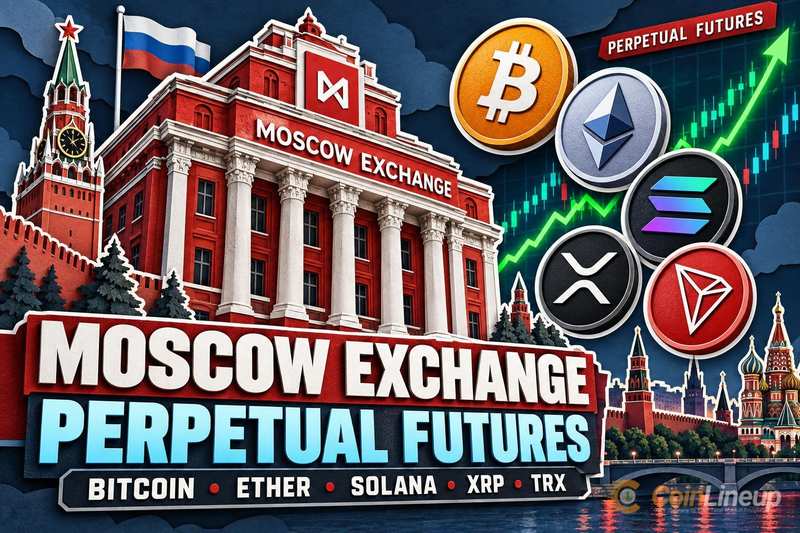
Moscow Exchange has announced plans to launch perpetual futures contracts tied to five major cryptocurrencies: Bitcoin (BTC), Ether (ETH), Solana (SOL), XRP and TRON (TRX). The proposed products would give traders on Russia's largest stock exchange a way to speculate on cryptocurrency prices without owning the underlying assets.
A Proposal, Not a Live Product
Perpetual futures are a class of derivative — a financial contract whose value is derived from an underlying asset. Unlike conventional futures, perpetuals carry no expiry date, meaning a trader can hold a position for as long as they choose. In practice, perpetuals stay tethered to spot prices through periodic funding payments exchanged between long and short position holders, a mechanism designed to keep the contract price from drifting far from the underlying asset's market value.
The announcement describes a proposal rather than an operational product. Final contract details, including trading pairs, leverage limits and settlement terms, have not been confirmed.
The plan extends the exchange's earlier steps into digital assets. Moscow Exchange previously outlined plans to build crypto indexes tracking SOL, XRP, TRX and BNB, signaling an ongoing effort to develop structured crypto products for Russian market participants.
The Five Assets in the Proposed Lineup
The five proposed underlying assets span several of the largest blockchain networks by market presence. Bitcoin and Ether are the two largest cryptocurrencies by market capitalization, while Solana, XRP and TRX — the native token of the TRON network — each represent major platforms with active user bases and significant trading volume globally.
Taken together, the lineup would touch both proof-of-work and proof-of-stake networks, as well as blockchains focused on payments, smart contracts (automated programs that run on a blockchain), and high-speed transactions.
What This Could Mean for Traders
Perpetual futures let traders take a long position, betting that prices will rise, or a short position, betting that prices will fall, without buying the underlying cryptocurrency. The mechanics are similar to those of equity derivatives, in which stock traders use options or futures to gain exposure to a company without purchasing its shares.
Derivatives trading, however, amplifies both gains and losses. A position that moves against a trader can produce losses greater than the initial amount placed, and higher potential returns come with a correspondingly higher risk of loss — a dynamic newcomers to derivatives should understand before committing capital.
The instrument has deep roots in the crypto sector: perpetual futures were pioneered by cryptocurrency trading platforms and have grown into one of the most heavily traded crypto derivatives worldwide, with activity concentrated largely on crypto-native venues. Traditional exchanges have entered the space more cautiously — CME Group introduced Bitcoin futures in 2017, but perpetual-style contracts remain uncommon on regulated national stock exchanges. A successful launch would therefore mark a relatively rare instance of a traditional bourse offering perpetual-style crypto products, underscoring how established market infrastructure and digital assets continue to converge.
Regulatory Context in Russia
Russia's broader regulatory direction has been moving toward structured crypto access. The Russian Central Bank has proposed allowing Bitcoin, Ether and USDT, the dollar-pegged Tether stablecoin, to trade on regulated exchanges. Russia's existing digital assets framework, adopted in 2020, already permits cryptocurrency ownership and investment while prohibiting its use as a means of payment for goods and services — a setup pointing toward an environment in which licensed venues such as Moscow Exchange could play a central role in how Russian residents access crypto markets.
Availability of the proposed perpetual futures will depend on Moscow Exchange publishing final product specifications and receiving any necessary regulatory clearance. Until those details are confirmed, the offering should be treated as a plan rather than a live product.
For anyone considering crypto derivatives for the first time, understanding how futures products bridge crypto and traditional finance is a useful starting point.
Disclaimer: This article is for informational purposes only and does not constitute financial or investment advice. Cryptocurrency and digital asset markets carry significant risk. Always do your own research before making decisions.

