MOEX to Launch Perpetual Futures for Bitcoin, Ether, Solana, XRP and Tron
Key Takeaways
- •MOEX will begin trading five perpetual futures tied to its own Bitcoin, Ether, Solana, XRP and Tron indexes on Sept. 22.
- •The contracts are available only to qualified investors and are settled in rubles without delivering the underlying cryptocurrencies, consistent with the Bank of Russia's May 2025 rules.
- •Built as one-day instruments with automatic rollover, the futures carry daily funding calculations, with the K1 parameter at 0% and K2 at 0.35%.
- •More than 72,000 qualified investors have traded MOEX's crypto-linked futures since 2025, generating cumulative volume above 600 billion rubles and an average daily turnover of 2.5 billion rubles in August.
- •The launch deepens a two-track Russian framework in which qualified investors access exchange-traded crypto derivatives while non-qualified investors remain limited to direct crypto purchases under caps and testing requirements.
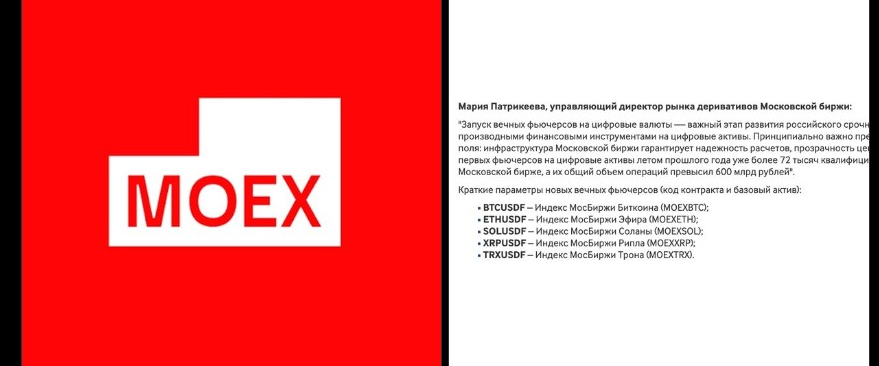
Moscow Exchange (MOEX) will launch five perpetual cryptocurrency futures on Sept. 22, widening the range of regulated digital-asset products available on Russia's largest exchange. The new contracts will track the exchange's own indexes for Bitcoin, Ether, Solana, XRP and Tron, will be restricted to qualified investors, and will be settled financially in Russian rubles rather than delivering the underlying tokens. Perpetual futures are derivative contracts with no fixed expiry, a format that has become standard across global cryptocurrency trading venues.
Five New Perpetual Contracts
MOEX will introduce the products under the tickers BTCUSDF, ETHUSDF, SOLUSDF, XRPUSDF and TRXUSDF. Each contract tracks a separate Moscow Exchange crypto index covering Bitcoin, Ether, Solana, XRP or Tron.
The instruments are designed as one-day futures with automatic rollover, which allows investors to maintain continuous exposure without having to move into a standard monthly contract. MOEX updates the relevant crypto benchmarks throughout the trading period using price data from major cryptocurrency exchanges. The automatic rollover removes the expiry management that fixed-term contracts demand, which is what lets the one-day instruments function as true perpetuals.
The perpetual lineup will sit alongside MOEX's existing monthly futures tied to the same five crypto indexes. Bitcoin and Ether index futures started trading in November 2025, while Solana, XRP and Tron contracts followed in May 2026. The exchange is now adding the perpetual format as demand for digital-asset derivatives grows among eligible market participants. BNB also has a MOEX index but does not appear in the five-contract perpetual launch, so whether the lineup later extends to other indexed assets is one point to watch after the debut.
Ruble Settlement Without Crypto Delivery
MOEX will quote each contract in U.S. dollars using the value of its related crypto index, but gains and losses will be settled in Russian rubles. Investors will not receive Bitcoin, Ether, Solana, XRP or Tron when positions close. Instead, the exchange will calculate the financial result through its derivatives clearing system, and changes in the dollar-ruble exchange rate can also affect the ruble value of a contract's outcome. That non-delivery design matches the condition the Bank of Russia set when it permitted crypto-linked instruments for qualified investors in May 2025, as detailed below.
The exchange will apply daily funding calculations to the contracts. Under its published specifications, the K1 funding parameter is set at 0% and K2 at 0.35%. Funding payments are the standard mechanism that keeps perpetual contracts tethered to their underlying indexes, since the instruments have no expiry date at which prices must converge.
The five products will expand a perpetual futures range that already includes 31 contracts tied to currencies, indexes, government bonds, precious metals and securities.
Investor Activity Tops 600 Billion Rubles
According to MOEX, more than 72,000 qualified investors have traded its crypto-related futures since the exchange entered the market in 2025, and their cumulative transaction volume has exceeded 600 billion rubles. The figures show that crypto-linked derivatives have developed into a larger segment of the exchange's futures business within roughly one year. MOEX reported an average daily crypto-futures turnover of 2.5 billion rubles during August.
The exchange first introduced a futures contract linked to BlackRock's iShares Bitcoin Trust ETF in June 2025. It later added an Ether ETF-linked product and then moved into contracts based directly on its own cryptocurrency indexes. The September launch extends that structure to perpetual contracts across five major digital assets. The progression — ETF-linked contracts, then index monthly futures, now perpetuals — traces a step-by-step build-out of crypto derivatives within the qualified-investor framework.
Qualified Investors Keep Exclusive Access
Russia's regulatory framework continues to limit these exchange-traded crypto derivatives to qualified investors. The Bank of Russia said in May 2025 that financial institutions may offer qualified investors derivatives and other instruments linked to crypto prices, as long as the products do not deliver cryptocurrency. MOEX follows that structure with cash-settled contracts and leaves final client access to brokers.
The restriction separates the futures market from direct cryptocurrency trading under Russia's newer rules. Both qualified and non-qualified investors can now conduct direct crypto transactions through regulated intermediaries. However, non-qualified investors face testing requirements and annual purchase limits, while qualified investors can trade without the same amount ceiling. The result is a two-track system in which the new perpetuals deepen the product set available to qualified clients, while non-qualified investors' exposure remains confined to direct purchases under those caps.
This article is for informational purposes only and does not constitute financial or investment advice. Cryptocurrency and derivatives trading involve substantial risk, including leverage and price volatility.
Source: The Market Periodical

