Waiting for the Troika Mid-Session Review Forecast
Key Takeaways
- •The mid-session review, required under the Congressional Budget Act of 1974, is due July 15 but the deadline is frequently missed.
- •The review updates the Administration's budget estimates and its official economic outlook partway through the year.
- •NEC Chair Hassett forecast in May that the economy would grow 5% in 2027, building on the Administration's already rapid 2026 growth forecast.
- •Reported GDP from the Bureau of Economic Analysis is so far tracking the Wall Street Journal's April survey mean forecast.
- •The Troika's growth assumptions underpin the budget's revenue and deficit projections, making the distance between reported GDP and the Administration's outlook the key gap to monitor once the review is released.
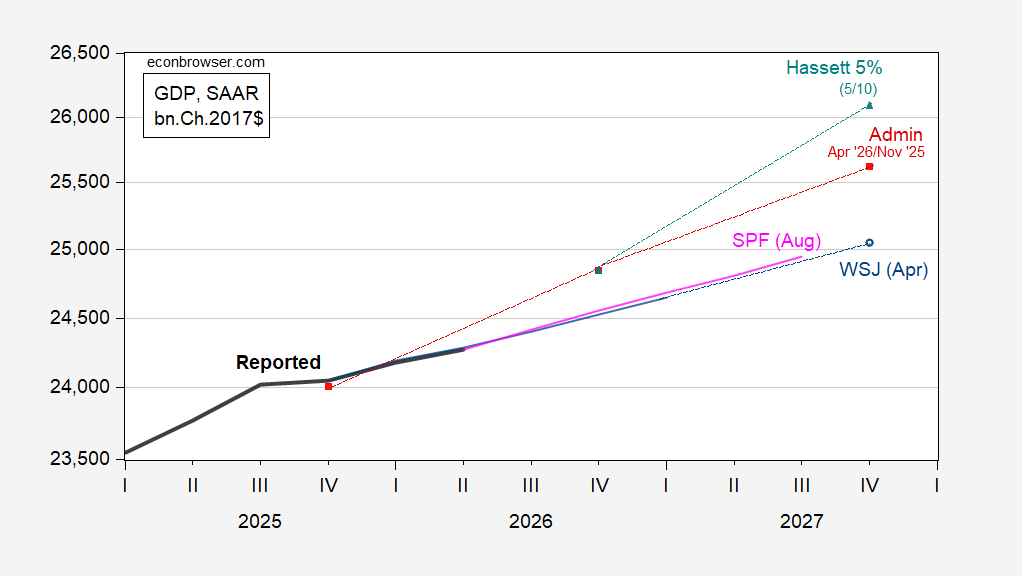
The mid-session review's due date is July 15, but it is often missed. The review, required under the Congressional Budget Act of 1974, updates the Administration's budget estimates and its official economic outlook partway through the year.
Looking back to May, NEC Chair Hassett forecast 5% growth in 2027, on top of the rapid 2026 growth forecast by the Administration. How are things looking with two more quarters of reported growth?
Figure 1: Reported GDP (bold black); the Administration's FY2027 Budget forecast, aka the OMB-Treasury-CEA "Troika" (red squares); WSJ April survey mean (blue); SPF median forecast (pink); Hassett 5% growth in 2027 (teal triangle). Source: BEA, WSJ April survey, Philadelphia Fed, and author's calculations.
The chart benchmarks the White House outlook against two private-sector anchors — the Wall Street Journal's survey of economists and the Survey of Professional Forecasters run by the Philadelphia Fed — with reported GDP coming from the Bureau of Economic Analysis. So far, reported GDP is tracking the WSJ April survey mean forecast.
The comparison matters beyond forecasting: the Troika's growth assumptions feed the budget's revenue and deficit projections, so the distance between reported GDP and the Administration's outlook is the key gap to watch once the mid-session review arrives.
Source: Econbrowser
