The Blackest Black Box Mid-Session Review Ever
Key Takeaways
- •The Mid-Session Review is the statutory update to the economic assumptions underpinning the President's budget, typically released in summer.
- •The MSR is prepared by the "Troika" consisting of the Council of Economic Advisers, Treasury, and OMB.
- •The latest MSR omitted or declined to update its economic assumptions, leaving the April forecast (finalized in November 2025) as the operative outlook.
- •Without updated MSR assumptions, Congress, outside analysts, and markets lose a routine window into the Administration's own economic view.
- •Reported GDP growth and the NY Fed nowcast align more closely with the April WSJ survey mean than with the Administration's forecast.
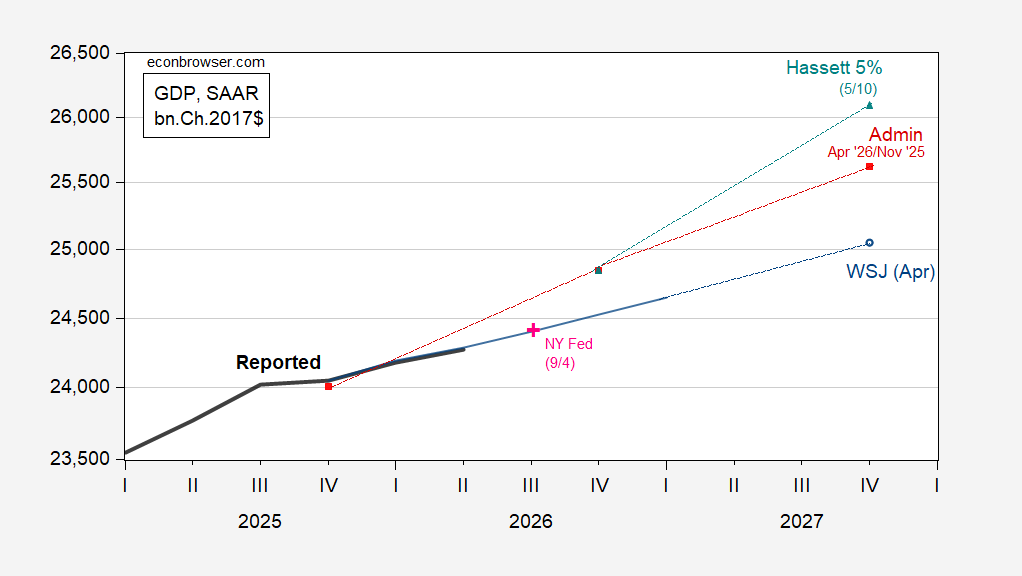
I set out to see what the Administration's Mid-Session Review economic forecast looked like. Alas, courtesy of Jared Bernstein, I am disappointed. Did Vought et al. purge all the economists from the CEA, Treasury, and OMB?
For readers unfamiliar with the document: the Mid-Session Review is the statutory update to the economic assumptions underpinning the President's budget, typically released in the summer, and it is produced by the "Troika" — the Council of Economic Advisers, Treasury, and OMB — whose growth, inflation, and interest-rate forecasts cascade into the budget's revenue and outlay projections. When an MSR omits or declines to update those economic assumptions, Congress, outside analysts, and markets lose a routine window into how the Administration itself views the economic outlook.
The MSR:
We'll have to take it that the Administration's forecast is therefore the same as those released in April (which were finalized in November 2025). I reprise from this August post, modified to add in today's NY Fed nowcast:
Figure 1: Reported GDP (bold black), Administration's FY2027 Budget forecast, aka OMB-Treasury-CEA "Troika" (red squares), WSJ April survey mean (blue), SPF median forecast (pink), Hassett 5% growth in 2027 (teal triangle). Source: BEA, WSJ April survey, Philadelphia Fed, and author's calculations.
Given reported GDP growth and the NY Fed nowcast, the economy is tracking more closely with the April WSJ mean forecast than with the Administration's forecast.
