Microsoft Calendar Q2 2026 Earnings: AI Cloud Strength Resets the MSFT Stock Debate
Key Takeaways
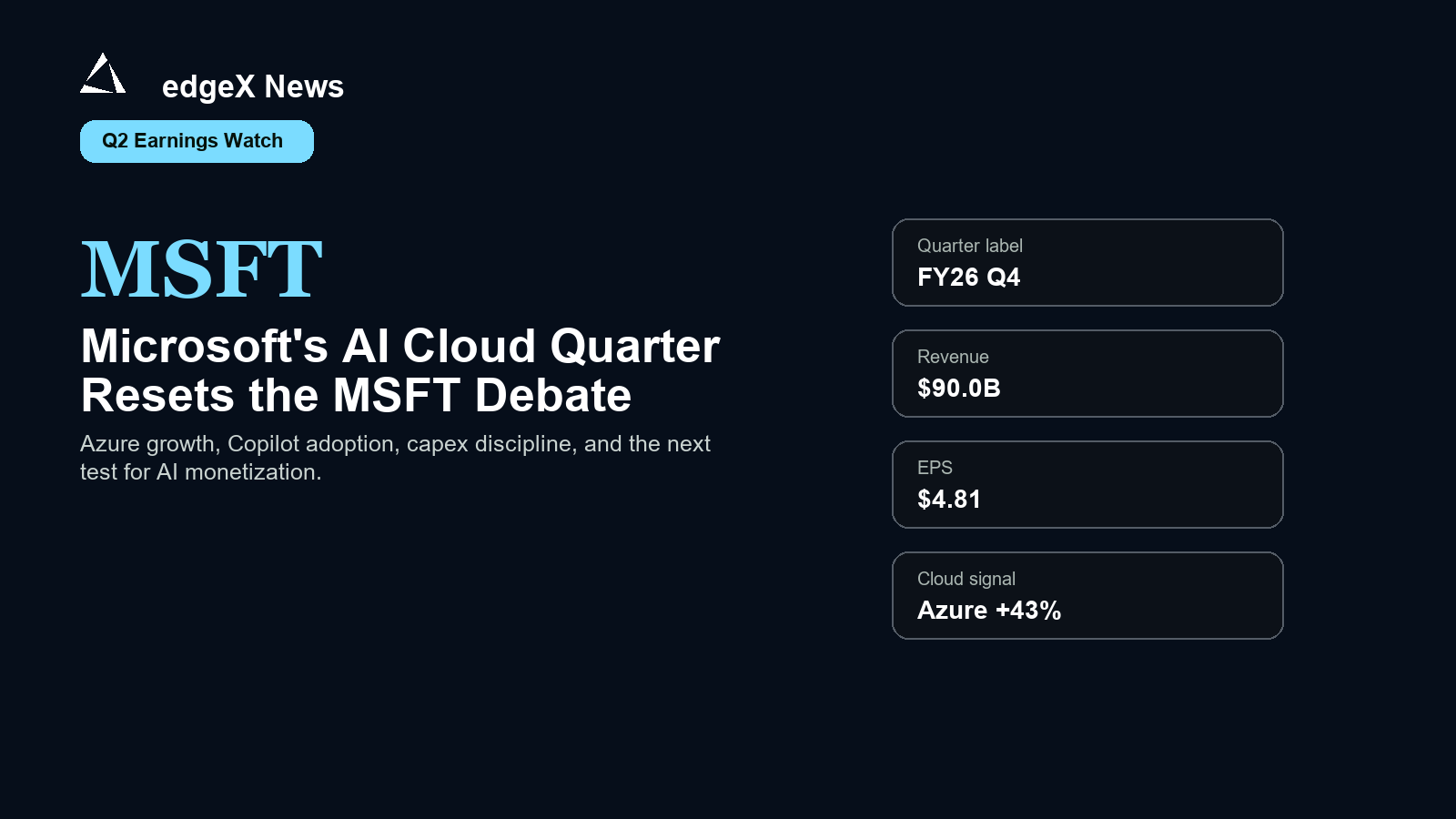
- •Microsoft reported approximately $90 billion in revenue and $4.81 diluted EPS for the quarter ended June 30, 2026, exceeding market expectations.
- •Azure and cloud services revenue grew 43% year over year, marking the strongest indicator that AI infrastructure spending is producing tangible customer demand.
- •Microsoft's quarterly capital expenditure reached approximately $41 billion, reflecting the scale of its data-center and AI buildout commitments.
- •The company's multibillion-dollar partnership with OpenAI positions Azure as the exclusive cloud provider for OpenAI workloads and gives Microsoft early access to GPT-class model integration across its product portfolio.
- •Investors shifted their focus from whether AI demand is genuine to whether that demand will prove durable and profitable enough at Microsoft's scale to justify sustained elevated capital expenditure.
Why This Earnings Report Matters Now
Microsoft's latest earnings did not arrive in a quiet market. By late July 2026, investors had become more selective about artificial intelligence spending. The easy phase of the AI trade - buying any company with a credible cloud or chip story - had already given way to a harder question: which companies can turn massive infrastructure investment into measurable revenue, margin, and cash flow?
The Numbers That Changed the Debate
That is why Microsoft's quarter ended June 30 matters. It is calendar Q2 2026, but Microsoft reports it as fiscal Q4 because its fiscal year ends in June. The distinction is important for accuracy, yet the investor question is simple: did Microsoft's AI and cloud engine continue to pull the company forward?
| Metric / Issue | Latest Reported Context | Investor Read |
|---|---|---|
| Reporting period | Quarter ended June 30, 2026 | Calendar Q2, Microsoft FY26 Q4 |
| Revenue | About $90.0 billion | Beat expectations and showed scale still growing |
| Diluted EPS | $4.81 | Profit growth remained strong despite AI spending |
| Microsoft Cloud | About $59.3 billion | Cloud remains the strategic center of the company |
| Azure and cloud services | Reported growth of 43% | Strongest proof that AI demand is converting into revenue |
| Capex | About $41 billion in the quarter | Still large, but investors want evidence of productive spending |
The table captures the central tension. Microsoft's quarter was strong enough to calm a market worried about AI cost inflation, but it also raised the stakes. A company spending tens of billions of dollars on infrastructure cannot be judged only on this quarter's revenue beat. It has to keep showing that Azure demand, Copilot adoption, and enterprise AI usage are turning capex into recurring economics.
The Investor Narrative After Earnings
The Microsoft story is no longer just software. It is becoming a capital-intensive cloud and AI infrastructure story wrapped inside one of the most profitable enterprise franchises in the world. That makes the stock harder to analyze. The old Microsoft could be judged mostly on subscription growth, operating leverage, and enterprise renewal cycles. The new Microsoft has to be judged on whether AI workloads produce enough growth to justify the size and speed of its data-center buildout.
That shift does not weaken the franchise, but it changes the valuation contract with investors. A mature software company gets rewarded for predictability. An AI infrastructure company gets rewarded for scale, but punished quickly if the market decides spending is running ahead of demand. Microsoft's advantage is that it can fund the buildout from a diversified earnings base. Its challenge is that investors can now compare every dollar of capex with visible Azure growth and ask whether returns are arriving fast enough.
What the market is really testing
The market is testing whether Microsoft can remain both an AI spender and an AI winner. Heavy capex is easier to tolerate when Azure growth accelerates, cloud revenue expands, and Copilot adoption moves from experiment to budget line. It becomes harder to defend if spending rises faster than utilization or if customers slow deployment after early pilots.
The quality of that demand matters. AI usage that comes from durable enterprise workloads is more valuable than demand pulled forward by trial budgets or one-off infrastructure bursts. Investors should listen for signs that customers are embedding AI into daily workflows, not only testing it at the edge of their software budgets.
What could change the next quarter
The next quarter will be about quality of growth. Investors should watch Azure growth, commercial bookings, remaining performance obligations, cloud gross margin, Copilot paid-seat adoption, and any change in capex guidance. A strong headline quarter is useful. A strong backlog and clear AI monetization path are more valuable.
The other issue is mix. If AI demand lifts high-margin software and cloud consumption together, Microsoft can defend its premium valuation. If demand is concentrated in infrastructure-heavy workloads with lower near-term margins, the market may still like the growth but debate the multiple. That is the subtle point in the post-earnings setup: the company does not only need AI revenue. It needs AI revenue that looks like Microsoft revenue.
Stock Reaction: Momentum Is Useful, But Not the Whole Story
Microsoft's post-earnings reaction was positive because the report answered the market's biggest near-term fear: that AI spending was outrunning demand. But momentum should not be confused with a finished debate. A stock can rally on proof that the story is working and still face a higher bar next quarter. For MSFT, the bar is not simply revenue growth. It is profitable AI scale.
That is why the report is best read as a reset rather than a conclusion. It moved the burden of proof from "is AI demand real?" to "how durable and profitable is AI demand at Microsoft's scale?" That is a better problem to have, but it is still a problem investors will keep measuring every quarter.
The Bull Case, the Bear Case, and the Middle Path
The bull case is straightforward: Microsoft has one of the cleanest paths to monetizing enterprise AI because it controls the software layer, the cloud layer, the developer platform, and a deep commercial distribution channel. If Azure continues to grow at elevated rates and Copilot becomes a normal part of enterprise seat expansion, the company can argue that AI is not a speculative add-on. It is the next layer of the Microsoft stack.
The bear case is not that Microsoft lacks demand. It is that the cost of meeting that demand could become heavier than investors currently expect. Data centers require land, power, GPUs, networking equipment, cooling, and long lead times. If returns arrive slowly, the market may begin to treat the buildout less like high-return software investment and more like infrastructure spending with a lower margin profile.
The middle path is probably the most realistic near-term setup. Microsoft can remain one of the strongest AI beneficiaries in public markets while still facing quarter-to-quarter arguments about capex intensity. For long-term investors, that means the stock is not simply a bet on AI enthusiasm. It is a bet on Microsoft's ability to turn AI enthusiasm into enterprise budgets, cloud consumption, and recurring software economics.
Valuation Lens After the Report
Microsoft's valuation debate is no longer about whether the company deserves a premium to the average software business. It clearly does. The more relevant question is how large that premium should be when the business is shifting toward heavier infrastructure needs. A clean cloud-growth beat supports the multiple, but only if investors believe the AI buildout is creating future revenue streams rather than pulling forward costs.
That is why the market will probably use Azure as the shorthand valuation signal. If Azure growth stays strong while margins remain healthy, investors can justify treating Microsoft's AI spending as a high-return growth investment. If Azure slows while capex remains elevated, the same spending could become a drag on sentiment. The stock therefore sits in a more demanding valuation zone: it has the quality of a compounder, but the market is increasingly asking it to prove the economics of a hyperscale AI platform.
What Investors Should Watch Next
The most important watch items are Azure growth durability, Copilot conversion, capex-to-revenue efficiency, cash-flow resilience, and enterprise software margins. Investors should also follow broader AI infrastructure sentiment. If hyperscaler capex is treated as productive investment, Microsoft can benefit. If the market starts treating AI infrastructure as overbuilding, even strong companies can face valuation pressure.
Investors should also watch how Microsoft talks about supply constraints. When demand is strong, capacity limits can support the bull case because they imply more revenue once capacity arrives. When sentiment weakens, the same constraints can sound like a warning about heavy spending and execution risk. The language around data centers, GPUs, power availability, and customer demand will therefore matter almost as much as the next reported Azure growth number.
Risk Map for the Next Trading Window
The immediate risk is not a collapse in Microsoft's business quality. It is expectation risk. After a strong quarter, investors may begin treating elevated Azure growth and expanding AI contribution as the new baseline. That can make even good results feel less impressive if the next report shows normalization. The second risk is capex fatigue. Markets can support heavy spending when the payoff is visible, but they can become impatient if management keeps asking for trust without clearer return metrics.
There is also platform risk. Microsoft depends on enterprise adoption, cloud workload migration, developer engagement, and partner ecosystems moving in the same direction. A slowdown in any one channel would not break the company, but it could change the narrative from synchronized AI adoption to uneven deployment. For a premium stock, that difference matters.
Trade Microsoft Stocks Perpetual Futures on edgeX
TradFi is going on-chain. edgeX now lets traders access Microsoft stock perpetual futures on a fully decentralized exchange - no account verification, no centralized custodian, and no compromise on performance.
The DEX Advantage for Stock Traders
Most traders who want exposure to stocks are still pushed toward TradFi platforms: brokerage accounts, KYC requirements, and limited trading hours. edgeX breaks that mold. Built on the EDGE chain and settled on Ethereum via Arbitrum, edgeX combines on-chain infrastructure with institutional-grade execution speed of up to 200,000 orders per second and sub-10ms matching latency.
Self-custody is built into every trade. Assets remain under the user's control, backed by private keys the user holds. USDC on the platform is designed around 1:1 dollar redemption, with Circle Ventures among the platform's backers.
Trade MSFT Perpetuals with an Edge
Microsoft stock perpetual futures on edgeX offer up to 10x leverage, giving traders meaningful exposure without locking up excessive capital. Liquidity is deep: $10 million within a 1 basis point spread, with sub-0.1 basis point slippage on trades over $0.1 million.
Through the current TradFi Trading Season promotion, traders can earn 110% fee rebates plus a share of a 200,000 USDC prize pool.
Why edgeX Stands Out
The case for decentralized exchange trading is straightforward: no KYC friction, full self-custody, deep liquidity, high leverage, and trading fee rewards returned to the community. For anyone seeking exposure to blue-chip stocks like MSFT without the constraints of traditional finance, edgeX offers a different route to express a market view.
Frequently Asked Questions
Is this a calendar Q2 2026 earnings article?
Yes, but with a fiscal-calendar note. The quarter ended June 30, 2026 falls in calendar Q2, while Microsoft reports it as fiscal Q4 2026.
What is the most important number in the report?
Azure and cloud growth matter most because they show whether Microsoft's AI infrastructure spending is translating into customer demand. Revenue and EPS matter, but the cloud signal drives the forward valuation debate.
Should readers treat the latest share price in this article as live market data?
No. This article does not state a live stock price. Readers should verify the current share price through Nasdaq, NYSE, a broker, or a real-time market-data page before making any trading decision.
How does edgeX fit into this earnings story?
edgeX gives traders a 24/7 perpetual futures venue for expressing a view on selected stock-linked markets without using a traditional brokerage account. The trading product is different from owning common shares, so readers should understand leverage, funding, liquidation, and custody mechanics before trading.

