Microsoft launches Execution Containers to limit what AI agents can access on Windows 11
Key Takeaways
- •Microsoft Execution Containers (MXC), which restricts the files and networks an AI agent can reach under Windows' enforcement, has reached general availability on Windows 11.
- •Microsoft's approach to agent security is built on three pillars: containment, identity tracking of agent activity, and manageability through Agent 365 and Intune.
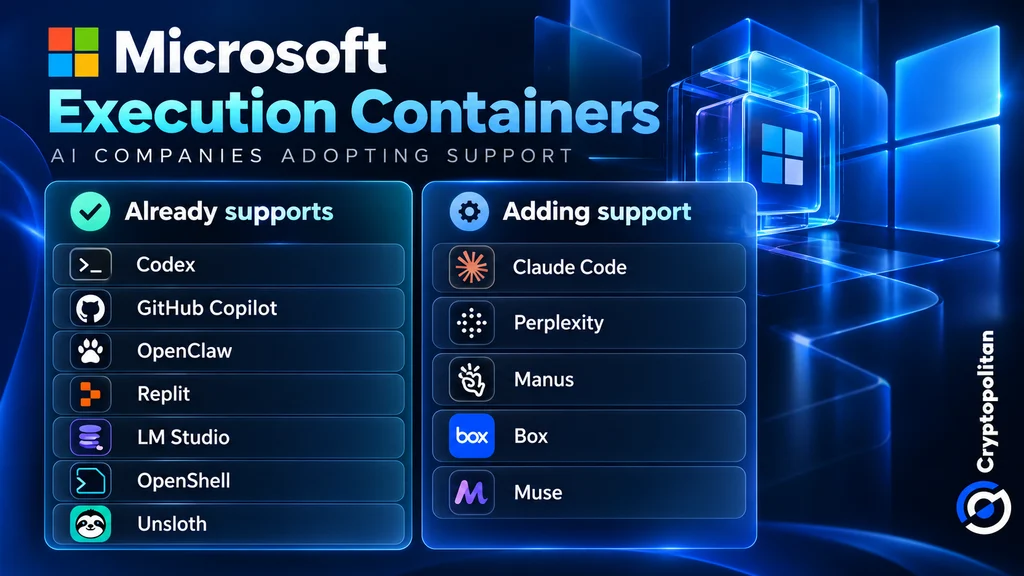
- •Codex, GitHub Copilot, OpenClaw, Replit, LM Studio, OpenShell, and Unsloth AI currently support MXC, while Claude Code, Perplexity, Manus, and Box are working to add support and Meta plans a native Windows version of Muse.
- •Microsoft shrank its MAI Code 1.1 Flash model by nearly 80% for local use while keeping a 256,000-token context window, part of an effort to cut cloud token costs for businesses.
- •The Surface Laptop Ultra, powered by Nvidia's RTX Spark chip with 128 GB of memory, will be purchasable for $2,599 starting October 16.
Microsoft used a Wednesday event in San Francisco to lay out its case for running AI agents under Windows' own security controls rather than relying on the cloud. The company announced that Microsoft Execution Containers (MXC), its technology for limiting what agents can access and do, is now generally available on Windows 11, giving businesses a direct way to fence in autonomous software. General availability is the operational milestone here: containment can move into production deployments now rather than sitting on a roadmap. In Microsoft's framing, the PC — not a remote data center — becomes the enforcement point for agent security.
MXC anchors Windows Intelligence, Microsoft's strategy for distributing AI workloads between local PCs and the cloud while keeping critical data secure and under corporate control.
Why Microsoft says today's agents are unsafe
Microsoft executive Pavan Davuluri warned that PC agents are "fundamentally insecure because they have broad system access," according to GeekWire. Unlike conventional applications, agents can read files, execute instructions, and operate autonomously without requiring constant human supervision.
Microsoft's response rests on three pillars: containment, which restricts what an agent can reach; identity, which keeps track of agent activity; and manageability, which places oversight in the hands of Agent 365 and Intune. That last pillar leans on tooling IT departments already know — Intune is Microsoft's endpoint-management platform — so agent oversight lands inside existing administrative workflows rather than beside them.
What Execution Containers actually restrict
MXC lets companies determine which files and networks an AI agent can access, and Windows enforces those limits on the agent even when it attempts to exceed its permitted access.
The platform provides several tiers of security, including the ability to isolate separate processes or sessions and to run agents through virtual machines or Windows 365 for Agents. Although the technology is not exclusive to Windows systems, Microsoft believes embedding MXC in the operating system gives companies greater authority over agent activity.
Support is already broad. Microsoft said Codex, GitHub Copilot, OpenClaw, Replit, LM Studio, OpenShell, and Unsloth AI currently support MXC. Claude Code, Perplexity, Manus, and Box are working to add support, and Meta plans to bring Muse to Windows as a native app. The pending integrations are the ones to watch, since third-party adoption will indicate whether MXC becomes a common boundary for agents on Windows or remains tied mostly to Microsoft's own ecosystem.
More companies on board does not automatically make AI agents safer, however. What matters is how well these controls perform in practice.
Where the cloud economics come in
Microsoft also aims to lower cloud computing costs for businesses. Handling suitable AI tasks locally could trim token expenses while letting cloud models absorb the heavier workloads. CEO Satya Nadella has described the goal as "unmetered intelligence to every desk and every home," as GeekWire reported.
Toward that end, Microsoft reduced the size of its MAI Code 1.1 Flash model by nearly 80% for local use while preserving a context window of 256,000 tokens.
The company has also spent on hardware capable of local AI operations. The Surface Laptop Ultra, which runs on Nvidia's RTX Spark chip with 128 GB of memory, can be purchased for $2,599 starting October 16. Memory is a practical ceiling for local AI, since a model has to fit on the machine to run there.
Running AI locally still carries costs, though. Companies must pay for hardware, electricity, and maintenance, as Lenovo's 2026 total-cost-of-ownership analysis of on-premise versus cloud generative AI shows. Whether a business achieves savings will depend on how much cloud computing it can displace.
The Recall shadow over local AI
Microsoft continues to face privacy concerns stemming from Recall, its controversial screenshot-based feature that was delayed after security criticism and later released as opt-in. This time, Microsoft says Copilot will access files and recent activity only with permission.
The Verge reports that Copilot will handle more local tasks, with hybrid features reaching Copilot+ PCs over the coming months. Copilot+ PCs are the Windows machines designed around on-device AI hardware.
The real test is whether Windows can make AI agents genuinely useful without giving them more access than users intended.

