Micron Fiscal Q3 2026 Earnings: MU Stock Rides the AI Memory Supercycle
Key Takeaways
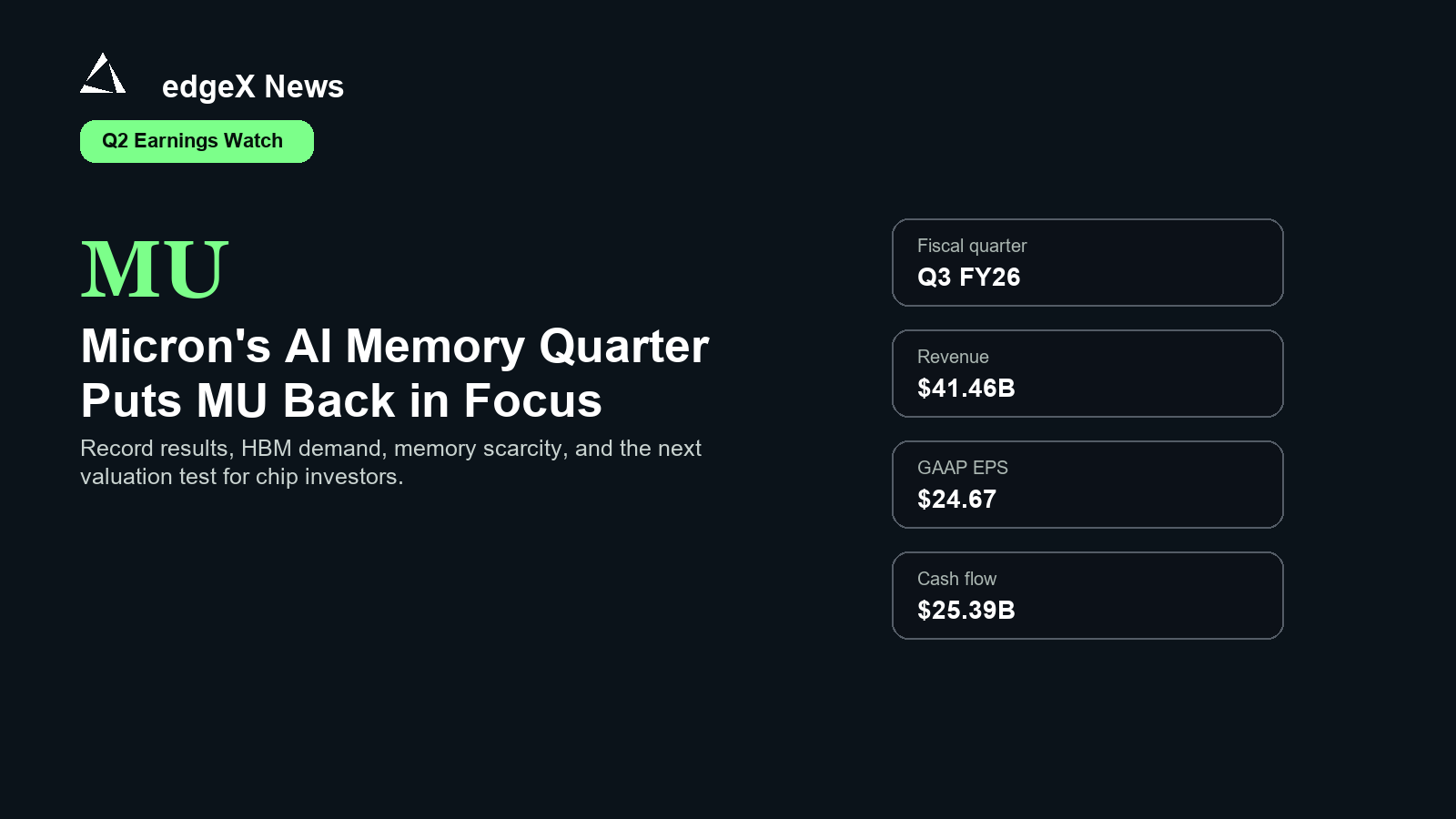
- •Micron's fiscal Q3 2026 revenue reached $41.46 billion, a sharp increase from $23.86 billion in the prior quarter and $9.30 billion in the year-ago period.
- •GAAP net income totaled $28.24 billion with diluted EPS of $24.67, while operating cash flow reached $25.39 billion for the quarter ended May 28.
- •High-bandwidth memory has emerged as a strategic input for AI accelerators, reframing memory supply as an integral layer of AI infrastructure rather than a generic commodity component.
- •Investors are debating whether Micron's record results represent a structural earnings reset driven by AI demand or a cyclical peak that could revert to traditional memory-industry downturn patterns.
- •Key risks include competitive positioning against SK Hynix and Samsung in HBM, hyperscaler customer concentration, and the potential for oversupply to compress pricing even if underlying AI demand remains healthy.
Why This Earnings Report Matters Now
Micron's earnings sit at the center of one of the most important questions in semiconductors: is memory still a cyclical commodity market, or has AI infrastructure created a structurally tighter and more profitable phase? The company's fiscal Q3 report did not end that debate, but it gave investors a strong piece of evidence.
The Numbers That Changed the Debate
Micron reported fiscal Q3 2026 results on June 24 for the quarter ended May 28. The numbers were striking. Revenue reached $41.46 billion, compared with $23.86 billion in the prior quarter and $9.30 billion in the year-ago period. GAAP net income was $28.24 billion, or $24.67 per diluted share, while operating cash flow reached $25.39 billion.
| Metric / Issue | Fiscal Q3 2026 Context | Investor Read |
|---|---|---|
| Revenue | $41.46 billion | Record scale and sharp sequential growth |
| GAAP net income | $28.24 billion | Memory profitability surged with AI-linked demand |
| GAAP diluted EPS | $24.67 | Earnings power expanded dramatically |
| Operating cash flow | $25.39 billion | Strong cash generation supports investment and balance-sheet flexibility |
| Strategic theme | Memory in the AI era | HBM and data-center demand drive the premium narrative |
| Market backdrop | Chip-stock volatility in late July | Strong results still face valuation and sentiment risk |
The table explains why MU is no longer a simple downturn-recovery story. Micron's reported numbers suggest the cycle has moved far beyond stabilization. But semiconductor investors do not only reward what has already happened. They pay for the durability of demand, the scarcity of supply, and the confidence that customers will keep absorbing premium memory at attractive margins.
The Investor Narrative After Earnings
The bull case for Micron is that AI has changed the memory hierarchy. DRAM and NAND have always mattered, but high-bandwidth memory is increasingly viewed as a strategic input for AI accelerators. That makes memory supply less like a generic component cycle and more like part of the AI infrastructure stack.
This distinction is critical. Traditional memory investors usually worry about oversupply, price erosion, and inventory digestion. AI-memory investors care about qualification, packaging, bandwidth, power efficiency, and whether customers can secure enough supply for multi-year accelerator road maps. Micron sits across both worlds, which makes the stock powerful but also difficult to underwrite.
What the market is really testing
The market is testing whether Micron can sustain record-like economics. Strong HBM demand can tighten supply, lift average selling prices, and improve margins. But memory has a long history of cycles. If supply expands too aggressively or AI demand pauses, investors may quickly reprice the stock. That tension is why MU can rally on strong results and still remain volatile.
The most important question is whether this cycle behaves differently from prior cycles. If AI demand absorbs new supply and keeps premium products scarce, Micron can look less cyclical than it used to. If supply catches up quickly or customers slow AI infrastructure orders, the market may decide the supercycle narrative moved too far too fast.
What could change the next quarter
The next quarter should be judged on guidance quality, HBM supply commitments, data-center revenue, gross margin durability, capex discipline, and signs of inventory behavior across customers. Investors should also track commentary from Samsung and SK Hynix because memory pricing is an industry structure story, not a Micron-only story.
Customer concentration is another watch item. AI demand can be extremely valuable when the largest buyers are competing for constrained supply, but it can also make results sensitive to the purchasing cadence of a small group of hyperscalers and accelerator platforms. The better the visibility on commitments, the more durable the valuation case becomes.
Stock Reaction: Momentum Is Useful, But Not the Whole Story
Micron's late-July market action was shaped by both company fundamentals and broader semiconductor sentiment. Reports showed chip stocks rebounding after strong Microsoft AI-cloud earnings and Samsung's memory commentary, but the group had also been under pressure earlier in the month. That is the point: MU is trading inside a high-conviction but crowded AI-memory theme.
Crowded themes can be rewarding and unforgiving at the same time. When the data support the thesis, buyers can move quickly because the narrative is already familiar. When the data disappoint, exits can become just as fast because many investors own the same idea. Micron's strong quarter improves the fundamental case, but it does not remove that positioning risk.
The Bull Case, the Bear Case, and the Middle Path
The bull case is that Micron is moving from cyclical recovery into a higher-quality memory cycle led by AI infrastructure. If HBM remains supply constrained and data-center demand keeps expanding, Micron can earn stronger margins for longer than investors usually associate with memory. Record revenue and cash flow would then be evidence of a structural reset, not just a peak-cycle snapshot.
The bear case is that memory has fooled investors before. Strong pricing invites supply. Strong margins encourage capacity additions. Customers can over-order when supply is tight and then digest inventory later. If AI demand slows or supply catches up faster than expected, the market may quickly return to the old memory-cycle playbook and compress MU's multiple.
The middle path is that Micron deserves more credit than a traditional commodity-memory stock but not unlimited credit as an AI pure play. The company is benefiting from a powerful demand wave, yet it still operates in an industry where timing, capacity, and customer ordering patterns matter. That makes guidance and industry supply discipline just as important as the latest reported profit number.
Valuation Lens After the Report
Micron's valuation now depends on whether investors believe the memory cycle has structurally improved. In an ordinary upcycle, a record quarter can be dangerous because the market starts looking for the peak. In an AI-led memory cycle, a record quarter can be treated as proof that the earnings base has reset higher. The difference between those two interpretations is enormous for MU.
The market will look for evidence that HBM and data-center memory are changing the company's margin profile. If premium products remain supply constrained and customers commit to longer-term demand, Micron may deserve a stronger multiple than past cycles. If results look more like a classic pricing spike, investors may hesitate to capitalize peak earnings too generously. That is why the next guidance update matters almost as much as the record numbers already reported.
What Investors Should Watch Next
Watch HBM revenue growth, data-center customer commitments, DRAM pricing, NAND stabilization, cash-flow conversion, and whether AI capex from hyperscalers continues to support memory demand. The risk is not that Micron had a weak quarter. It did not. The risk is that investors demand every future quarter to look like a supercycle quarter.
That is why guidance matters as much as reported results. A record quarter tells investors the cycle has turned. A credible forward outlook tells them whether the turn can persist. For MU, the market will reward evidence that AI memory is not only lifting one period's earnings, but changing the quality and duration of the company's profit base.
Risk Map for the Next Trading Window
Micron's biggest risk is the old memory problem returning under a new AI label. If industry supply expands too quickly, pricing can weaken even when end demand remains healthy. A second risk is customer timing. Hyperscalers can spend aggressively for several quarters and then pause to digest capacity. That would not necessarily end the AI story, but it could create a painful reset for memory names.
A third risk is comparison. Investors will measure Micron against SK Hynix and Samsung, especially in HBM. If competitors appear better positioned in qualification, volume commitments, or customer mix, MU may not receive full credit for strong industry demand. The best outcome is not just a strong memory market. It is a strong memory market in which Micron proves it can capture the most valuable parts of demand.
There is also macro risk. Memory demand is increasingly tied to AI infrastructure, but Micron still sells into broader electronics, enterprise, and consumer channels. If global growth slows or hardware demand weakens outside AI, investors may become less willing to pay for a pure supercycle narrative. MU needs AI strength to dominate the story, but it also benefits when the rest of the memory market is not deteriorating underneath it. That balance will shape how investors read the next update.
Trade Micron Technology Stocks Perpetual Futures on edgeX
TradFi is going on-chain. edgeX now lets traders access Micron Technology stock perpetual futures on a fully decentralized exchange - no account verification, no centralized custodian, and no compromise on performance.
The DEX Advantage for Stock Traders
Most traders who want exposure to stocks are still pushed toward TradFi platforms: brokerage accounts, KYC requirements, and limited trading hours. edgeX breaks that mold. Built on the EDGE chain and settled on Ethereum via Arbitrum, edgeX combines on-chain infrastructure with institutional-grade execution speed of up to 200,000 orders per second and sub-10ms matching latency.
Self-custody is built into every trade. Assets remain under the user's control, backed by private keys the user holds. USDC on the platform is designed around 1:1 dollar redemption, with Circle Ventures among the platform's backers.
Trade MU Perpetuals with an Edge
Micron Technology stock perpetual futures on edgeX offer up to 10x leverage, with a maximum position size of 280 MU, giving traders meaningful exposure without locking up excessive capital. Liquidity is ultra-deep: $10 million within a 1 basis point spread, with sub-0.1 basis point slippage on trades over $0.1 million.
Through the current TradFi Trading Season promotion, traders can earn 110% fee rebates plus a share of a 200,000 USDC prize pool.
Why edgeX Stands Out
The case for decentralized exchange trading is straightforward: no KYC friction, full self-custody, deep liquidity, high leverage, and trading fee rewards returned to the community. For anyone seeking exposure to high-profile stocks like MU without the constraints of traditional finance, edgeX offers a different route to express a market view.
Frequently Asked Questions
Is this a calendar Q2 2026 earnings article?
It is not named calendar Q2 by Micron. Micron's latest official release is fiscal Q3 2026 for the quarter ended May 28, 2026. It is relevant to calendar-Q2 earnings coverage because the reporting period sits inside the Q2 market window.
What is the most important number in the report?
Revenue and operating cash flow are the cleanest headline numbers, but HBM and data-center demand are the most important strategic signals for valuation.
Should readers treat the latest share price in this article as live market data?
No. This article does not state a live stock price. Readers should verify the current share price through Nasdaq, NYSE, a broker, or a real-time market-data page before making any trading decision.
How does edgeX fit into this earnings story?
edgeX gives traders a 24/7 perpetual futures venue for expressing a view on selected stock-linked markets without using a traditional brokerage account. The trading product is different from owning common shares, so readers should understand leverage, funding, liquidation, and custody mechanics before trading.

