Commentary: Loyalty Attacks and a One-Sided 'Patriotism' Test in Michigan's Senate Race
Key Takeaways
- •Republican former Rep. Mike Rogers and surrogates including Donald Trump and Sen. John Kennedy have attacked Democratic Michigan Senate nominee Abdul El-Sayed, a Muslim American physician, as a "jihadist" and questioned whether he supports America or terrorist groups.
- •El-Sayed has repeatedly denied and disavowed any affiliation with the Muslim Brotherhood, and no evidence has been produced to substantiate such ties.
- •Michigan is home to one of the largest Arab American and Muslim communities in the United States, and some Jewish Democrats in the state say they are torn about supporting El-Sayed despite his stated commitment to the safety of Jews.
- •If elected, El-Sayed would become the first Muslim to serve in the United States Senate, a milestone that has pushed questions of identity and loyalty to the center of the race.
- •The author contends the patriotism attacks cut only one way, citing Trump's dealings with Putin, Jared Kushner's Middle East business ties, and administration conduct, while the November midterm vote will reveal how the attacks land with Michigan's Arab American, Jewish, and younger voters.
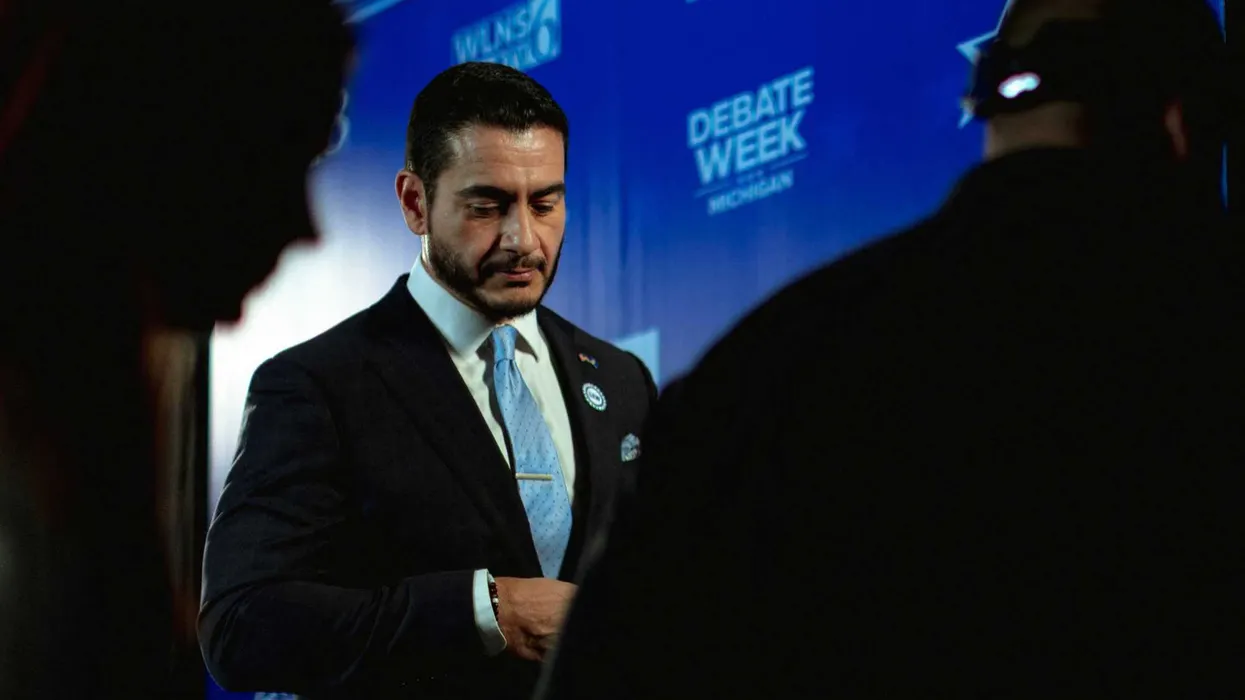
Amid all the campaign nastiness, it has apparently been deemed acceptable in Michigan's Senate race for former Rep. Mike Rogers, the Republican, and his supporters to challenge the “patriotism” of Democrat Abdul El-Sayed, who proudly identifies as Muslim and is an outspoken opponent of the Israeli government. The contest, playing out in a perennial swing state ahead of a midterm vote that will help determine control of the Senate, has drawn national surrogates and national attention.
Rogers and visiting boosters — including Donald Trump and Sen. John Kennedy of Louisiana — have actively attacked El-Sayed as a “jihadist.” Rogers used the debate stage to put a blunt, fundamental question to El-Sayed, an American citizen and physician with whom there are plenty of other policy disagreements: “Are you for America, or are you for these terrorist groups overseas?”
Rogers and El-Sayed obviously dislike each other, but reaching into the political beliefs of El-Sayed's estranged mother, who abandoned him at age 3, strikes many as beyond the pale. Rogers has repeatedly tried to tie El-Sayed to overseas Islamic groups, playing on his ethnicity and his outspoken advocacy on behalf of Palestinian rights. The setting sharpens the stakes: Michigan is home to one of the largest Arab American and Muslim communities in the United States, so the framing of this contest speaks directly to a significant share of the state's own electorate.
Some Jewish Democrats in Michigan — as happened in the New York City election that elevated Mayor Zohran Mamdani — say they are torn about supporting El-Sayed, despite his statements of commitment to the safety of Jews in the United States. Israeli government policy has, after all, become conflated with perceptions of antisemitism globally. El-Sayed has repeatedly denied any ties to the Muslim Brotherhood and has disavowed the organization. No evidence has been produced to show he has ever had any affiliation with it.
Yet the attempt to tag El-Sayed with “dual loyalties” makes many people uncomfortable — an effort that El-Sayed himself argues recalls the attempts to tie John F. Kennedy, as a presidential candidate, to papal loyalty rather than American policy. Where is the right to hold an opinion, however justified or not, that departs from what is perceived as the norm? Growing popular support for a different approach to Middle East politics, particularly among younger Americans, makes Rogers's argument factually odd. As with Mamdani and other progressive Democrats, there is a wide array of substantive disagreements with the Trump administration to which Rogers pleads total loyalty — from tax cuts to tariffs to the war with Iran — none of which requires resorting to ethnic stereotypes. If elected, El-Sayed would become the first Muslim to serve in the United States Senate, a milestone that helps explain why questions of identity and loyalty have moved to the center of the race.
What about patriotism?
The patriotism issue is strange, and it seems to cut only one way for the Republicans who control every branch of government.
Trump is making business deals with Russia's Vladimir Putin even as Putin continues to kill civilians of Ukraine — a supposed American ally — in a land-grab war, and as U.S. intelligence says Putin is helping Iran target U.S. military service members stationed near Iran. What could be more questionable for “patriotism” than aiding those who would attack U.S. interests in the name of a Trump foreign policy based on splitting the world into spheres of interest?
Yet another book has been excerpted in Vanity Fair, with documentation showing years of reliance on U.S. foreign policy by Trump son-in-law Jared Kushner, who was doing billion-dollar deals with Saudi and other Middle Eastern leaders with whom Washington was supposedly seeking peace plans. Kushner's partner in those negotiations, Steve Witkoff — himself a Trump business partner — publicly called Putin a “humanitarian” for the release of a U.S. kidnap victim of a state-sponsored abduction, held and tortured for more than four years.
Trump has openly admired the tactics of global strongmen such as Hungarian leader Viktor Orbán, North Korea's Kim Jong Un and China's Xi Jinping — along with the press restraints, the neutering of Congress and the defiance of judges that follow their patterns. Mass deportation campaigns have overrun legal and humanitarian restraint, producing the arrest, capture, deportation and even death of U.S. citizens who raised a voice in protest. There are refusals to follow court orders and a patently politicized Justice Department pursuing Trump's enemies.
Even in the Iran war, the government has refused to acknowledge U.S. casualties while publicly insisting that the military serve as a hub for cultural warfare rather than as an organization capable of protecting even its own military families at the Bahrain naval base — or of feeding and supplying the sailors and Marines aboard the aircraft carrier Abraham Lincoln.
The polls — and, shortly, the midterm vote — are yelling that voters see Trump caring about Trump rather than about the country. How the attacks land with Michigan voters — the state's sizable Arab American community, its Jewish Democrats, and the younger voters shifting on Middle East policy — is among the questions the November ballot will help answer.
Where exactly is this “patriotism” line Rogers wants to draw only for a candidate who happens to be Muslim and believes Palestinians should not be crushed?
Terry H. Schwadron retired as a senior editor at The New York Times, served as Deputy Managing Editor at the Los Angeles Times and held leadership positions at The Providence (RI) Journal-Bulletin. He was part of a Pulitzer Gold Medal team in Los Angeles, and his team shared in several Pulitzers in New York.

