University of Michigan Consumer Sentiment Down Again as Preliminary Reading Misses Forecast
Key Takeaways
- •The University of Michigan's preliminary consumer sentiment index registered 46.3, falling short of the 47.5 consensus forecast compiled by Bloomberg.
- •Within the report, the expectations component came in above consensus while the current conditions component landed below it.
- •The October reading sits well below the index's long-run historical average, and because consumer spending accounts for roughly two-thirds of US GDP, economists and policymakers watch such deviations closely.
- •Econbrowser standardized the Michigan, Conference Board, and Gallup confidence series over January 2021 through February 2025 and applied the Cummings and Tedeschi (2024) adjustment for online interviews, noting the picture looks somewhat worse without it.
- •The final October sentiment reading is scheduled for release at the end of the month, with the Conference Board's index providing a separate checkpoint on household confidence.
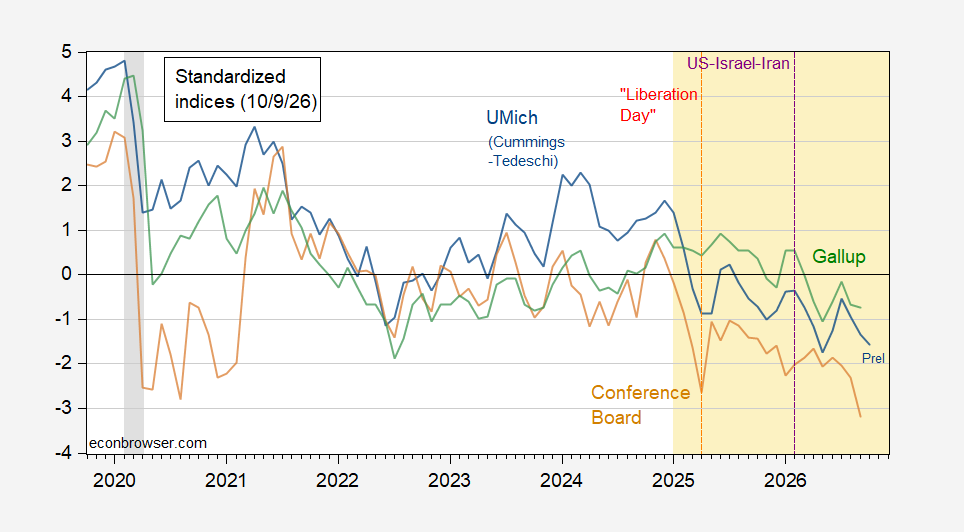
The University of Michigan's preliminary consumer sentiment index came in at 46.3, falling short of the 47.5 consensus forecast compiled by Bloomberg. Within the report, the expectations component landed above consensus, while the current conditions component came in below.
The figures were flagged in an Econbrowser post, "U.Mich. Sentiment Down (Again)", which places the reading in context alongside other widely followed consumer confidence gauges.
A Measure Far Below Historical Norms
Produced monthly by the University of Michigan's Surveys of Consumers, the index tracks households' assessments of their personal finances, general business conditions, and buying conditions. It comprises two subindices — current economic conditions and consumer expectations. The expectations subindex is also one of the components of the Conference Board's Leading Economic Index, a composite designed to flag turning points in the US business cycle. Preliminary estimates are released in the middle of the month based on the first round of survey responses, with final figures following at month's end. At 46.3, the preliminary October reading sits well below the index's long-run historical average. Because consumer spending accounts for roughly two-thirds of US gross domestic product, deviations from that norm are watched closely by economists and policymakers.
A Standardized Comparison Across Gauges
To put the indicators on a common footing, Econbrowser standardized each series by subtracting its mean and dividing by its standard deviation over the window from January 2021 through February 2025. The charted Michigan series incorporates the adjustment developed by Cummings and Tedeschi (2024), which accounts for the effect of online interviews on the survey results.
Figure 1 shows the adjusted University of Michigan sentiment series (blue), the Conference Board Confidence Index (brown), and Gallup Confidence (green), all demeaned and divided by their standard deviations over 2021M01–2025M02. A red dashed line marks the April 2025 "Liberation Day" tariff announcement, and a purple dashed line marks the US-Iran war.
The author notes that if the Michigan series is not adjusted, the picture looks a bit worse. Figure 2 — labeled "Figure 21" in the original post — repeats the comparison using the unadjusted University of Michigan series (blue), the Conference Board Confidence Index (brown), and Gallup Confidence (green), with the same standardization window and the same event markers.
The final October sentiment reading is due at the end of the month, in line with the survey's standard release calendar. The Conference Board's index, based on its own monthly household survey, offers a separate checkpoint on household confidence to watch alongside it.
Source: University of Michigan, Gallup, Conference Board, Cummings and Tedeschi (2024), and the author's calculations.

