Mexico Targets Lower U.S. Gas Imports With Infrastructure and Unconventional Resources
Key Takeaways
- •Mexico is seeking to cut U.S. natural gas imports by strengthening infrastructure and developing unconventional resources.
- •U.S. pipeline gas imports into Mexico are currently above 8 Bcf/d.
- •The government’s plan includes construction of 13 gas-fired power plants.
- •Pipeline expansion is expected to focus in part on the Yucatán region.
- •The effort is intended to strengthen domestic energy supply and reduce exposure to imported gas flows from the United States.
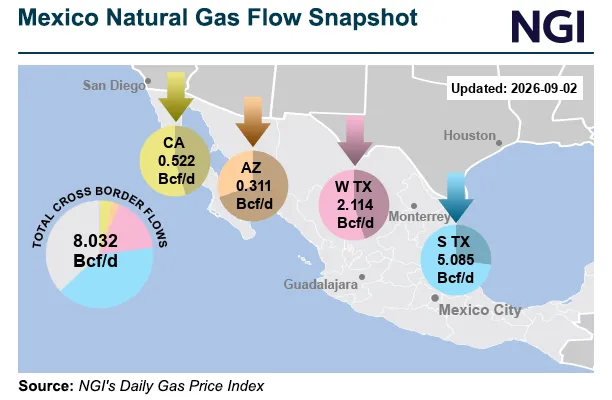
President Claudia Sheinbaum said in her state of the union address Tuesday that Mexico is targeting a reduction in U.S. natural gas imports by strengthening infrastructure and developing unconventional resources.
At a glance
- U.S. pipeline imports top 8 Bcf/d
- Mexico plans 13 gas-fired plants
- Pipeline buildout targets the Yucatán
Mexico continues to rely heavily on U.S. pipeline gas, with imports topping 8 Bcf/d. Sheinbaum’s remarks pointed to a strategy centered on expanding infrastructure and tapping unconventional resource potential to narrow that dependence, highlighting how central gas supply remains to the country’s power system and broader energy planning.
The government’s plans also include 13 gas-fired power plants, according to the outline presented in the address. That buildout would reinforce gas’s role in meeting electricity demand, while pipeline expansion is expected to focus in part on the Yucatán region, which remains a key area in the country’s broader gas and power supply strategy.
The effort comes as Mexico seeks to strengthen domestic energy supply and reduce exposure to imported gas flows from the United States, with any progress likely to depend on how quickly new infrastructure and upstream development can be advanced.
Related tags
Burgos Basin, Fertilizer, Mexico, Pemex, Power Demand, Sabinas-Burro Picachos, Sheinbaum, Tampico-Misantla, Yucatan Peninsula
Christopher Lenton
Christopher was promoted to Managing Editor, Mexico, in December 2024, having joined NGI as a Senior Editor for Mexico and Latin America in November 2018. Prior to that, he was a Senior Editorial Manager at BNamericas in Santiago, Chile. Based out of Santiago, he has covered Latin American energy markets since 2009 as a reporter, editor and analyst. He has an MA in International Economic Policy from Columbia University and a BA in International Studies from Trinity College.

