Two Men Sentenced to 15 Years After 700 Pounds of Meth Found Hidden in Cucumber Shipment
Key Takeaways
- •Andres Jasso Jr., 39, and Rufino Pineda-Perez, 61, each received 15-year federal prison sentences plus 10 years of supervised release for concealing over 700 pounds of methamphetamine in a cucumber shipment.
- •DEA agents arrested both men beside the trailer in Gainesville, Georgia, on June 30, 2025, after surveillance, finding thousands of wrapped methamphetamine packages hidden among 20 pallets of cucumber boxes.
- •Both defendants pleaded guilty on March 11 to conspiracy to possess methamphetamine with intent to distribute, and Pineda-Perez additionally pleaded guilty to illegal reentry after a prior deportation.
- •Pineda-Perez had prior drug convictions in 2001 and 2015, was deported twice, and is described as a Mexican citizen without legal U.S. status.
- •The case reflects a broader pattern of narcotics concealed in legitimate commercial cargo, underscoring the need for warehouse and transportation professionals to follow clear procedures for irregular shipments.
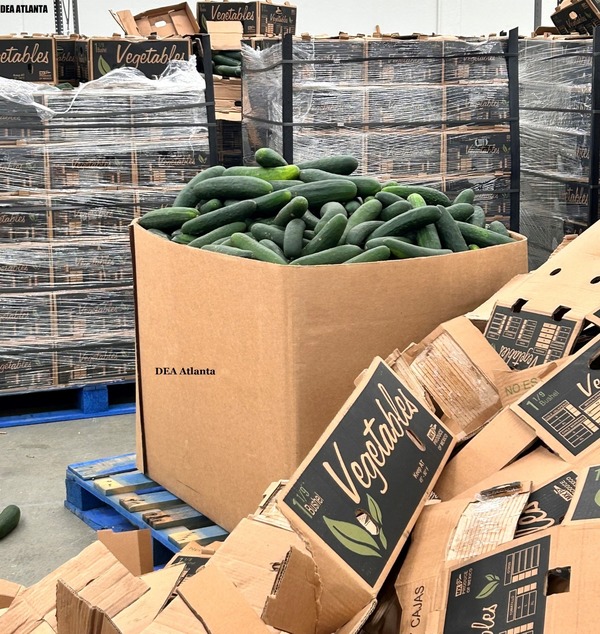
Two men will spend 15 years in federal prison after investigators discovered more than 700 pounds of methamphetamine concealed inside a tractor-trailer shipment of cucumbers parked outside a Gainesville, Georgia, warehouse. The case highlights how criminal groups can use ordinary produce freight moving through everyday warehouse and distribution networks to conceal controlled substances.
DEA agents had been watching the trailer on June 30, 2025, after developing information about a large drug load. Investigators arrested Andres Jasso Jr. and Rufino Pineda-Perez beside the rig before uncovering thousands of wrapped packages.
U.S. Attorney Theodore S. Hertzberg described the concealment as an "astonishing amount of deadly methamphetamine." Federal judges handed Jasso, 39, and Pineda-Perez, 61, separate 15-year prison terms. Pineda-Perez received his sentence Wednesday, while Jasso was sentenced July 17. Each man will also complete 10 years of supervised release after prison.
Both men pleaded guilty March 11 to conspiracy to possess methamphetamine with intent to distribute. Prosecutors additionally secured Pineda-Perez's guilty plea for illegal reentry following a previous removal from the United States. Court records linked both defendants to the cucumber-load operation, which began with surveillance at the warehouse.
Agents Find 20 Pallets of Cucumber Boxes
DEA agents observed Jasso and Pineda-Perez sitting in a sedan next to the parked trailer. Authorities then searched the commercial unit and discovered 20 pallets of boxes containing cucumbers. Those cartons held thousands of individually wrapped methamphetamine packages, according to federal prosecutors. Officials calculated the seized narcotics weighed more than 700 pounds.
Co-conspirators had directed the pair to unload the boxes and separate the narcotics from the produce. The announcement did not identify the shipment's sender or intended recipient. Federal authorities also withheld the warehouse's name and the trailer's route, and prosecutors did not disclose where the load originated.
Prior Conviction and Deportation History
Prosecutors described Pineda-Perez as a Mexican citizen without legal status in the United States. Arizona authorities convicted him in 2001 for transporting marijuana and subsequently removed him from the country. He later reentered the U.S. and encountered federal agents during a 2014 Atlanta-area cocaine transport. A judge imposed a six-and-a-half-year prison term in 2015, followed by another deportation.
The DEA led the investigation with assistance from the Georgia State Patrol, the Georgia Bureau of Investigation and ICE. Assistant U.S. Attorney Johnny Baer handled the prosecution in the Northern District of Georgia. Authorities did not identify additional defendants, a supplier or a distribution destination, and the release offered no estimate of the cucumbers' commercial value.
Commercial trailers move high-volume food freight through warehouses and distribution networks every day, and this case falls within a broader pattern of federal prosecutions involving narcotics concealed in legitimate commercial cargo. For transportation and warehouse professionals, it underscores the need for clear procedures for addressing unusual instructions, unfamiliar contacts and irregular shipment details.
Source: FreightWaves

