META Stock Forecast: BofA Holds $810 Target as Citi Reiterates Buy Rating
Key Takeaways
- •BofA Securities reiterated its Buy rating and $810 price target on Meta, implying roughly 20% upside from recent trading levels near $675.
- •BofA estimates Meta could save approximately $8.5 billion by deploying its Broadcom-developed MTIA 450 and MTIA 500 chips AI inference workloads beginning in 2027, alongside a planned 5 to 6 gigawatt buildout of owned computing capacity.
- •Meta's Muse AI agent, launched on September 8 to perform multi-step background tasks, recorded downloads exceeding those of Instagram and Facebook on several recent days, according to Citi.
- •Rosenblatt reiterated a Buy rating with an $886 price target, citing Meta One's 15 million trial and paid subscribers, while Goldman Sachs and Citi maintained Buy ratings with $725 and $800 targets respectively.
- •Meta canceled its Olympus project for a combined AI training-and-inference processor after internal estimates indicated the design would cost about 30% more, reducing its economic value at scale.
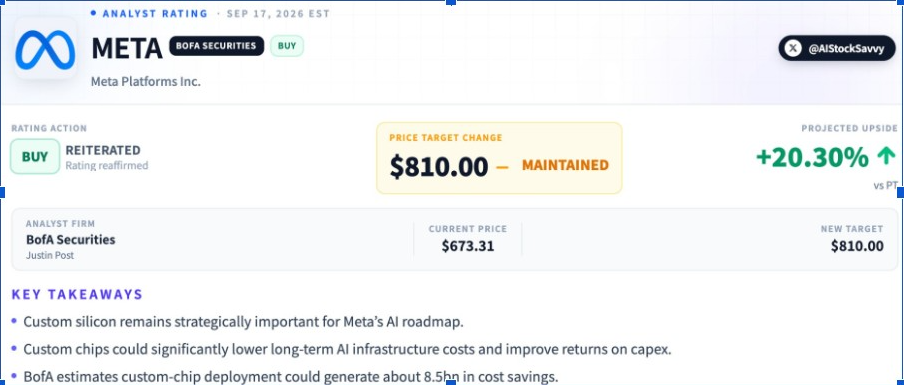
Meta Platforms Inc. shares traded near $675 on September 17 as Wall Street analysts reaffirmed positive ratings on the company, pointing to its artificial intelligence strategy, custom-chip roadmap, and subscription business.
BofA Securities reiterated its Buy rating on META and maintained an $810 price target, implying roughly 20% upside from recent trading levels. Citi also kept a Buy rating and set an $800 target, citing Meta's AI product pipeline and the upcoming Meta Connect event on September 23–24. The analyst updates arrive as Meta broadens its AI offerings through its Muse agent and prepares to deploy a new generation of in-house AI chips beginning in 2027.
BofA Estimates $8.5 Billion in Savings From Meta's Custom AI Chips
BofA analyst Justin Post said custom silicon remains an important component of Meta's long-term AI infrastructure strategy. Meta plans to roll out its third-generation MTIA 450 chip, code-named Arke, in the first half of 2027, followed later in the year by the higher-performance MTIA 500, known as Astrid. Both processors are being developed with Broadcom and are designed primarily for AI inference workloads. Inference — running trained models to respond to user requests — scales with product usage, which makes it a recurring operating cost for companies serving AI at scale.
The company has committed to deploying more than 1 gigawatt of custom-chip capacity over 12 months, with broader deployment planned as the technology matures. According to BofA's estimates, Meta could operate between 5 GW and 6 GW of owned computing capacity in 2027, a buildout that would require approximately $200 billion in spending. Assuming chips account for around 60% of that cost and Meta's custom processors are about 40% cheaper than third-party alternatives, the firm calculates savings of approximately $8.5 billion. The estimate illustrates why chip sourcing has become a central variable in how analysts model the cost of large-scale AI buildouts.
Meta had previously explored developing a processor capable of handling both AI training and inference. That project, known as Olympus, was canceled after internal estimates indicated the design could cost about 30% more, reducing its economic value at scale.
Citi Sees Muse and Meta Connect as Near-Term Drivers
Citi reiterated its Buy rating and $800 price target, naming Meta among its preferred internet-sector stocks ahead of Meta Connect, the company's annual developer conference. The firm expects the September 23–24 event to provide updates on Meta's AI product strategy, including developments around the Muse personal AI agent.
Muse launched on September 8 and is built to carry out multi-step tasks rather than operate solely as a question-and-answer chatbot. The agent runs on Meta's Muse Spark model and can continue executing tasks in the background after a user leaves the application. Citi noted that Muse downloads have exceeded those of Instagram and Facebook on several recent days.
The brokerage also expects investors to watch for information about Meta's next foundation model, internally known as Watermelon, as the company increases AI computing capacity into 2027. In Citi's view, newer AI products could support engagement and monetization as Meta expands the infrastructure required to run larger models and agent-based services.
Analyst Coverage Reinforces Positive META Outlook
Other analysts have likewise maintained positive ratings on the company. Rosenblatt reiterated a Buy rating with an $886 price target, citing the rollout of Meta One and continued usage momentum around Muse. Meta One has disclosed 15 million trial and paid subscribers following the earlier launch of single-app Plus subscriptions, a service line that gives Meta a direct-to-consumer revenue stream alongside its advertising-led core business.
Goldman Sachs separately maintained its Buy rating and $725 price target, focusing on Meta's ability to turn expanded AI computing capacity into consumer products and revenue opportunities.
META shares were changing hands around $675.50, up about 0.33% on the day. The published targets, ranging from Goldman Sachs's $725 to Rosenblatt's $886, all sit above the stock's current level. Taken together, recent analyst targets underscore Wall Street's focus on Meta's ability to control AI infrastructure spending while scaling Muse, subscriptions, and other AI-powered services.
This article is for informational purposes only and does not constitute financial or investment advice. Analyst price targets and cost-saving estimates are forecasts and do not guarantee future stock performance.
Source: The Market Periodical

