Meta Patent Filing Describes Cameras That Recognize Faces and Log Actions
Key Takeaways
- •The patent describes cameras feeding footage into AI that recognizes faces, identifies actions, and packages the results into tagged clips.
- •Users would be able to request footage conversationally on a connected device, and the system would return pre-sorted highlights.
- •The application is a continuation of a 2022 parent filing and is currently only “Ready for Examination.”
- •Meta’s existing Ray-Ban smart glasses and Quest-related hardware provide a potential base for the technology, but the feature is not a product yet.
- •The filing has drawn privacy concerns because facial recognition would identify bystanders without their active consent.
Meta has filed a patent for a camera system that uses facial recognition to identify people by name and automatically generates media clips around their detected actions. The system is assistant-driven: on request, it serves pre-sorted “who did what, when” highlights to a phone or headset. The application is a continuation of a 2022 parent filing and currently sits at “Ready for Examination”—not granted, and far from a shipping feature.
Meta Platforms Technologies, the entity that holds Meta’s research-and-development and hardware intellectual property, published the patent. The filing describes cameras feeding footage into an AI that tags the individuals in frame, detects what they are doing, and bundles both into media clips delivered on demand to a phone or headset.
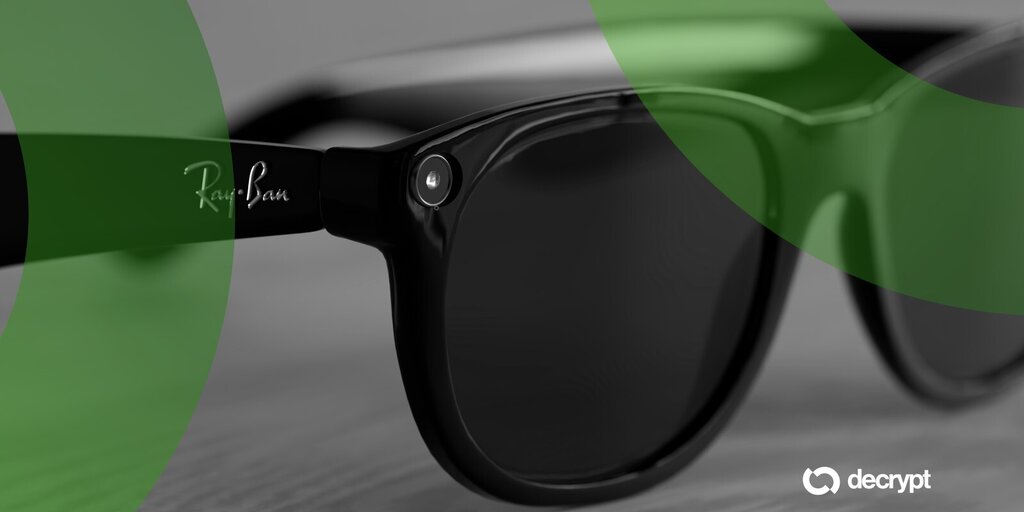
The idea does not come out of nowhere. Meta’s camera hardware has been worn on faces for years: the Ray-Ban smart glasses—built with EssilorLuxottica and first shipped in 2023, and now widely nicknamed “pervert glasses” online—record first-person video and let the wearer ask an AI about what it sees. EssilorLuxottica has reported selling more than two million pairs of the Meta-branded glasses, so any capability layered onto them would start from a sizable install base. The same Meta entity behind those frames and the Quest headsets owns this filing, and the patent drawings show a glasses wearer observing a room of people. Facial recognition would move that hardware from “records what I point at” to “knows and names who’s in the room.”
How the pipeline works
The patent lays out a four-step loop. Cameras capture live or recorded footage and pass it to the system. A facial-recognition layer scans the frames to flag who is present—not simply that a person is there, but which specific person. A separate action-detection layer runs on top of that, reading movements such as picking something up, leaving a room, or a group gathering. Finally, the system bundles its findings into individual media files, each tagged with a person, an action, or both.
What distinguishes it from a smart doorbell is the assistant layer. The filing frames retrieval as conversational: a connected device can request footage by query, and the system composes the answer from the tagged clips rather than requiring the user to scrub through video. The drawings map both server-side and on-device processing flows, with a natural-language understanding pipeline feeding the clip composer.
The capability itself—identifying and logging specific people by face without their active consent—is what draws criticism. That is the precise concern Democratic senators raised when they pressed Meta over facial recognition in its smart glasses; as previously reported by Decrypt, the senators warned that real-time face identification could expose people to stalking and harassment. Meta has been on this ground before, and it has been costly: the company paid $650 million to settle an Illinois biometric privacy lawsuit over Facebook’s photo-tagging face scans, shut down that facial recognition system in 2021 and deleted the face templates of more than a billion users while citing regulatory uncertainty, and in 2024 agreed to pay Texas $1.4 billion to settle similar claims brought under that state’s biometric law.
Meta’s hardware already sits at the center of that fight. Owners of the recently released Ray-Ban glasses have been able to quietly record strangers in public, and contractors reviewed private footage. In Europe, where the glasses are also sold, GDPR treats facial data as biometric information that generally requires a person’s explicit consent before processing, which sets a higher bar for any feature that names bystanders. A wearable camera that also names those strangers would widen the gap between Meta’s “helpful assistant” framing and what the technology can do—and the public is already building defenses.
For now, it is a patent, not a product. The status is “Ready for Examination,” with Patentlyze rating the likelihood of grant as medium. As a continuation, the application can claim its 2022 parent’s priority date while pursuing revised claims—a standard way companies keep ideas alive across years of prosecution, during which claims are frequently narrowed before any grant. Meta has filed similar computer-vision work for glasses before, and publication means the idea is on the record—not that the feature has been built or approved.

