Meta Cuts Muse Spark Prices Up to 21x for Developers Who Allow Training on Their Prompts
Key Takeaways
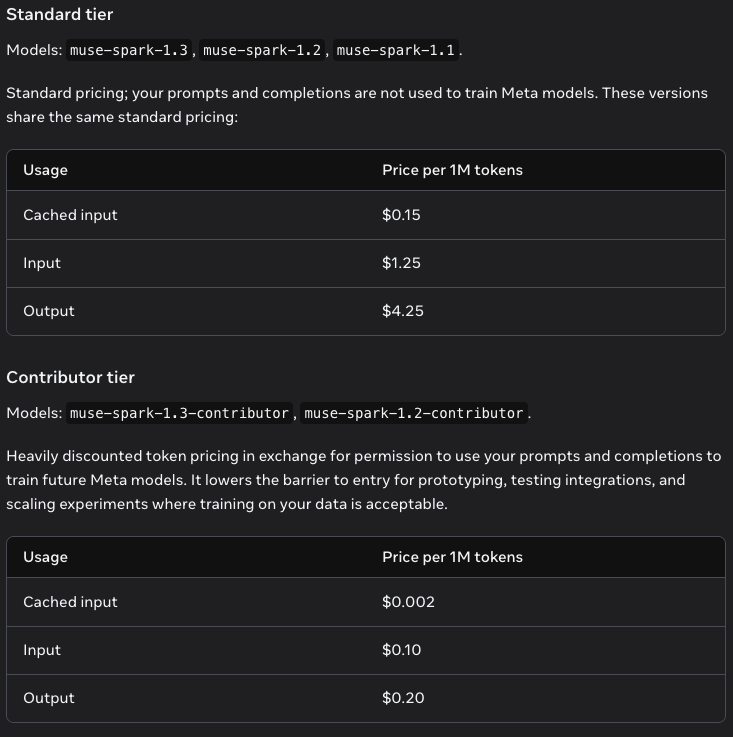
- •Meta's Contributor tier cuts average token costs by roughly 95%, with input tokens at $0.10 and output tokens at $0.20 per million, versus $1.25 and $4.25 on the standard plan.
- •Cached input token prices fall 75-fold from $0.15 to $0.002 per million tokens on the Contributor tier, while all prompts, responses, and usage data feed into Meta's training pipeline.
- •Contributor-tier access is capped at 100 requests per minute, compared with 3,000 RPM on the standard plan, making it suitable for experimentation rather than production deployment.
- •Meta paused an internal program in June that tracked employee computer usage after criticism, reflecting its difficulty sourcing high-quality coding interaction data.
- •The launch follows broader AI price cuts by Anthropic and OpenAI, as vendors compete on pricing and increasingly exchange discounts for access to training data.
Meta released Muse Spark 1.3 on September 2, introducing a two-tier pricing structure. Developers who permit Meta to train on their prompts and outputs pay as little as one-twenty-first of the standard rate. The launch signals that pricing — not just raw model capability — has become a competitive front among AI providers, with vendors increasingly willing to trade discounts for training data.
Cached tokens drop 75x
On the standard plan, a million input tokens cost $1.25, and a million output tokens cost $4.25. The Contributor tier reduces those prices to 10 cents and 20 cents respectively, an average savings of roughly 95%.
The largest discount applies to cached input tokens, which let developers reuse context without paying for reprocessing. Those fall from $0.15 to $0.002 per million tokens — a 75x cut that makes repeated workflows nearly free to run. For developers running agents that repeatedly reference the same long context, cached-token pricing can dominate the total cost of an application, which is why this line item carries the steepest discount.
In exchange, developers give up control of their data. On the Contributor tier, all prompts, responses, and usage patterns feed into Meta's training pipeline.
Rate limits also differ: the standard plan allows 3,000 requests per minute, while Contributor access is capped at 100 RPM — too few requests for production-scale functionality. The combination of a 100 RPM cap and unrestricted data use positions the tier for experimentation and prototyping rather than deployment.
Meta paused internal employee tracking program
Meta Superintelligence Labs, the division behind the Muse Spark line, built these models to fill a specific gap. Facebook, Instagram, and WhatsApp generate a torrent of conversational and visual data, but very little of the high-quality coding interactions that agentic tools need to improve.
Mario Zechner, the developer behind the open-source harness Pi, said the rise in coding agent capability from April to October 2025 was driven mainly by Claude Code storing user sessions by default and feeding them into reinforcement learning training.
Meta has struggled to source such material itself. An internal program that tracked how employees used their computers came under heavy criticism and was put on hold in June.
Arvind Narayanan, a computer science professor at Princeton, noted that large firms stick with token-billed enterprise plans even when consumer subscriptions like Claude Max and ChatGPT Pro cost 10 to 20 times less, because enterprise plans keep their data out of training runs. Narayanan suggested Meta's offer could push those companies to be more careful in distinguishing proprietary data from data they would willingly trade for a discount.
"It lowers the barrier to entry for prototyping, testing integrations, and scaling experiments where training on your data is acceptable," Meta's pricing guide says about the Contributor tier.
Meta first experimented with the two-tier structure in Muse Spark 1.2 in August 2026. Muse Spark 1.3 features a 1 million-token context window, capable of accommodating roughly 750,000 words in a single session, and the company claims it requires fewer tool calls to complete complex tasks than its predecessors.
The move comes amid broader industry price cuts: Anthropic reduced the cost of cached tokens for its new Fable and Mythos models, and at the end of July, OpenAI lowered prices across its latest models. OpenAI draws training data from free ChatGPT tier users, while Anthropic applies stricter data rules. Meta's approach makes that trade-off explicit and priced, an angle worth watching as rivals decide whether to follow with data-for-discount programs of their own.
Source: Cryptopolitan
