Meta Puts Its Muse AI Agent on a Keychain; 37% of Cryptopolitan Readers Say 'Not for Me'
Key Takeaways
- •Meta launched its Muse AI agent on September 8 with a free tier and $20 or $100 monthly subscriptions, and Sensor Tower data cited by Dezeen shows more than 2.5 million downloads in its first few weeks.
- •Meta unveiled the Muse Charm, a keychain-sized device with a fingerprint sensor, two-inch screen, animated avatar, and built-in 5G modem, but has announced no price and targets a December release.
- •The Connect hardware lineup included the $449 Ray-Ban Meta (Gen 3) with extra battery life, the $349 camera-free Ray-Ban Meta Audio, and $1,299 VR glasses available next spring.
- •Amazon began blocking Muse from shopping on its site on September 21, two days before the keynote, saying it had not authorized the agent's access.
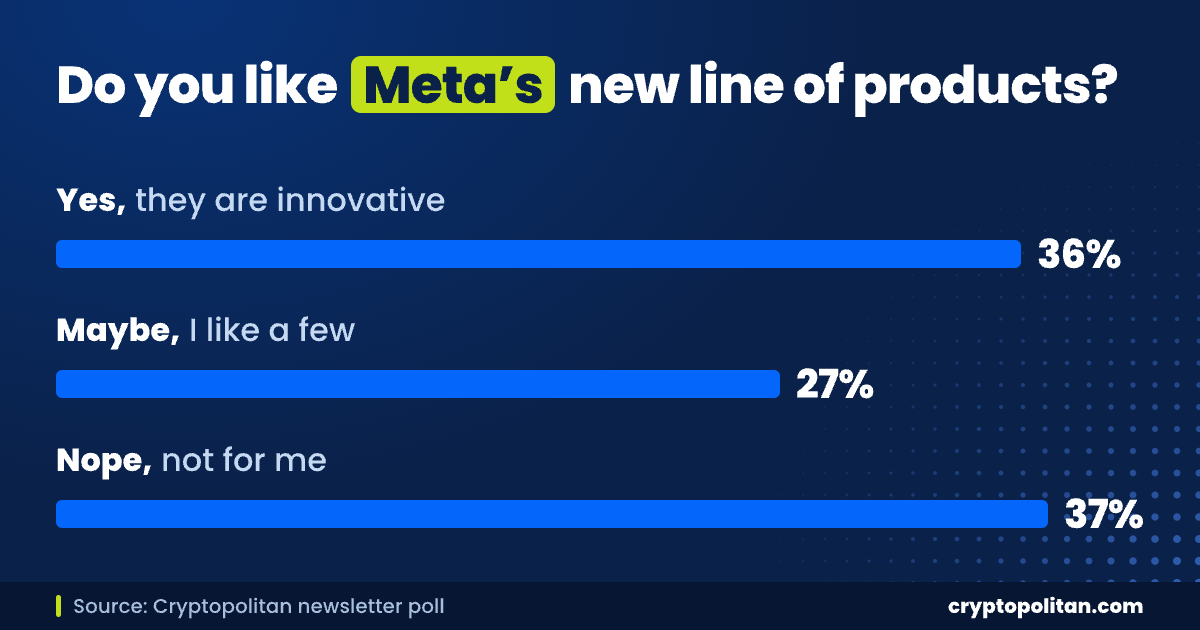
- •A Cryptopolitan reader poll found 37.27% said the products were not for them, about 35.5% called them innovative, and roughly 27.3% liked a few, a divide shaped more by trust in Meta than by the devices themselves.
Meta's annual Connect developer and hardware conference wrapped up last week with a new wave of glasses, headsets and AI products. The event opened with Mark Zuckerberg's keynote at Meta's Menlo Park headquarters on September 23 and closed with the unveiling of a pocket-sized gadget built for a single purpose: talking to the company's new AI agent. Cryptopolitan asked its newsletter readers for their view of the lineup. The responses came back split almost evenly between enthusiasm and a flat no, and the reasons behind that divide point more to trust than to the hardware itself.
What Meta Showed Off
Over the past few years, Meta Connect has primarily been a showcase for the company's glasses. This year was different, with the focus shifting to Muse, the personal AI agent Meta launched only two weeks before the event. Nearly every device presented on stage was framed as another way for users to interact with Muse. Meta's own recap of the event leads with bringing Muse to its AI glasses before it gets to any of the hardware.
Muse is an agent, which sets it apart from a regular chatbot. Once users connect their accounts, it books services, fills in forms, sends emails and makes purchases on their behalf. It launched on September 8 with a free tier and monthly subscriptions costing $20 or $100 depending on usage. According to Sensor Tower data cited by Dezeen, the Muse AI app has been downloaded more than 2.5 million times in its first few weeks.
The hardware announcements followed. The Ray-Ban Meta (Gen 3) brought thinner frames and roughly one hour of extra battery life, and went on sale the same day at $449. Next came the Ray-Ban Meta Audio, priced at $349, the first glasses Meta has introduced without a camera — a launch that reads as a direct response to privacy criticism of the company's camera-equipped models. The most advanced product in the lineup is the Meta VR glasses, a slim headset tethered to a pocket "puck" that handles computing and battery. They are priced at $1,299 and will be available next spring.
The "One More Thing": Muse Charm
Zuckerberg saved the Charm for the end. It is a small handheld device roughly the size of an Apple Watch face, worn with a lanyard instead of a strap. Users tap a fingerprint sensor in the corner and start talking. A two-inch screen displays an animated avatar called Jolly, a built-in 5G modem removes the need for a phone, and there appears to be a small camera so the agent can see what it is pointed at. The Charm came out of Meta's new design group, led by former Apple design chief Alan Dye. Dezeen's coverage framed the launch in Tamagotchi-style terms, placing the device in the lineage of pocket virtual companions rather than phones.
Zuckerberg's own pitch was that Meta had "packed the whole Muse experience, including the whole real-time voice and avatar stack into something that fits on a keychain." He also admitted that some details still need finalizing.
That admission is bigger than it sounds. Meta has not announced a price. The company says only a small number of prototypes exist and that components are not locked in. The target is December, in time for the holidays.
Anyone who followed AI hardware in 2024 will feel a twinge of déjà vu. Humane's AI Pin launched at $699 with a monthly subscription, struggled through brutal reviews, and was shut down in February 2025 when HP bought the company's remains for $116 million. The Rabbit R1 followed a similar arc at a price point. Both tried to do what a phone already does. Meta is betting it can avoid that trap by keeping the Charm as a companion to an agent people already use, rather than a replacement for the phone in their pocket. Where the Pin and the R1 asked buyers to take a chance on an unproven agent, the Charm arrives attached to software that already counts more than 2.5 million downloads.
The Trust Problem Sitting Under All of It
Muse's first three weeks have been bumpy, and that shapes how people view the hardware wrapped around it.
Privacy questions arrived on day one. ABC News reported experts raising concerns about an agent with access to people's apps, financial details and personal data, while Zuckerberg pointed to a secure credential store designed so Muse cannot read stored passwords or card numbers. Dezeen noted the agent has already faced accusations from users about how it handles private messages and sensitive account details. On September 21, Amazon started blocking Muse from shopping on its site, saying it had not authorized the agent's access. The timing was pointed: the block landed two days before Zuckerberg took the Connect stage.
Then there is the business model. Muse carries no advertising. Meta's stated plan is to take a small fee on transactions the agent completes — a reversal for a company whose consumer products have been underwritten by advertising for most of its history. That is cleaner than ads in some ways, but it also means the company earns more the more users let the agent spend.
Put a camera and a 5G connection on that agent, hang it from a keychain, and the source of some people's hesitation becomes easier to see.
What the Split Tells Us
The poll went out the evening after the keynote, with the Charm in the headline. Most respondents were reacting to that device first and the rest of the lineup second.
Earlier surveys add useful context. Across several polls this year, Cryptopolitan readers have shown a pattern that is easy to miss: they follow AI closely while keeping it at a cautious personal distance. Back in May, 38% told the publication they had never used an AI agent. When asked about handing an agent control of a crypto wallet, "Nope" won again, though most respondents said they were open to it with conditions attached. Meta is now asking people to carry an agent with them, so resistance from this audience was to be expected — and it showed up.
"Nope, not for me" (37.27%) was the top answer, though narrowly. The phrasing matters. Readers were not asked whether the products were bad, and "not for me" is a personal verdict rather than a review. Some in this group likely have nothing against the technology itself. They simply do not want a Meta agent with a camera, a data connection and a transaction-fee model living in their pocket, especially after the first few weeks of Muse headlines. With Meta, the brand carries its history into every launch, and a product whose whole job is to know more about you gets judged on that history first.
"Yes, they are innovative" (~35.5%) was almost as large, and deserves careful reading. The option said "innovative," which is not the same as "I'd buy one." Plenty of people can admire a $1,299 VR headset that streams IMAX films and still have no plans to own it. Still, a third of an audience this sceptical giving Meta credit is meaningful. The glasses business is genuinely working for the company, and the Charm is at least a more serious attempt at an AI gadget than what came before it.
"Maybe, I like a few" (~27.3%) was the most practical answer in the set. Meta showed four devices at four very different price points aimed at four different users. Liking the $349 camera-free audio glasses while shrugging at the Charm is a perfectly coherent position, and so is wanting the hearing feature and nothing else. This group judged the lineup product by product rather than issuing a single verdict on Meta, which is probably the fairest way to read it.
The real split is not between people who like gadgets and people who do not. It is between people judging the devices and people judging the company behind them. Those two groups ended up only a couple of points apart.
What December Will Settle
Three things will decide whether the Charm becomes Meta's version of the AI Pin or something that actually sticks.
Price comes first. Meta has not given a number, and the Humane experience showed how quickly a premium price plus a subscription kills curiosity. If the Charm needs its own data plan on top of a Muse subscription, a lot of the "maybe" crowd will drift to "no."
Second is whether Muse itself earns trust over the next couple of months. The device is only as useful as the services the agent is allowed to reach, and the Amazon dispute shows how fragile that is. An agent that cannot shop at the largest online retailer in the US has a gap no hardware can fill.
The third factor is quieter. Meta released camera-free glasses at the same event where it launched a camera-equipped keychain, which suggests the company knows exactly where the objection sits and is hedging both ways. Which one sells may prove telling.
Readers were split nearly evenly on the day of the announcement. By the time the Charm reaches shelves, they will have a price, reviews and a few months of Muse's behavior to judge. That second reading is likely to say far more than the first.

