Meta AI Predicts Ethereum Could Surge to $9,500–$12,500 by January 1, 2027
Key Takeaways
- •ETH has fallen from above $2,000 and is consolidating near $1,800 after testing the $1,750–$1,780 support area.
- •A weekly close above $2,000 is identified as an important technical signal that could indicate the corrective phase is ending.
- •Meta AI’s conditional forecast calls for ETH to reach $9,500–$12,500 by January 1, 2027, with a potential upside above $15,000 in the most aggressive case.
- •The bullish scenario assumes major financial institutions adopt Ethereum and its Layer-2 networks for tokenized securities, funds, and on-chain settlement.
- •Citi’s revised target, the Glamsterdam upgrade, EIP-8037, regulatory progress, and spot ETF flows are presented as key indicators for Ethereum’s longer-term outlook.
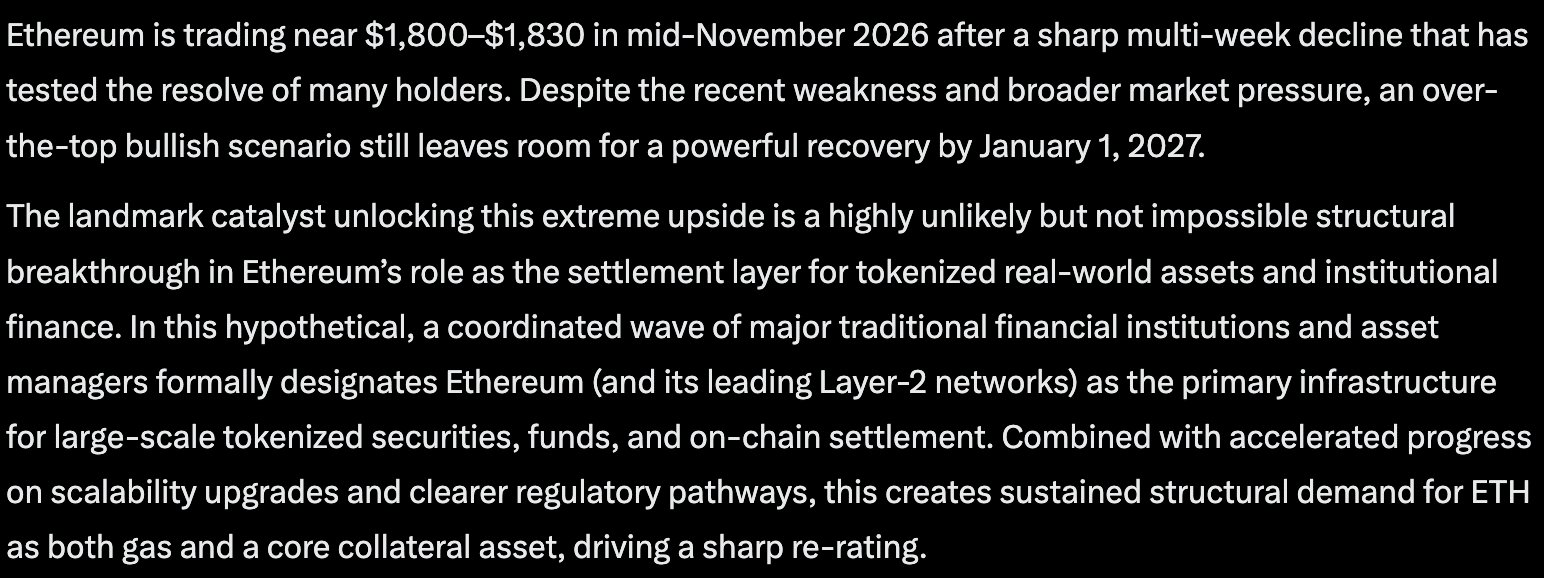
Ethereum (ETH) is trading near $1,800–$1,830 in mid-November 2026 after a sharp, multi-week decline that has tested the resolve of many holders. Despite the recent weakness and broader market pressure, an over-the-top bullish scenario — published by 99Bitcoins under a headline asking whether Meta CEO Mark Zuckerberg is bullish on Ethereum co-founder Vitalik Buterin — still leaves room for a powerful recovery by January 1, 2027.
The projection at the heart of the piece comes from Meta AI, Meta's artificial intelligence assistant, which envisions a structural breakthrough in Ethereum's role as the settlement layer for tokenized real-world assets and institutional finance. The article itself characterizes this catalyst as highly unlikely, though not impossible.
(Source: Meta AI)
Under this hypothetical, a coordinated wave of major traditional financial institutions and asset managers would formally designate Ethereum — along with its leading Layer-2 networks — as the primary infrastructure for large-scale tokenized securities, funds, and on-chain settlement. Combined with accelerated progress on scalability upgrades and clearer regulatory pathways, the scenario foresees sustained structural demand for ETH both as gas and as a core collateral asset, driving a sharp re-rating.
Tokenization — the representation of instruments such as funds and securities as on-chain tokens — has been a recurring institutional theme in the blockchain space, which is why the scenario hinges so heavily on Ethereum's settlement role. Measured against current levels, the projection implies a roughly five- to seven-fold move, a scale that underscores how much weight rests on a catalyst the article itself describes as a long shot rather than a base case.
ETH Technical Analysis
ETH has broken lower from levels above $2,000 and is now consolidating in the $1,800 region after testing support near $1,750–$1,780. The recent decline has produced a series of lower highs, with immediate resistance clustered around $1,900–$2,000 and a more significant supply zone near the prior local highs. On the downside, the $1,700–$1,750 area represents the next key demand zone.
Momentum indicators have cooled substantially following the sell-off, leaving the asset oversold on intermediate timeframes — conditions that have historically preceded sharp relief rallies once forced selling is exhausted.
In a standard recovery, a sustained weekly close back above $2,000 would be an important first confirmation that the corrective phase is ending, making that level the clearest near-term checkpoint between the ongoing correction and any recovery path. Under the extreme institutional-tokenization catalyst outlined above, those intermediate levels would be cleared rapidly, allowing measured-move extensions and multi-cycle projections from the current base to support a far more aggressive upside trajectory.
The past few weeks have been unambiguously difficult and have pushed many investors into a defensive posture. Even so, Ethereum has repeatedly shown it can recover from deep drawdowns when structural demand returns, and ongoing technical development, institutional product infrastructure, and the theoretical potential for a major shift in real-world asset settlement keep the door open for a powerful rebound.
Recent Developments That Could Improve the Odds
Even amid the current sell-off, several developments support longer-term optimism.
Analysts at Citi recently raised their 12-month Ethereum price target, citing improving crypto activity and the potential for renewed ETF inflows. Work also continues on the Glamsterdam upgrade, Ethereum's forthcoming protocol upgrade, along with related Ethereum Improvement Proposals (EIPs) — the network's formal mechanism for proposing protocol-level changes — including discussions around state-growth management and execution capacity that could support higher network throughput.
One such proposal, EIP-8037, addresses the fact that Ethereum's state is growing faster than its execution capacity. According to commentary shared on X, Buterin has said the proposal offers a realistic path to scaling the network more safely by charging more gas for operations that add new state. The development was highlighted in a post by the account Captain GM (@g13m) on November 16, 2026:
Breaking News Vitalic backs EIP 8037 upto 8x gas for new state. Ethereum's state is growing faster than its execution capacity, and Vitalik Buterin said EIP-8037 offers a realistic path to scaling Ethereum more safely. The proposal charges more gas for operations that add… pic.twitter.com/cqJmMC3ovT
— Captain GM (@g13m) November 16, 2026 (via X)
Spot Ethereum ETFs — exchange-traded funds that hold ether directly — while experiencing recent outflows, still reflect a maturing institutional product suite. Broader market-structure conversations and expanding global access — including retail trading developments in certain jurisdictions — keep Ethereum at the center of the smart-contract and tokenization narrative.
These developments do not erase near-term pressure, but they provide tangible building blocks that a more dramatic catalyst could amplify. For observers gauging whether the conditions in Meta AI's scenario are taking shape, the practical markers are the direction of spot ETF flows after the recent outflows, milestones in the Glamsterdam upgrade process — including EIP-8037 — and any concrete movement on regulatory clarity, the same variables the projection identifies as its preconditions.
Meta AI's Projection: How High Could ETH Go?
Meta AI projects that if the institutional-tokenization catalyst materializes, ETH could reach between $9,500 and $12,500 by January 1, 2027, with a stretch target above $15,000 in the most aggressive outcome. The publication acknowledged that such a move may seem unrealistic given recent price action, while arguing that returns of this magnitude are fairly standard during parabolic blow-off tops in bull markets.
Source: 99Bitcoins

