Mercy Erhiawarien Says Africa Needs Patient Capital, Not More Entrepreneurial Talent
Key Takeaways
- •Erhiawarien contends that Africa lacks patient capital rather than entrepreneurial talent, and that the standard ten-year VC fund model designed for fast-scaling unicorns is poorly suited to the continent.
- •She advocates for the creation of new financial instruments that provide founders with safety nets, allowing them to take risks and scale sustainably rather than being pressured by investors seeking quick exits.
- •Erhiawarien identifies manufacturing, healthcare, agriculture, education, and community development as priority sectors for investment, while expressing deep skepticism toward the AI boom for its lack of risk management.
- •She warns that low-tech scalable solutions risk being sidelined as funding concentrates on AI, potentially leaving cost-effective and practical innovations without support.
- •Erhiawarien argues that global investors should stop framing Africa as uniquely risky, asserting that African entrepreneurs are bankable and that the continent should be viewed as an opportunity rather than a cautionary zone.
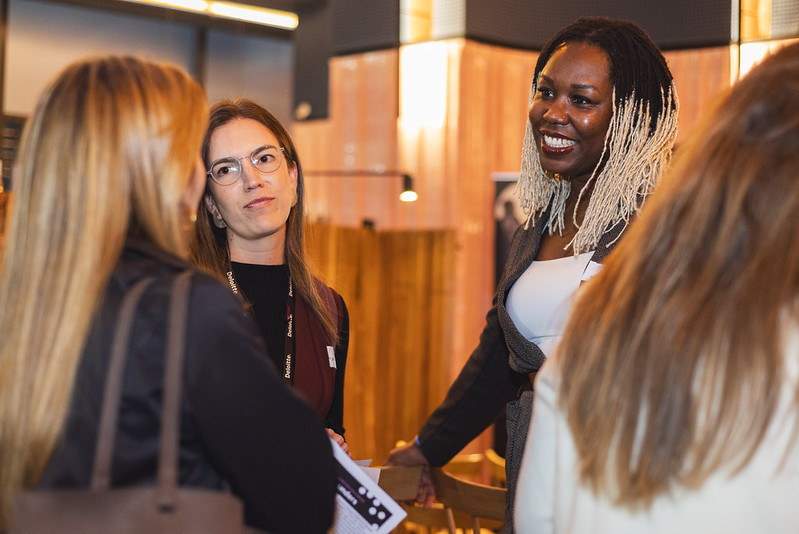
At Somerset Westview Restaurant in Nairobi’s leafy Kilimani neighbourhood, the maître d’s phone rings every few minutes, perhaps for a reservation, a dinner enquiry, or a question about whether the terrace is open. Behind the reception desk, at a quieter table away from the restaurant’s rhythm, Mercy Erhiawarien speaks with the measured cadence of someone careful not to waste words.
Erhiawarien, Head of International Programmes at Halcyon, a Washington, D.C.-based nonprofit startup accelerator that supports early-stage founders with a particular focus on social impact and women entrepreneurs, sits upright and initially appears stern. The impression fades quickly. She laughs readily, often at herself, and pauses before answering not because she is searching for language, but because she appears intent on precision.
Over nearly an hour, the conversation moves from Lagos and Nairobi to venture capital, village life, housing, artificial intelligence (AI), and her view that Africa’s biggest shortage is not entrepreneurial talent, but patient capital—a perspective that places her among a growing chorus of operators and funders questioning whether the standard ten-year VC fund cycle, designed around fast-scaling unicorns and rapid exits, fits a continent where many businesses need longer runways to reach profitability.
“I believe opportunity exists in places where people rarely look,” she says. It is the closest thing she offers to a personal philosophy.
That view is rooted in a life lived across continents. Born in Nigeria’s Delta State and raised largely in the United States, Erhiawarien grew up moving between two worlds. The contrast in infrastructure, opportunity, and public institutions deepened, rather than diminished, her connection to Africa.
Stories from her father, who grew up in a rural village before becoming an accountant, strengthened her conviction that where a person is born should not determine what they can become.
Erhiawarien says she wants financial instruments that give founders the confidence to take risks, neighbourhoods protected from speculative capital, and an Africa whose greatest export is opportunity.
This interview has been edited for length and clarity.
Lagos or Nairobi?
I’ll say both, but it depends on the weather. When it’s cold in Nairobi, I prefer Lagos because it will be warm. When Lagos is too hot, I prefer Nairobi because it is cool.
I love how Nairobi is set up. I love the greenery and the vibrancy. I love that you have a solid Kizomba dance culture. I am increasingly seeing Nairobi as a city at the centre of ideas for how we can grow the continent, or at least one of those centres. Kenya has done a solid job positioning itself that way.
Lagos is home. Lagos is in my blood. Although I am not from Lagos, it is definitely Nigeria. Lagos is the heartbeat and the energy of Nigeria. It is where things happen. It is the New York of Africa—and I will say it: not Nairobi. I will even say it is more New York than New York.
If I visited the neighbourhood where you grew up, what would explain the investor you have become?
I do not know whether the neighbourhood itself shaped the investor I have become. I cannot say I feel like an investor yet, but I am one in the making.
My background has shaped how I view different things. I am Nigerian, born in Delta State, but raised in the U.S. I spent the first few years of my life in Nigeria, and then we moved. Going back and forth between the U.S. and Nigeria, the disparities in quality of life and infrastructure always weighed heavily on my mind.
My father grew up in a village. I do not know whether many people in today’s generation know what the village looks like, but learning from his experience shaped my perspective on the need for people to have access to opportunity, and for us to find ways to support underserved communities so they can thrive economically.
In terms of how that has shaped me as a future investor, I believe in opportunities in places where they are least sought out. I believe in opportunities for African people globally. I believe in ensuring that the poorest communities have a chance to thrive. I also have a tolerance for risk when ideas do not always come from capital cities.
You mentioned your dad. What is one thing he taught you that has stayed with you?
Some lessons are unspoken. He is generous and values education. He prioritised making sure all of us were educated to whatever level we wanted to reach. He championed the education of many of his nieces and nephews, as well as people who were not related to him. He is someone who has invested in people.
That is what I have taken from watching him operate. The way he knows people and has always cared about young people means many of my friends and younger friends speak of him as one of the adults in their lives they can talk to about different things. I have learned that it is important to invest in people.
What was money like in your childhood? Was it discussed openly, hidden, or always scarce?
My dad was an auditor and an accountant, so to an extent, money was discussed. We would have budgets for school expenses.
Secretly, some of us learned to pad those budgets because you would usually submit your budget and then get less than you asked for. He would say, “You don’t need the money.” But money was discussed, and I think that was important because it taught you the value of money in a certain way.
What part of your younger self have you deliberately refused to outgrow?
I think it is probably a problem, but I am very idealistic about the continent. Some people would say I am idealistic about the continent. I would say I am deeply optimistic about Africa’s future, and I have not outgrown that. I hope I never do.
Sometimes there is a perception of Nigeria as a country that will break your heart. But I feel like it is a toxic relationship worth being in, even through the heartbreak, because we have to build the thing that matters to us.
What breaks your heart about the continent?
Our leadership. It makes me very sad that we lack visionary leadership that looks ahead to what can be, and that is fiercely protective of what is needed to get the continent there, or to get individual countries there. We have it in some places, but not everywhere.
The other thing that breaks my heart is that some countries do not have systems in place to help people have the right mindsets. That ends up destroying economies and eroding them over time because the mindset is not there. It is not right. It is not ready.
Where would we rather have dinner if you wanted to tell me who you really are?
That is a hard question because I am very easy. My friends like to think I am bougie, but I am very easy. Just feed me, so long as I am not the one cooking it myself and some effort was made. I am good. I do not know. You would have to ask somebody else that.
What is the one thing you will never order in a restaurant?
Sausages or hot dogs.
Investors often say they back people more than products. What do you notice in founders within the first five minutes that most people miss?
I think a lot of founders are bankable in the sense that the ideas they want to build are bankable, but the environment will not allow it.
There is also a growing trend on a continent where the population is overwhelmingly young: founders who are not building with an actual mission in mind, but are building for economic welfare and see entrepreneurship as the route to that.
When I look at founders, I try to suss out which is which. Usually, the ones building with an end in mind are bankable, even though the perception is that they are risky and should not be invested in.
Tell me about a founder you rejected who later proved you wrong.
I do not think I can name any founders. We rejected some founders because they were not a fit for what we needed. Maybe they were too advanced and we were looking for a slightly earlier stage. There is always a push and pull. You see that somebody has it; they are going to scale, you know they are going to grow. But because the criteria in that moment do not quite fit them, you end up on the sidelines, watching them grow without being part of their growth story. That is probably one thing I would say.
Not many investors are writing early-stage cheques. Do you know why?
That is why I want to be a future investor. I agree with you.
One of my frustrations is exactly what you said. I am rethinking what capital is and what it looks like. I have not done any conclusive research, but I think the model we have is a little flawed.
The challenge is that many businesses spend years borrowing money before they actually make a profit, while the VC model wants you to have become a unicorn so investors can exit by year ten. I do not know that this is the model the continent needs.
The question that concerns me is: how do we bridge the gap? How do we create financial instruments that are actually founder-friendly—especially if you have vetted the founder adequately—and allow them to build with a little bit of a safety net?
I recently had conversations with some family friends—Nigerian family friends, my uncles in the U.S.—and we talked about how their generation, people in their mid-60s approaching retirement, could have a job and stay in one place for 30 or 40 years because of guaranteed stability. Many of them became very risk-averse and did not want to take on new opportunities for fear of failure.
When they look at their children who are trying to build things, who are moving around and not staying in the same job, there is anxiety. One of the uncles said something profound: our generation, because our parents were able to be risk-averse and stay still, had a safety net that enabled us to be risky, to bet on ourselves, and to start businesses that did not make sense to our parents after a four-year degree.
That is what the continent needs, especially founders. Founders need financial instruments that create safety nets so we can venture greatly and dare greatly. A lot of VCs are looking to get their money out quickly, and I think we end up putting founders at risk.
I do not know what that instrument is. I do not know what it looks like. But I would love to build something that enables founders to get the support they need and scale sustainably. Imagine a world where a founder is invested in, scales, and then invests in someone else. For that to happen, the money needs to have values too, if we want cyclical, compounding impact.
Have you ever fallen in love with an idea rather than a founder?
All the time.
There are young founders in Ghana. Can we just applaud the founder of Ashesi University—Patrick Awuah, who left a career at Microsoft to establish the institution in 2002 as a liberal-arts-focused university built on principles of ethics, leadership, and entrepreneurship—for creating a space that challenges founders to think about how to solve problems? There are young founders in Accra, still in university, trying to solve patient data within the healthcare system. I love that. When I heard their pitch, I thought, “I have been dreaming about this thing for years,” because it is a problem I have in the U.S. with my health experience. Yes, it needs to be built.
So, all the time, there are so many wonderful ideas. And for me, because I end up liking the idea, usually I like the founder too. Usually, yes.
You do have some founders who are a mess and do not deserve your loyalty—do not write that down—but there are quite a few who have the right perspective and want to build something transformational.
What uncomfortable truth do global investors still misunderstand about African entrepreneurs?
African entrepreneurs are bankable, and we need to stop talking about risk when it comes to the continent.
Let us put aside the fact that the U.S. was born of colonialism and the brutal oppression of minority peoples, or the majority at the time. The reality is that the U.S. grew by absorbing risk and ignoring risk. So why should the continent be any different? Why is Africa a no-go area, the only place where only a few dare to explore? Let us stop treating it as an infectious disease and see it as an opportunity. It is bankable.
If you controlled a $10 billion Africa fund tomorrow, where would you deploy it first, and what sectors would receive nothing?
Thank you for my $10 billion fund; I receive it [laughs].
I would invest in manufacturing. I would invest in healthcare—not sexy, but I would. Manufacturing, agriculture, education, and neighbourhoods. There is a reason I say “neighbourhoods.”
Why?
One trend we are seeing in the U.S. is an unstable housing sector, as VCs buy up property and create what they call single-family renters. People are losing the ability to own their own homes, while a middleman owns the property and makes millions from it, ignoring the rights of the people who live there.
One place that saddens me a lot is Makoko in Nigeria. It is a community on the water that is being pushed out by the government of Lagos. I think the approach has been wrong. If the government invested in the community, it could create an economic asset that would bring tourists to Nigeria. A lot of policy focuses on people who have, but you need to focus on different layers of the economy. I would invest in communities to create vibrant places, retain vibrant places, and protect them from people who would exploit poverty.
What is one investment trend everyone seems excited about that leaves you unconvinced?
AI. It is not going to be good.
People are not building with risk management in mind or with the negative consequences that can arise. No one is thinking about that. We are kind of just saying, “We’ll mine at all costs.”
In 20 years, we will start writing papers about how AI destroyed everything. It is a trend moving headlong. But we have foreknowledge of the negative consequences, and we are still moving at breakneck speed, ignoring all the signs. I do not know if I am allowed to say that.
What kind of boss are you on a stressful Monday morning?
It depends on the Monday morning. You have to ask my colleagues that.
I try not to be stressed. I try not to pass on stress. I like to be measured, take stock of my own stress, and try not to pass it on. But yes, you can ask my colleagues.
What is the hardest conversation you have had with a founder in the past year?
Not the hardest, but more disappointing: realising that I do not have the bandwidth to support my founders the way I want to. When I fail to support them, it makes me feel bad.
I definitely have at least one person I owe an apology to right now.
What is happening in African technology today that excites you but is not making headlines?
I do not know if I have an answer for that. I have not been following African technology much. But one thing I foresee is that low-tech solutions that can scale are likely to be discarded in the wake of AI. Those solutions might cost less to deploy, but because they are not AI, founders might struggle to get support. That should be considered.
If this interview were read ten years from now, what would you hope people say you got right about Africa?
Everything.
I hope people will say, “Mercy was right; Africa was going to not only come up, but become the place that people look to for help.”
Random thought: some people live in countries where tourists show up. Some of us do not know what that looks like. We have people who come for business, not for fun. I would love to hear someone say, “I travelled to Malawi or Zambia and had a blast; it was beautiful, the people were friendly, I had so much fun.”
I would love to see an Africa where getting a visa is hard. I applaud Kenya for the best visa process globally—hands down. I applied for my visa on Monday, and look at me. I love that.
But I think we need to carry ourselves with more dignity. We need to carry ourselves with greater pride as a continent. And I know I will be proved right on that at some point.

