Meralco Reports Strong H1 2026 Results as Generation Arm Drives Growth; System Loss and Electric Cooperative Performance Under Scrutiny
Key Takeaways
- •Meralco reported a consolidated core net income of P26.5 billion for H1 2026, with its generation segment driving growth through a 69% income increase while the distribution utility and retail electricity supply segments contracted.
- •MGEN's renewables operations achieved 113% growth over 2025 levels, supported by the energization of MTerra Solar, one of the largest solar facilities in the world.
- •Meralco's distribution system loss rate of 6.1% in 2026 remained below the Energy Regulatory Commission's 6.5% cap, while many electric cooperatives operate under a higher 12% cap and frequently exceed it.
- •Chairman Manuel Pangilinan warned that eliminating the system loss charge could lead to distribution utility bankruptcies and potential nationwide blackouts.
- •Meralco recorded a SAIDI of just six minutes in 2025, compared to over 2,000 minutes for electric cooperatives such as BATELEC 1 and BATELEC 2, highlighting a significant performance gap in power reliability.
On July 29, Meralco — the Philippines' largest private electric distribution utility, serving Metro Manila and surrounding provinces — held a press conference covering its financial and operational highlights for the first half of 2026 (ended June 30). The presenters included Betty Siy-Yap, SVP and Chief Finance Officer; Ronald Valles, SVP and Head of Regulatory Management; Ronnie Aperocho, EVP and Chief Operating Officer; Emmanuel Rubio, President and CEO of Meralco PowerGen Corp. (MGEN); and Manuel V. Pangilnan, Chairman and CEO.
Financial Performance
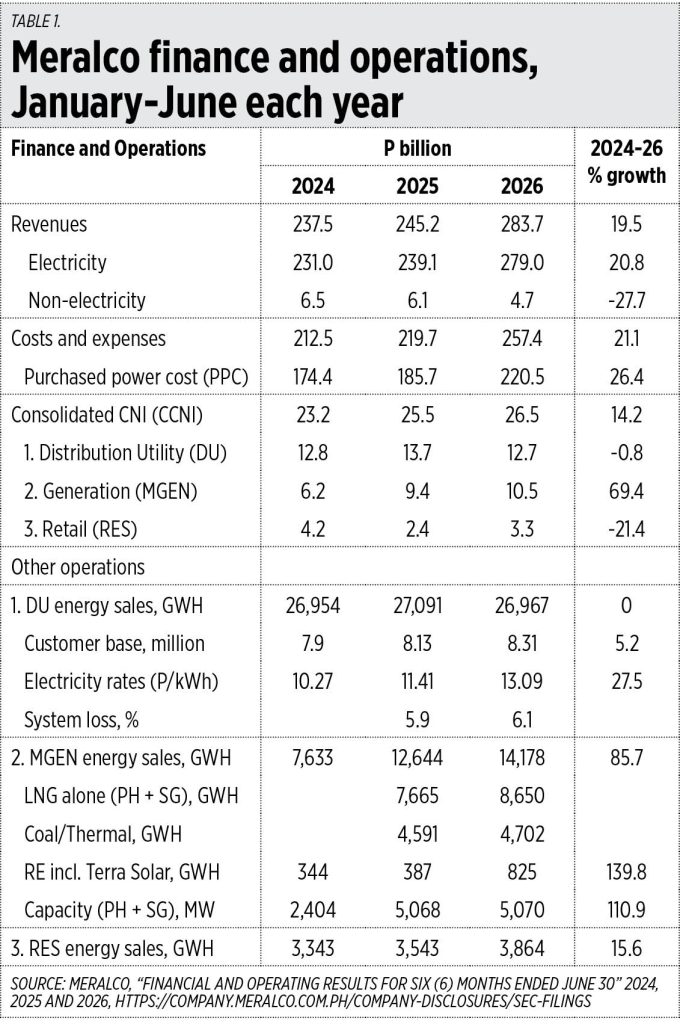
Ms. Siy-Yap reported that Meralco's consolidated core net income (CCNI) for H1 2026 reached P26.5 billion from gross revenue of P283.7 billion. Meralco operates through three main segments: the parent distribution utility (DU), the generation arm MGEN, and the retail electricity supply (RES) business.
A review of the Financial Highlights for H1 2024 and 2025 (SEC Form 17-C), available on the Meralco website, shows that the generation segment posted a 69% increase in income from 2024 to 2026, while DU and RES contracted by 1% and 21% respectively. In energy sales measured in gigawatt-hours (GWh), generation expanded by 86%, the DU remained flat, and RES grew by 16%. The shift underscores how Meralco's growth trajectory is increasingly tied to its generation portfolio rather than its traditional distribution franchise.
Mr. Rubio joined MGEN in July 2024, and the significant expansion in both income and electricity production has occurred under his leadership over the past two years.
Distribution Utility Operations
Mr. Aperocho presented the DU's business drivers and service performance, covering system loss, electricity rates, and sales performance across residential, commercial, and industrial customer segments. He also outlined major projects including network modernization, reliability improvements, and STL construction. The data showed that Meralco's customer base grew by 2.2% from 2025 to 2026, while electricity sales declined by 0.5%.
Mr. Valles discussed the company's power purchase agreement (PPA) framework and the competitive selection process (CSP) for certain projects.
Generation and Renewables
Mr. Rubio highlighted MGEN's strong renewables performance, with 113% growth over 2025 levels, including the energization of MTerra Solar — among the largest solar facilities globally. LNGPH posted 20% growth over 2025, and the company's thermal or coal plants also delivered solid results. He further discussed the Toledo BESS project, carried out in cooperation with VinEnergo, the RES operations (Vantage and MGEN RES), a record of 118 million safe man-hours with no accidents or fatalities, and various community initiatives.
System Loss in Global Context
During the open forum, Mr. Pangilinan emphasized the diversity of the company's earnings mix — spanning distribution, generation, and supply — which he said provides greater financial stability and business resilience. He also questioned a proposal to eliminate the system loss (SL) charge for customers, warning that it would result in either taxpayers bearing the cost or the bankruptcy of many distribution utilities and electric cooperatives, with the possibility of nationwide blackouts. The SL charge has been a recurring subject of legislative and regulatory scrutiny in the Philippines, where consumer advocacy groups have long called for its reduction or removal.
According to global transmission and distribution system loss data, the Philippines had a system loss rate of 10% in 2023, comparable to rates in Saudi Arabia and the United Kingdom. Industrialized nations such as Japan, Qatar, Germany, and the United States maintain system loss rates of approximately 5%, unable to reduce them to zero or even 1%. Singapore is an outlier with only 0.2% system loss.
The Philippines' transmission system loss is relatively small. The National Grid Corp. of the Philippines (NGCP) does not impose a separate SL charge; instead, it has installed equipment such as capacitor banks and static synchronous compensators (statcoms) that reduce system loss, then incorporates the residual small loss-like cost and congestion cost into wheeling rates.
Meralco's distribution system loss of 6.1% in 2026 is below the 6.5% cap set by the Energy Regulatory Commission. Electric cooperatives, by contrast, operate under a 12% system loss cap, meaning a higher amount is passed on to their customers — and many ECs exceed even this elevated threshold.
Electric Cooperative Performance
The DU has limited room for growth unless it expands into areas currently served by electric cooperatives, many of which have demonstrated poor operational performance despite decades of government support through the National Electrification Administration (NEA). The NEA oversees more than 100 electric cooperatives that serve the majority of provincial areas outside major urban centers, making their performance a critical factor in the country's overall electricity service quality.
Using the System Average Interruption Duration Index (SAIDI), which measures the total duration of power interruptions over a year, the contrast is stark. In 2025, Meralco recorded a SAIDI of six minutes. By comparison, Batangas EC 1 (BATELEC 1) recorded 2,214 minutes (approximately 36.9 hours), and BATELEC 2 recorded 2,060 minutes (approximately 34.3 hours).
Efficiently managed private distribution utilities such as Meralco, the Visayan Electric Co. (VECO), MORE Electric and Power Corp., and others could potentially serve more customers if they were to absorb or jointly manage underperforming electric cooperatives as corporate entities. Under such a model, they would be regulated by the Securities and Exchange Commission rather than the NEA, and would not be entitled to taxpayer subsidies or bailout loans.
Bienvenido S. Oplas, Jr. is the president of Bienvenido S. Oplas, Jr. Research Consultancy Services, and Minimal Government Thinkers. He is an international fellow of the Tholos Foundation. Contact: minimalgovernment@gmail.com

