MENA Crypto Transaction Volume Reaches $350 Billion as Saudi Arabia Leads Regional Growth
Key Takeaways
- •MENA's annual on-chain crypto transaction volume has grown to roughly $350 billion by 2025–2026, up from about $100 billion in 2022, per the Bitcoin Policy Institute.
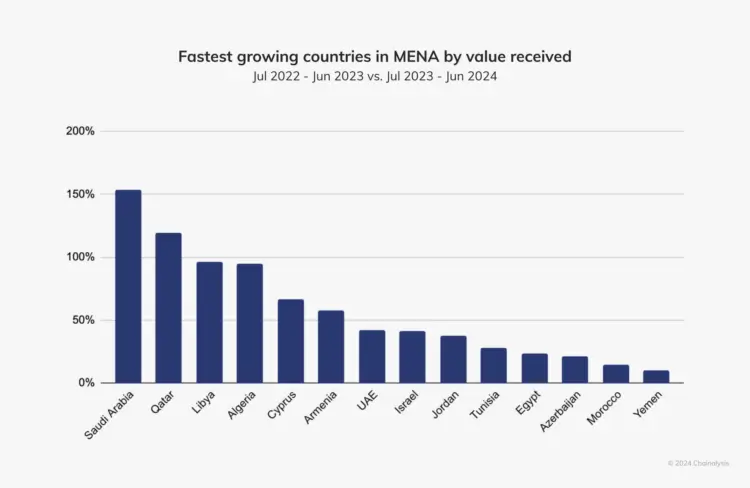
- •Saudi Arabia posted MENA's fastest crypto growth at 154% year-over-year, yet the IMF notes cryptocurrencies remain prohibited there while a digital-asset strategy is being developed.
- •Turkey is MENA's largest crypto market by transaction value, processing nearly $200 billion annually, driven partly by lira depreciation and inflation.
- •Qatar's Financial Centre introduced a Digital Assets Framework in 2024 covering tokenization, custody, exchanges, transfers, and smart contracts.
- •Bitcoin accounts for an estimated 38% of UAE crypto activity, Ethereum 22%, and USDT and USDC together 30%, highlighting the role of dollar-linked stablecoins in the region.
Crypto activity across the Middle East and North Africa (MENA) has expanded sharply, with annual on-chain transaction volume reaching approximately $350 billion by 2025–2026. According to the Bitcoin Policy Institute, that figure has climbed from roughly $100 billion in 2022, reflecting stronger investment activity and wider digital-asset use across the region. The trend matters beyond the region itself: MENA has repeatedly ranked among the fastest-growing crypto regions globally in Chainalysis adoption reports, meaning regulatory choices made in Gulf capitals increasingly shape how digital-asset businesses route institutional flows.
Saudi Arabia has emerged as the fastest-growing crypto market in MENA, recording 154% year-over-year growth, while Qatar followed with a 120% increase over the same period. Turkey, however, remains the regional leader by transaction value, processing nearly $200 billion annually despite the faster growth seen elsewhere.
Saudi Arabia Leads MENA Crypto Growth as Turkey Tops $200 Billion
The growth figures indicate that crypto expansion across MENA is not concentrated in a single market or driven by a single adoption model. Instead, Gulf investment, inflation pressures, regulation, and cross-border activity are each shaping different markets in distinct ways.
Saudi Arabia's 154% growth rate comes from Chainalysis data covering July 2023 through June 2024. That expansion coincided with broader investment in fintech, blockchain infrastructure, and digital payments, part of the kingdom's wider economic diversification push under its Vision 2030 program, which targets technology and financial-services development.
However, higher transaction activity has not translated into unrestricted cryptocurrency regulation. The IMF stated in its 2026 consultation that cryptocurrencies remain prohibited in Saudi Arabia. Authorities are instead developing a digital-asset strategy focused on financial stability, monetary sovereignty, consumer protection, and market integrity. At the infrastructure level, Saudi Arabia joined the BIS-backed mBridge project in 2024, which tests wholesale central bank digital currencies for cross-border payments between commercial banks — a signal that the state is prioritizing state-controlled payment infrastructure even as private crypto trading remains restricted. What to watch next is whether the forthcoming digital-asset strategy formalizes any licensing path for crypto businesses, which would determine how much of the measured transaction activity moves onshore into regulated channels.
Qatar has taken a more formal regulatory path. Its Qatar Financial Centre introduced a Digital Assets Framework in 2024 covering tokenization, custody, exchanges, transfers, and smart contracts, giving licensed firms a defined rulebook in a jurisdiction that, like Saudi Arabia, had previously restricted crypto activity.
Turkey remains substantially larger by transaction value. Chainalysis placed the country near $200 billion annually through mid-2025, making it MENA's biggest crypto market. Persistent lira depreciation and inflation have supported cryptocurrency demand as residents seek alternative investments and ways to preserve purchasing power — a pattern consistent with other high-inflation economies where stablecoins are used as a dollar substitute rather than purely as speculative assets.
Gulf Regulation and Stablecoins Reshape Regional Crypto Activity
The UAE represents another model, built around institutional participation and regulated digital-asset businesses. Chainalysis measured more than $56 billion in transactions during 2024–2025, up 33% from the prior period, with large institutional transfers accounting for much of the increase. The UAE's approach — regulated free zones such as the Dubai Virtual Asset Regulatory Authority (VARA), established in 2022, and the Abu Dhabi Global Market's crypto framework — has made it a regional hub for licensed exchanges and custody providers. Meanwhile, the Bitcoin Policy Institute estimated the UAE market at approximately $150 billion using a different methodology.
That difference highlights a major limitation when comparing regional totals. Chainalysis previously measured $338.7 billion across MENA between July 2023 and June 2024, and later reported regional volume above $500 billion for the year ending June 2025. Consequently, the $350 billion estimate should be viewed within the context of its specific methodology.
Asset composition also differs across Gulf markets. According to Bitcoin Policy Institute data, Bitcoin accounts for an estimated 38% of UAE activity, while Ethereum represents 22%. USDT and USDC together account for another 30%, underscoring the significant role of dollar-linked stablecoins in regional digital-asset activity, particularly for cross-border transfers and remittance corridors where traditional channels are slower or costlier.
Broader geopolitical pressures have also influenced trading behavior. During the June 2025 Israel-Iran conflict, Bitcoin fell about 2.3% to $105,200, while Ether declined 7.5%. Bitcoin later stabilized between $104,000 and $106,000, and its market dominance increased to 64.8% during the same period.
Overall, the data shows a MENA crypto market expanding through several distinct channels: Saudi Arabia leads in percentage growth, Turkey dominates in transaction value, and Gulf regulation supports institutional participation. The near-term indicators to follow include the details of Saudi Arabia's digital-asset strategy, further mBridge pilots, and whether Turkey introduces comprehensive crypto legislation to complement its growth in transaction volume.
Source: Blockonomi

