Memecoin Data 2026: $31.2 Billion Market Cap, Short Lifespans, and a 97% Failure Rate
Key Takeaways
- •The memecoin market was valued at about $31.2 billion across roughly 6,270 tracked tokens in September 2026, with Dogecoin alone accounting for roughly 40% of the category.
- •Talos found that 81% of tracked memecoins fell 90% or more from their all-time high, and only 3.3% ever returned to their peak price.
- •An equal-weight portfolio of the ten largest memecoins lost 78.74% from January 2025 to February 2026, while gold gained 92.46% over the same period.
- •About 97% of memecoins have died or lost most of their trading volume, according to Binance Research data cited by CoinLaw.
- •Pump.fun's token graduation rate fell to 0.26% in June 2026, and its daily revenue dropped more than 83% to roughly $800,000.
Memecoins — crypto tokens built on internet jokes, animals, and viral moments — can rise quickly, but the data shows most fade just as fast. Four recent research efforts covering market size, lifespan, returns, trader profits, and scam losses through September 2026 point in the same direction: a small group of large tokens holds most of the value, while the rest lose much of their worth within a year or two.
Key Figures at a Glance
- The memecoin market is worth about $31.2 billion across roughly 6,270 tracked tokens (September 2026).
- The median memecoin reached its all-time high 17.2 days after it first traded.
- 81% of tracked memecoins fell 90% or more from their peak, and only 3.3% ever regained it.
- An equal-weight portfolio of the ten largest memecoins lost 78.74% from January 2025 to February 2026.
- About 97% of memecoins have died or lost most of their trading volume, according to Binance Research.
- Pump.fun's graduation rate fell to 0.26% in June 2026.
How Big Is the Market?
The memecoin category stood at roughly $31.2 billion in September 2026, spread over about 6,270 tracked tokens, based on data verified on September 16. The total dropped 4.7% in the preceding 24 hours. CoinLaw's separate estimate put the segment near $30.6 billion in June 2026; the two figures come from different sources but sit within about 2% of each other.
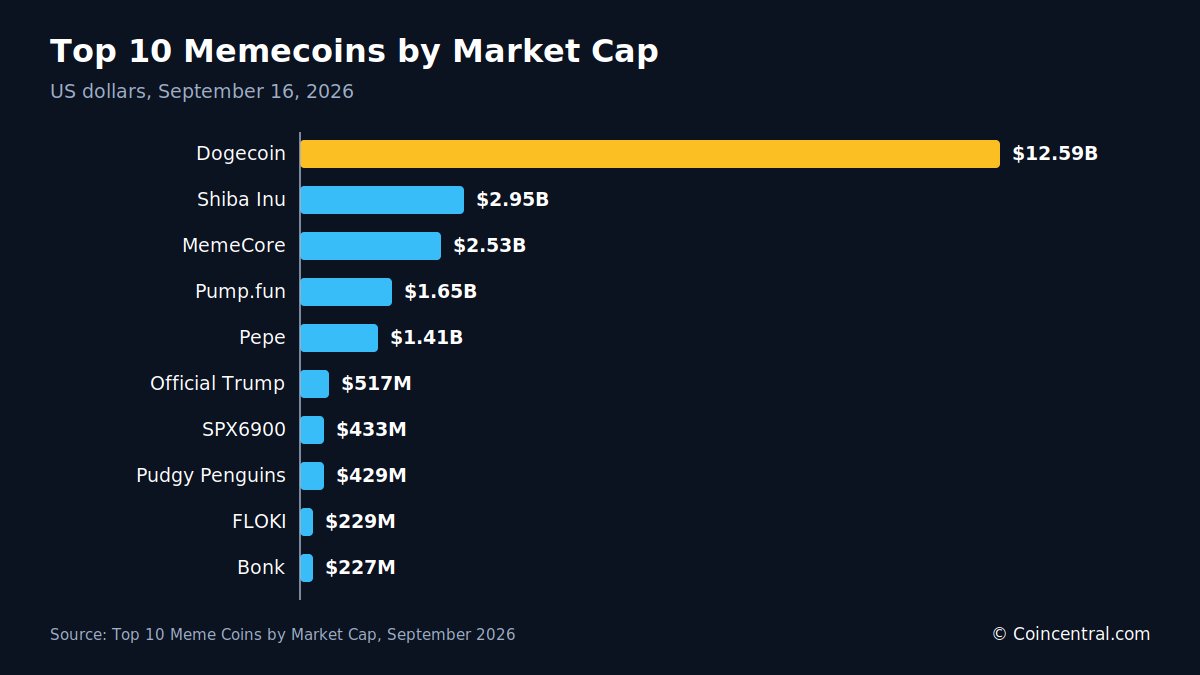
Dogecoin leads by a wide margin. At $12.59 billion, it is more than four times the size of Shiba Inu at $2.95 billion, and it alone accounts for about 40% of the entire category. The ranking below Dogecoin has shifted since July: MemeCore, at $2.53 billion, and the Pump.fun token PUMP, at $1.65 billion, have both entered the top five. Both are tied to meme infrastructure rather than a single joke coin.
Value is also concentrated by chain. CoinLaw reports that the Solana meme sub-category holds about $3.78 billion, compared with about $308.5 million on Base — the chain with the largest launchpad carries the most meme value.
Headline market caps can conceal a trading problem. MemeCore changes hands for only $0.71 million a day against its $2.53 billion capitalization, or roughly 0.03% of its value; a holder attempting exit a large position in such a market could move the price against themselves. Supply adds a further constraint: only 42% of MemeCore tokens circulate, and about 27% of Official Trump tokens do, with the remainder still to be released — a potential source of selling pressure later.
How Fast Do Memecoins Peak and Collapse?
Talos examined 150 memecoins launched after the Solana wave began with BONK in December 2023, applying the Kaplan-Meier method, a survival-analysis tool from medical research. The study set three markers: a coin's first trade on an exchange as the start, its all-time high as the peak, and a 95% drop from that peak as the collapse.
The speed of the ascent stands out. A quarter of the coins peaked within 1.6 days of their first trade, and the median coin reached its all-time high after 17.2 days. The decline takes longer, but it arrives: the median coin had lost 95% of its value from its peak about 370 days later, and half the coins in the study traveled from launch to peak to a 95% drop in an average of 456 days. By day 1,000, roughly 90% of the tokens had fallen 95% from their highs.
Most coins get only one run. Two-thirds of the Solana-era coins never staged a second rally: they went up once, topped out within days, and never came close to that level again. The remaining third took a few months, on average, to reach their all-time high.
Talos lists limits for its own work. A coin had to trade on at least one centralized exchange to qualify, so the sample leans toward coins that performed better than most. The 95% cutoff was also chosen by the authors, and a different threshold would change the median. Talos concludes that the measured lifespans likely overstate how long a typical launchpad coin lasts.
How Many Lose Most of Their Value?
Talos found that 81% of tracked memecoins fell 90% or more from their all-time high; only 19% avoided a decline that deep. Recovery is rare — just five coins, or 3.3% of the sample, ever returned to their peak price. Price since launch tells a similar story: only five of 151 tokens trade above their day-one price, and after 300 days a majority of tokens were worth about 10% of their starting value.
Size offers no protection. Three of the five largest tokens by market cap from this period — TRUMP, PUMP, and PENGU — are worth less now than at launch.
On-chain usage follows the same curve. Counting Solana addresses holding at least $1, Talos found that activity peaks early and rarely recovers: today, the major memecoins retain no more than 7% of the active addresses they had at their peak. Price and activity both fade after the initial rush.
Returns vs Bitcoin, Stocks, and Gold
Marquette University finance professor David Krause tracked the ten largest memecoins from January 2025 to February 2026, using an equal-weight, buy-and-hold portfolio built from 60 weeks of price data on Yahoo Finance. The portfolio lost 78.74%. Over the same period, Bitcoin lost 30.68%, the S&P 500 gained 17.84%, and gold gained 92.46% — a gap of 171.20 percentage points between the memecoin basket and gold.
Every coin in the sample lost money. Dogecoin had the smallest loss at 70.02%, and Brett the largest at 93.30%. Official Trump, which launched on January 18, 2025, reached a market cap above $90 billion within days, according to CoinDesk data cited by Krause, then fell about 94% from that peak. In Krause's sample it lost 85.19%, with its largest weekly gain of 71% coming in the week of its launch.
Krause says the results probably understate the losses. His sample holds only coins trading in February 2026, and smaller coins that went to zero are excluded. He also notes that the losses hit the whole segment: coins with different launch dates and sizes all lost money in the same period.
Volatility, Drawdowns, and Risk
The memecoin portfolio moved far more than the comparison assets. Its annualized volatility was 103.82% — about 2.7 times Bitcoin's 38.46%, more than six times the S&P 500's 16.38%, and more than five times gold's 18.63%. The worst drawdown was also deeper: the portfolio fell 82.71% from high to low, versus 44.38% for Bitcoin, 16.88% for the S&P 500, and 5.37% for gold. Up weeks were less frequent, too — the portfolio gained in 41.4% of weeks, against 49.2% for Bitcoin, 54.2% for the S&P 500, and 71.2% for gold.
On a risk-adjusted basis, the Sharpe ratio came in at -0.848 for the memecoin portfolio and -0.747 for Bitcoin, compared with 0.726 for the S&P 500 and 2.994 for gold.
Memecoins also move with the rest of crypto — only harder. The portfolio's correlation with Bitcoin was 0.78, and its beta to Bitcoin was 2.076, meaning a 10% drop in Bitcoin was accompanied by an average 20.8% drop in the portfolio. The relationship with gold ran the other way, at a correlation of -0.41. A study cited by CoinLaw similarly found that memecoin correlations with the broader crypto market drift toward 1 in stress periods.
Individual tokens vary. Annualized volatility in Krause's sample ranged from 69.86% for Shiba Inu to 159.43% for SPX6900. CoinLaw, citing Binance Research, lists peak volatility readings of 301.8% for Pepe in April 2023, 63.4% for Shiba Inu in March 2024, and 29% for Dogecoin in November 2024.
Pump.fun, Launchpad Revenue, and Trader Profits
Pump.fun launched on January 19, 2024 — a month after BONK set off the Solana memecoin wave in December 2023 — and has helped create about 12 million tokens since then, according to CoinLaw. It was the first Solana application to pass $1 billion in total revenue, earning $124.7 million in the first quarter of 2026 — about 36% of the $342.2 million generated by all Solana apps that quarter. Daily revenue has since dropped more than 83%, to about $800,000 by June 2026.
The graduation rate indicates where new tokens end up. In June 2026, only 0.26% of Pump.fun tokens graduated from the launchpad, about 80% lower than three months earlier. The platform collects a fee on each token creation and each trade, so its revenue depends on activity rather than on whether any single token survives. Together, the graduation rate and the daily revenue line are the two figures that show whether the launchpad model is still operating at the scale it reached in early 2026.
Trader results improved in 2026. The share of Pump.fun traders in bottomed at 30.1% in June 2025, then rose to 56.8% in February 2026, 70.0% in March, and 73.3% in April. From April 2024 onward, the share had stayed below 50% in most months.
Most of the gains were modest. In April 2026, about 2.05 million profitable wallets — 65.1% of the profitable group — earned between $1 and $500. Another 87,000 earned $500 to $1,000, and 169,000 earned more than $1,000, putting roughly 5.4% of profitable wallets above the $1,000 mark. CoinLaw describes the cohort as many small traders rather than a pool of big winners.
Rug Pulls, Scams, and Why 97% Fail
CoinLaw, citing Binance Research, reports that about 97% of memecoins have died or lost most of their trading volume. The average memecoin lasts about one year — roughly one-third the lifespan of an average crypto project.
Scams compound the damage. Chainalysis estimated that a record $17 billion was stolen in crypto scams and fraud in 2025, with rug pulls — episodes in which creators drain a token's funds and abandon the project — accounting for more than $2.8 billion of that total. The average rug pull took about $510,000 in 2025. Chainalysis also flagged 74,037 tokens launched in 2024 as suspected pump-and-dump schemes, equal to about 3.59% of all tokens launched that year.
Several causes recur across the sources. Krause points to concentrated ownership, thin trading, and demand built on social media attention. The Top 10 guide highlights attention decay — once a meme loses its cultural pull, the price follows — and notes that drops of 50% to 90% within days of a peak are routine in the category. Supply schedules play a part as well: only 56% of the Pump.fun PUMP token supply circulates, and releases to the team and early investors can dilute holders. Talos adds that millions of memecoins are created, but only a tiny share reach centralized exchanges, and fewer still last.
Regulation and Market Rules
On February 27, 2025, the SEC's Division of Corporation Finance said typical memecoins do not involve the offer and sale of securities, meaning sellers do not need to register those sales under the Securities Act of 1933. The CFTC retains authority to act on fraud and market manipulation, but it does not oversee memecoin markets the way it oversees derivatives.
On March 5, 2026, the SEC ended its lawsuit against Justin Sun, and a firm linked to him paid $10 million. In March 2026, a joint SEC and CFTC framework treated Dogecoin as a digital commodity.
US rules remain unsettled. The Top 10 guide reports that the CLARITY Act failed its Senate vote in September 2026 and that Bitwise closed its proposed Dogecoin ETF because of low institutional demand. The guide also says celebrity and political tokens face particular scrutiny. For now, that combination — a determination that typical memecoin sales are not securities offerings, CFTC authority over fraud and manipulation, and no comprehensive statute after the CLARITY Act's defeat — is the framework under which US memecoin trading operates.
What the Numbers Show
The four data sources point the same way: memecoins peak within days, lose most of their value within about a year, and rarely recover. The market remains large at about $31.2 billion, but Dogecoin alone holds roughly 40% of it, and even the ten largest coins lost 78.74% over 14 months while gold gained 92.46%. Launchpads collect fees whether or not a coin survives, most traders pocket small gains at best, and scam losses reached billions of dollars in 2025. The figures most likely to update this picture are all published and trackable: the share of supply still to circulate for MemeCore, Official Trump, and PUMP; Pump.fun's graduation rate and daily revenue; and the progress of US market-structure legislation.
Each study carries caveats. Talos and Krause both note that their samples lean toward survivors, so real results for the average coin were likely worse. Prices and rankings change daily; check live figures before making any decision. This article is for information only and is not financial advice.
Sources
- Talos (Victor Ramirez), The Death and Life of the Average Memecoin
- CoinLaw, Memecoin Statistics 2026: Market Cap, Profits, and Pump.fun
- David Krause, Marquette University, An Empirical Analysis of Meme Coin Performance: 2025 to 2026
- Top 10 Meme Coins by Market Cap in September 2026
This article originally appeared on CoinCentral.

