Military Historian Max Boot: Trump's Inconsistent Iran Strategy 'Guaranteed to Fail'
Key Takeaways
- •Max Boot, a conservative foreign-policy commentator and Council on Foreign Relations senior fellow, criticized President Trump's Iran strategy as schizophrenic, documenting at least seven policy reversals between confrontation and conciliation since the war began.
- •Trump pledged on July 22 to bomb Iranian infrastructure for every cargo ship attacked in the Strait of Hormuz, yet at least three ships have since been attacked without any U.S. military response.
- •A recent CNN poll found that only 28 percent of Americans approve of Trump's handling of the Iran war, while the United States has suffered eighteen service member casualties and faces critical shortages of missiles needed to sustain operations.
- •Boot argued that Iran neither fears nor trusts Trump because of his frequent reversals, and that Republican hard-liners consistently push the president to retreat whenever he moves toward a negotiated deal.
- •Boot urged Trump to abandon his oscillating approach and commit to sustained diplomacy, warning that the current strategy guarantees an inconclusive forever war reminiscent of the post-9/11 conflicts in Iraq and Afghanistan.
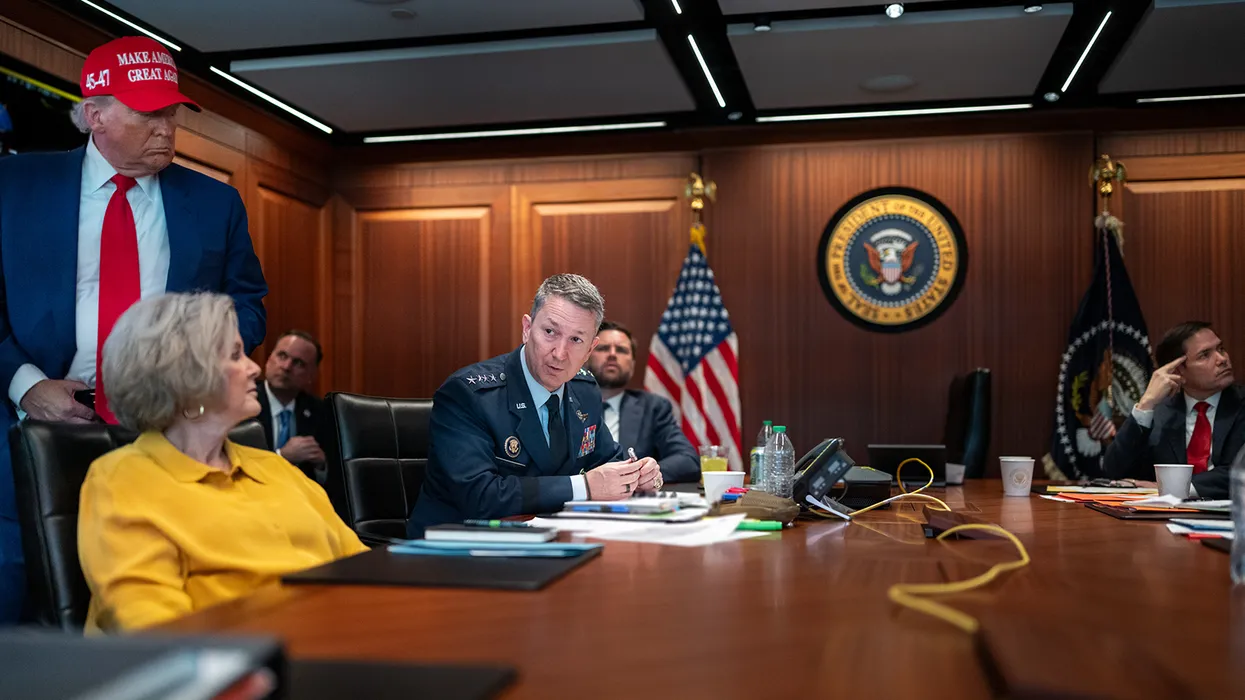
Conservative military historian and Washington Post columnist Max Boot argues that President Donald Trump's shifting approach to the ongoing conflict with Iran has produced an intractable quagmire, undermining both his own threats of military action and his diplomatic overtures.
Boot, a senior fellow at the Council on Foreign Relations and author of several widely read military histories, has long been a prominent conservative foreign-policy voice — and one of the most persistent Republican-aligned critics of Trump's instincts on national security.
In a column published Monday, Boot described Trump's leadership as "schizophrenic," saying the president veers between conciliation and confrontation with what he called "metronomic regularity" — at turns praising Iranian leaders as "very rational people" and denouncing them as "scum."
"There are many reasons for this quagmire," Boot wrote, "but a significant part of the explanation is President Donald Trump's schizophrenic approach."
According to Boot, Trump has reversed course at least seven times since the start of the war, vowing devastating attacks before pivoting to give negotiations another chance. Most recently, on August 1, Trump wrote on social media that "the U.S.A. is locked and loaded and ready to go against the Islamic Republic of Iran, at levels of Military Terror, Strength, and Power not seen since World War II," but added that he would "hold off any attack" because "the perimeters of a deal has been agreed to." Boot noted that Trump presumably meant "parameters."
Boot argued that Trump's constant oscillation between dealmaking and warmaking undercuts both efforts. He pointed to Trump's July 22 pledge to "bomb and destroy ONE BRIDGE OR POWER PLANT" for every cargo ship Iran attacked in the Strait of Hormuz. Since then, at least three ships have been attacked without any U.S. retaliation, Boot said. The Strait of Hormuz is one of the world's most strategically vital maritime chokepoints, through which roughly a fifth of global oil consumption routinely transits, meaning that any sustained disruption carries far-reaching economic consequences beyond the immediate military exchange.
The credibility gap extends beyond military threats, Boot contended. On July 22, the Trump administration announced a nuclear-power deal with Saudi Arabia, only for the president to add major conditions the following day — conditions that Saudi negotiators had not agreed to. Boot suggested these after-the-fact demands were a response to criticism from Republican hawks, and that each time Trump moves toward a deal with Iran, he retreats under pressure from the same hard-liners.
"While the Iranians don't fear Trump, they also don't trust him to make a deal, because he reverses himself so often," Boot wrote.
Boot called Trump "his own worst enemy" and urged him to commit to a single approach — either confrontation or conciliation — for a sustained period. He advocated for the conciliatory path, building on an earlier memorandum of understanding, while acknowledging that reaching an agreement with Iran's divided leadership would be difficult and would likely require recognizing some degree of Iranian control over the Strait of Hormuz.
However, Boot noted that Trump lacks the domestic political support needed to escalate the war or absorb the economic consequences of a prolonged closure of the Strait of Hormuz and possibly the Bab el-Mandeb Strait. A recent CNN poll found that only 28 percent of Americans approve of Trump's handling of the Iran war. The United States has already lost 18 service members, and Boot warned that further casualties would likely erode public support even more. Additionally, the Defense Department is running critically short of the missiles required to sustain operations against Iran or any other adversary.
"The one approach that is guaranteed to fail is the one that Trump is now pursuing," Boot concluded. "Zagging between war and peace, threats and negotiations, bombastic rhetoric and unctuous outreach. He may think it's the 'art of the deal,' but in fact, as the past five months have shown, it's simply a formula for an endless and inconclusive conflict — a 'forever war.'" The phrase invokes the term that came to define the post-9/11 wars in Iraq and Afghanistan — conflicts shaped by many of the same tensions between escalation and negotiation that Boot sees recurring in the current standoff.

