Datalab Releases Marker 2, Reporting 76.0% on olmOCR-bench and 5.4x MinerU Pipeline Throughput
Key Takeaways
- •Marker 2 introduces three conversion paths: balanced mode for higher-quality GPU use, fast mode for lower-cost runs, and a CPU-only no-OCR mode.
- •Datalab says Marker 2 balanced mode scored 76.0% overall on olmOCR-bench and reached 2.9 pages per second on a single B200 GPU.
- •The benchmark figures cited for Marker, MinerU, Docling, and LiteParse come from Datalab’s own runs using Ai2’s third-party olmOCR-bench harness.
- •The release adds breaking changes, including a Python 3.10 minimum, a move from Poetry to uv with hatchling, and removal of structured-extraction converters.
- •Marker’s code is Apache 2.0, while its model weights require a paid license for commercial use above specified startup funding or revenue thresholds.
Datalab has released Marker 2, a full rewrite of its open source document conversion pipeline for turning PDF, image, PPTX, DOCX, XLSX, HTML, and EPUB files into markdown, JSON, HTML, or chunks. Accurate and fast document conversion has become a critical bottleneck for enterprise AI pipelines — particularly retrieval-augmented generation (RAG) systems and LLM data ingestion workflows that depend on clean structured text extracted from real-world documents.
The release rebuilds Marker around three components Datalab shipped in recent months: Surya OCR 2, a fast 20M-parameter layout model, and a rebuilt pdftext component that the company says is 3x faster than its previous version.
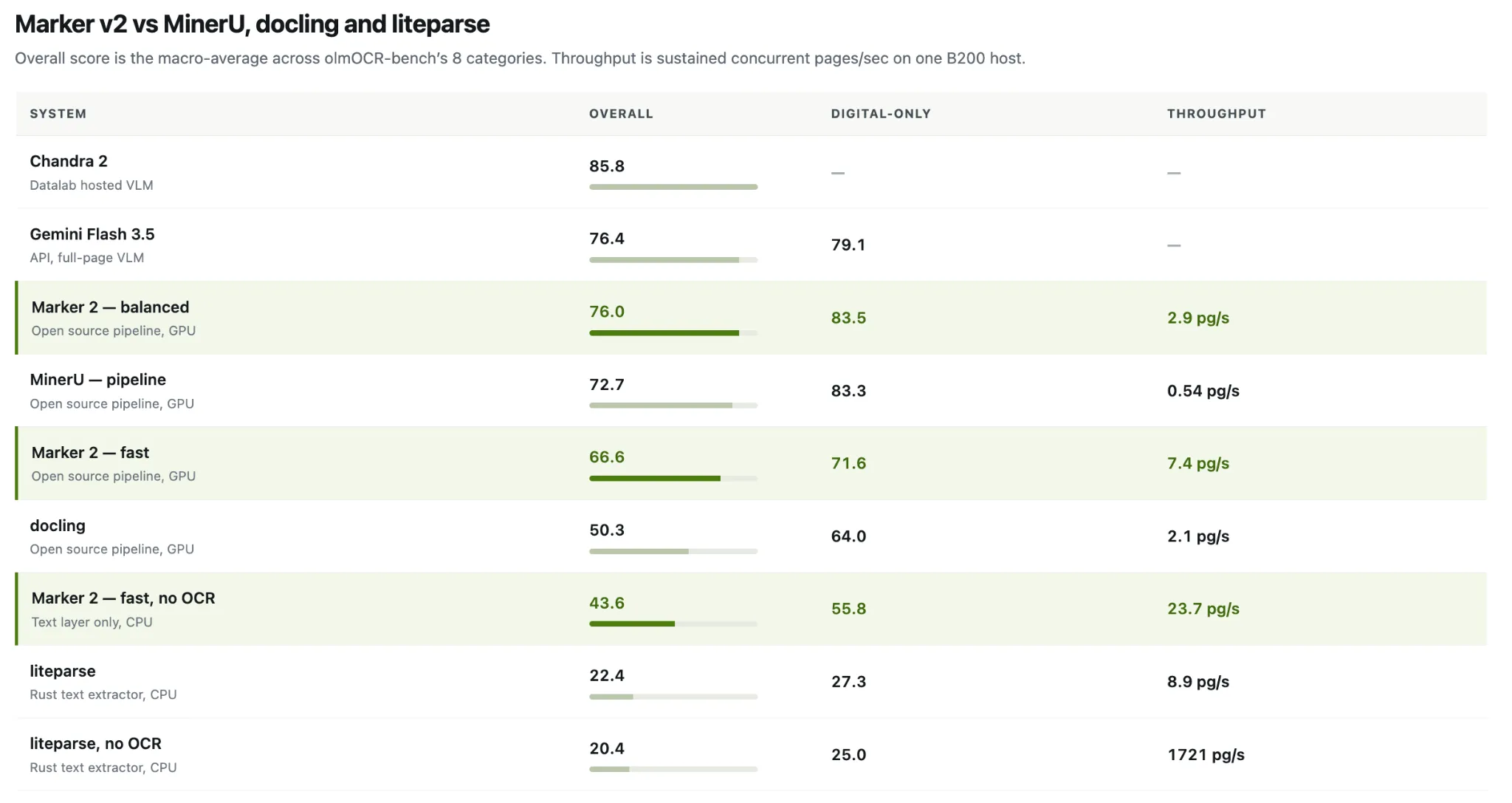
The main benchmark result cited by Datalab comes from olmOCR-bench, a third-party benchmark from Allen AI. In Datalab's runs, Marker 2's balanced mode scores 76.0% overall and 83.5% on born-digital PDFs. It sustains 2.9 pages per second on a single B200 GPU. Datalab says that is more than 5x the throughput of MinerU's pipeline backend, which scores 72.7% at 0.54 pages per second. Docling scores 50.3% at 2.1 pages per second on the same harness.
Marker 2 is out now – up to 5x faster and more accurate than mineru, docling, and liteparse with similar configs. Converts pdfs, images, docx to markdown. CPU + GPU compatible, up to 27 pages/s. pic.twitter.com/75nMipDaZ7 — Vik Paruchuri (@VikParuchuri) July 21, 2026
Marker 2 is out now – up to 5x faster and more accurate than mineru, docling, and liteparse with similar configs. Converts pdfs, images, docx to markdown. CPU + GPU compatible, up to 27 pages/s. pic.twitter.com/75nMipDaZ7
What changed in Marker 2
Marker 2 now provides three conversion paths rather than a single path.
The balanced mode uses the Surya VLM for layout, and the full page is re-OCRed when embedded text is poor. Datalab describes it as the highest-quality option and the best fit for GPU use. It scores 76.0% on olmOCR-bench.
The fast mode uses a lightweight rf-detr/onnx layout detector plus pdftext, with minimal and targeted VLM use. It scores 66.6% and is designed to be cheaper to run.
The --disable_ocr mode performs pure text-layer extraction without VLM calls. It runs entirely on CPU, scores 43.6%, and reaches 23.7 pages per second.
Mode selection is now device-aware by default: balanced on GPU and fast on CPU or MPS, while still allowing users to override the setting with --mode. Full CPU support is another structural change. The fast --disable_ocr path does not require a GPU or inference server, and the 20M-parameter layout model still reads columns, tables, and headers on CPU.
Datalab says the third major change is architectural and is responsible for the throughput results. Multiple thin CPU workers share a single Surya inference server. The parent process budgets VLM concurrency across those workers, so throughput scales with server capacity rather than per-process VRAM. Datalab reports that balanced mode sustains about 2.9 pages per second compared with a single-stream rate of about 0.3 pages per second on the same hardware.
The release also introduces breaking changes. Python 3.10 or later is now required. Packaging has moved from Poetry to uv, with hatchling as the build backend, although pip install marker-pdf is unchanged. The structured-extraction converter and extractors have been removed; Datalab points users to the hosted API or a --use_llm workflow instead.
Benchmark context
The scoring benchmark is olmOCR-bench from Ai2. It includes 1,403 PDFs and roughly 8,400 pass/fail unit tests covering math rendering, table structure, reading order, headers and footers, and old scans. The overall score is the macro-average across eight categories, computed with the official olmOCR-bench checker. Throughput is measured as sustained concurrent pages per second on one B200 host, not as single-stream latency.
Datalab notes that olmOCR-bench is a third-party benchmark from Ai2, but the scores and throughput figures cited for Marker, MinerU, Docling, and LiteParse come from Datalab's own runs. The company says the results are reproducible through the open harness in the Marker repository, which includes competitor runners for MinerU, Docling, and LiteParse alongside Marker's own runner.
The figures also reflect one benchmark's document mix on a single hardware setup. Results can differ on other document sets, and teams evaluating the systems would need to run the harness against their own corpus to determine rankings for their documents.
Marker 2 and MinerU
MinerU's pipeline backend is the closest architectural comparison because both systems read the PDF text layer and apply OCR selectively. Marker balanced leads on overall score, 76.0 to 72.7. On born-digital documents, the two are nearly tied, with Marker at 83.5 and MinerU at 83.3.
The larger difference is throughput. Marker balanced sustains 2.9 pages per second compared with MinerU's 0.54 pages per second, a 5.4x gap while also posting a higher overall score. Marker fast sustains 7.4 pages per second, roughly 13.7x MinerU's pipeline rate, but scores 6.1 points below MinerU.
MinerU also offers a VLM backend, which Datalab says scores higher than MinerU's pipeline backend. That backend uses a full-page VLM approach and was not included in the comparison table cited in the article. Datalab says teams evaluating MinerU should benchmark that path separately.
Marker 2 and Docling
Docling shows the widest margin among the GPU pipelines in Datalab's comparison. Marker balanced leads 76.0 to 50.3 overall and 83.5 to 64.0 on born-digital documents. Marker also runs faster in the reported setup, at 2.9 pages per second compared with Docling's 2.1 pages per second.
Datalab says Docling was run on its default pipeline, which uses the text layer for born-digital pages and OCR for image regions.
Docling's counterweight is governance and format breadth rather than benchmark accuracy in this comparison. Its codebase is MIT-licensed, it originated at IBM Research, and it is hosted as a project in the LF AI & Data Foundation. Its input support also extends beyond documents into audio and email formats.
Marker 2 and LiteParse
LiteParse, from the LlamaIndex team, is a Rust document parser and does not compete on the same axis as Marker. On CPU, LiteParse scores 22.4 overall and 20.4 with OCR disabled, compared with Marker's CPU-only score of 43.6.
LiteParse with OCR disabled reports 1721 pages per second, about 73x Marker's CPU mode. That is the central tradeoff in the comparison. Marker's fast --disable_ocr mode runs a 20M-parameter layout model on CPU and still recovers structure, which Datalab says is why it more than doubles a plain text dump's score. LiteParse has no layout model and performs poorly on non-linear documents, according to the source article.
Marker 2 and full-page VLM systems
Datalab emphasizes that Marker is designed as a pipeline rather than a VLM, describing the two as distinct tool categories. In the company's evaluation, its hosted Chandra 2 scores 85.8, while Gemini Flash 3.5 via API scores 76.4. Datalab's Chandra repository also places Ai2's olmOCR 2 at 82.4 and dots.ocr 1.5 at 83.9 in a separate table.
For scans, math-heavy pages, and top accuracy, Datalab says the VLM tier remains ahead of all listed pipelines. Marker balanced is 0.4 points behind Gemini Flash 3.5 overall in the cited results and is ahead of Gemini Flash 3.5 on born-digital documents, 83.5 to 79.1, without requiring a per-page API call. The pipeline-versus-VLM tradeoff is a recurring design question across the document AI tooling landscape, with pipelines generally offering lower per-page cost and local deployment while VLM-based approaches lead on the hardest document types.
Category-level results
The selected mode changes the failure profile as well as the headline score. In the olmOCR-bench categories cited by Datalab, math is the sharpest limitation for non-balanced modes. Fast mode reads equations from the PDF text layer instead of VLM-OCRing them, so arXiv math falls from 83.9 to 23.4. The --disable_ocr mode scores 0.0 in that category by design.
Outside the two math categories, old scans are the weakest split in every mode, with the best result topping out at 43.2.
Licensing
The four systems differ significantly in licensing for commercial teams.
Marker's code is Apache 2.0. Its model weights use a modified AI Pubs OpenRAIL-M license that is free for research, personal use, and startups with under $5 million in funding or revenue. Beyond that threshold, commercial use of the weights requires a paid license.
MinerU is now under the MinerU Open Source License, based on Apache 2.0 with added conditions. A separate commercial license is required above 100 million monthly active users or $20 million in monthly revenue, and online services built on it must disclose that fact.
Docling is MIT-licensed, with model licenses tracked separately in their original packages.
LiteParse is open source from run-llama, with LlamaParse positioned as the paid cloud path for difficult documents.
The licensing landscape across these projects reflects a broader industry pattern in which open-source AI tooling increasingly pairs permissive code licenses with more restrictive or commercial terms on model weights, reflecting the tension between open distribution and monetization of trained models.
The cited primary sources include the olmOCR-bench repository at https://github.com/allenai/olmocr/tree/main/olmocr/bench, the Marker 2 release notes at https://github.com/datalab-to/marker/releases/tag/v2.0.0, Datalab's blog post at and the announcement tweet at https://x.com/VikParuchuri/status/2079545884681830784.

