Report: Trump's Trade War Gives Canada the Excuse to Act on Long-Standing Plans
Key Takeaways
- •President Trump has imposed tariffs of up to 50 percent on hundreds of Canadian goods since the start of his second term, sharply straining relations between Washington and Ottawa.
- •Prime Minister Mark Carney, who led both the Bank of Canada and the Bank of England, is using his banking background and European connections to seek deeper trade ties with the EU, the UK, and France.
- •Canada is marketing its largely untapped oil, agricultural, and rare mineral resources to European countries as an alternative to reliance on the United States.
- •The United States has historically been the destination for about three-quarters of Canadian exports, so a durable reorientation toward European buyers would represent a significant shift for the Canadian economy.
- •Ottawa has a foundation for European outreach in the Comprehensive Economic and Trade Agreement (CETA) with the EU, provisionally applied since 2017, though concrete commercial outcomes remain uncertain.
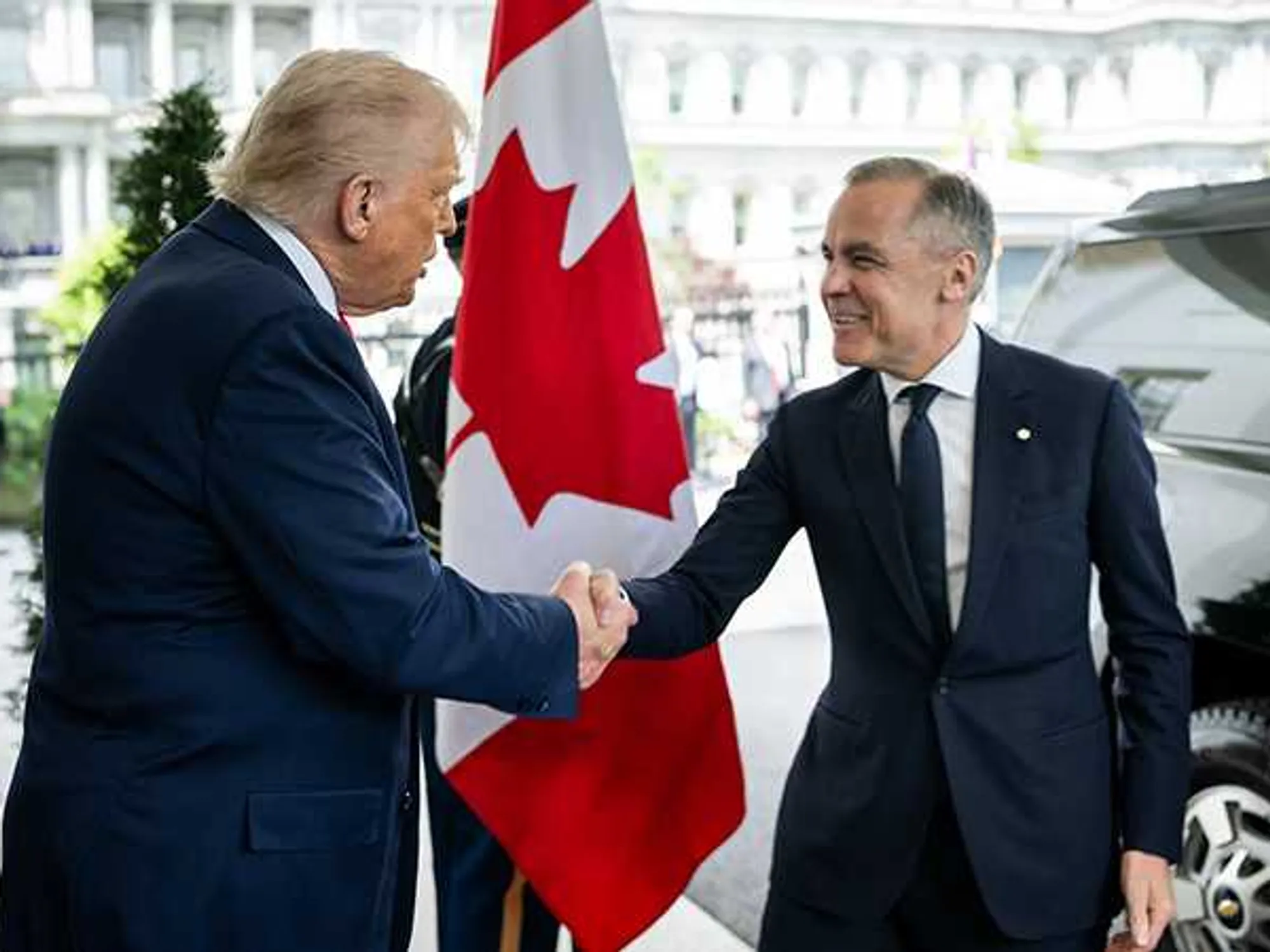
President Donald Trump has developed a heated rivalry with his counterpart across the border, Canadian Prime Minister Mark Carney. Yet according to a new report, Carney is responding to Washington's unexpected turn against Ottawa with cool calculation — using the moment to implement policies the northern democracy had long wanted to pursue anyway.
"Canada's last breakup, with Great Britain, took roughly 100 years of painstaking and piecemeal constitutional reform to accomplish," reported The New Republic's John Last on Sunday. "This time, things are moving a little faster. Since President Donald Trump launched his trade war against his closest neighbor shortly after taking office a second time—leveling tariffs of up to 50 percent on hundreds of goods—relations have been icy, and keep getting icier."
Last described how Carney, who previously worked as a highly successful banker, has deployed his skills and connections to appeal to modern European countries. Those credentials run deep: Carney served as governor of the Bank of Canada from 2008 to 2013 before taking the same post at the Bank of England, where he served from 2013 to 2020. From the European Union to individual nations such as the United Kingdom and France, Canada has long identified more closely with the culture and politics across the Atlantic — in particular their more robust social safety nets and outspoken advocacy for diversity.
As characterized by Last, Carney is now urging European nations to develop trade relationships with the world's second-largest country by area, one with vast untapped natural resources in oil, agriculture and rare minerals. The situation is framed as one in which other countries could be vastly enriched because they align more closely with Canada's center-left political values than with the increasingly far-right United States. The economic stakes of that pitch are considerable: the United States has long been the destination for roughly three-quarters of Canadian exports, so a durable reorientation toward European buyers would mark one of the most significant shifts in a trade relationship that anchors the Canadian economy. Ottawa also has a framework to build on, in the Comprehensive Economic and Trade Agreement (CETA) with the European Union, provisionally applied since 2017. Whether Carney's outreach matures into concrete commercial outcomes, and how the tariff fight with Washington evolves, remains to be seen.
"The answer to that question is hard to discern while Trump continues blustering from the White House," Last wrote. "Canadians, Carney likely may have an inclination to lean away from America anyway—from its increasingly crass politics, debased culture, and unrestrained greed. Canadians may be more American than they like to admit, but they are not as American as America is now. Another few years of accelerating decay may simply be too much to come back from. For now, at least, Canada is exploring its options—and it doesn't seem inclined to wait around."
He concluded, "Jilted lovers seldom do."
Speaking with AlterNet in August, Dr. Richard D. Wolff — professor emeritus of economics at the University of Massachusetts Amherst — contextualized Canada's shifting of economic and political relationships away from the United States as part of a larger pattern.
"Our government is busy strong-arming people around the world in way that it can, militarily, economically, politically, and discovering time after time to their amazement, if you take them seriously, that the folks are going to resist," Wolff said. "And that's what's going to happen."
Linking the US-Canada trade war and the US-Iran war, Wolff added that "Israel and the United States thought they could bomb Iran June 2025, and that was a 12-day war because they couldn't get them to bend over and surrender. So they went to work, tried it again February 28th of this year. And they're not doing it. And so now you discover, gee, the people of Canada being threatened in this way and that way by the tariffs are not bending and are putting pressure on their leaders to find a way other than capitulation."

