Marcos SONAs From 2022 to 2025 Assessed Against Economic Targets
Key Takeaways
- •Marcos’ 2022 SONA set targets including 6.5% to 8% annual GDP growth from 2023 to 2028, a single-digit poverty rate by 2028, and a 3% deficit-to-GDP ratio by 2028.
- •The Philippines has reached upper-middle income country status, with GNI per capita of $4,850 within the required World Bank range.
- •GDP growth has slowed from 6.6% in 2022-2023 to 2.8% in the first quarter of this year, while other reported Asian economies posted stronger second-quarter 2026 growth.
- •The budget deficit remained high at -5.6% of GDP in 2025, making the 2028 target difficult without a significant reduction this year.
- •Unemployment averaged 4.4% from 2022 to 2025 before rising to 5.1% in January-May this year.
President Ferdinand Marcos, Jr. is scheduled to deliver his fifth State of the Nation Address (SONA) this coming Monday, his second to the last as President. The address is expected to highlight what his administration has accomplished over the past four years and outline the work it intends to pursue in the remaining two years.
The following are key economic pronouncements and plans from President Marcos’ previous four SONAs. Taken together, they provide measurable benchmarks for judging the administration’s record on growth, poverty reduction, public debt, the budget deficit, income status, infrastructure, employment, and support for small enterprises.
SONA 2022
In his 2022 SONA, Mr. Marcos set several macroeconomic targets for his administration:
“Six point five to 7.5% GDP growth in 2022; 6.5 to 8% growth annually between 2023 to 2028.
“Nine percent or single-digit poverty rate by 2028; 3% National Government deficit to GDP ratio by 2028.
“Less than 60% National Government debt-to-GDP ratio by 2025.
“At least $4,256 income (GNI) per capita and the attainment of upper-middle income status by 2024.”
SONA 2023
In 2023, the President cited the economy’s performance despite difficult global conditions:
“While the global prospects were bleak, our economy posted a 7.6% growth in 2022 — our highest growth rate in 46 years…We are still considered to be among the fastest-growing economies in the Asian region and in the world….
He also emphasized major infrastructure programs, including the Luzon Spine Expressway Network Program:
“The 1,200-kilometer Luzon Spine Expressway Network Program will effectively connect Ilocos to Bicol from 20 hours to just nine hours of travel.
The President also referred to the Mega-Bridge Program:
“Under the Mega-Bridge Program, 12 bridges totaling 90 kilometers will be constructed, connecting islands and areas separated by waters. The Program notably includes the Bataan-Cavite Interlink Bridge [applause] and the Panay-Guimaras-Negros Island Bridges, each spanning 32 kilometers, and also the Samal Island-Davao City Connector Bridge.”
SONA 2024
In 2024, Mr. Marcos highlighted reported reductions in poverty:
“Our poverty rate has significantly dropped to 15.5%, down from 18% in 2021. This present figure is even lower than the pre-pandemic level of 16.7% in 2018.
“Ang katumbas nito ay halos dalawa’t kalahating milyong Pilipino ang naiangat natin mula sa kahirapan (This is equivalent to almost 2.5 million Filipinos who we have raised out of poverty).
“Kasabay nito, nabawasan nang lagpas isang milyon at pitong daang libo ang bilang ng mga Pilipinong walang sapat na pambili ng pagkain. Patuloy nating pagsisikapan na marami pa tayong maiaahon mula sa kahirapan (At the same time, the number of Filipinos unable to afford sufficient food has decreased by more than 1.7 million. We will continue to strive to lift even more people out of poverty).”
SONA 2025
In 2025, the President focused on employment and support for small enterprises:
“Dumarami ang mga nalilikhang hanapbuhay sa ating bansa ngayon (The number of jobs being created in our country is increasing.).
“Ipagpapatuloy natin ang pagbibigay ng puhunan sa mas marami pang negosyante para makapagsimula ng maliit na negosyo o microenterprise, sa mababang interest, at walang kolateral. Pati na rin ang kapital at proteksyon para sa mga yamang-isip (We will continue to provide capital to more entrepreneurs — offering low-interest, collateral-free loans — so they can start small businesses or microenterprises. We will also provide capital and protection for intellectual property.).
“Hindi tayo titigil hanggang halos dalawa’t kalahating milyong maralitang pamilya ay matutulungan natin na magkaroon ng kanilang sariling maliit na negosyo (We will not stop until we have helped nearly two and a half million impoverished families establish their own small businesses).”
Assessments
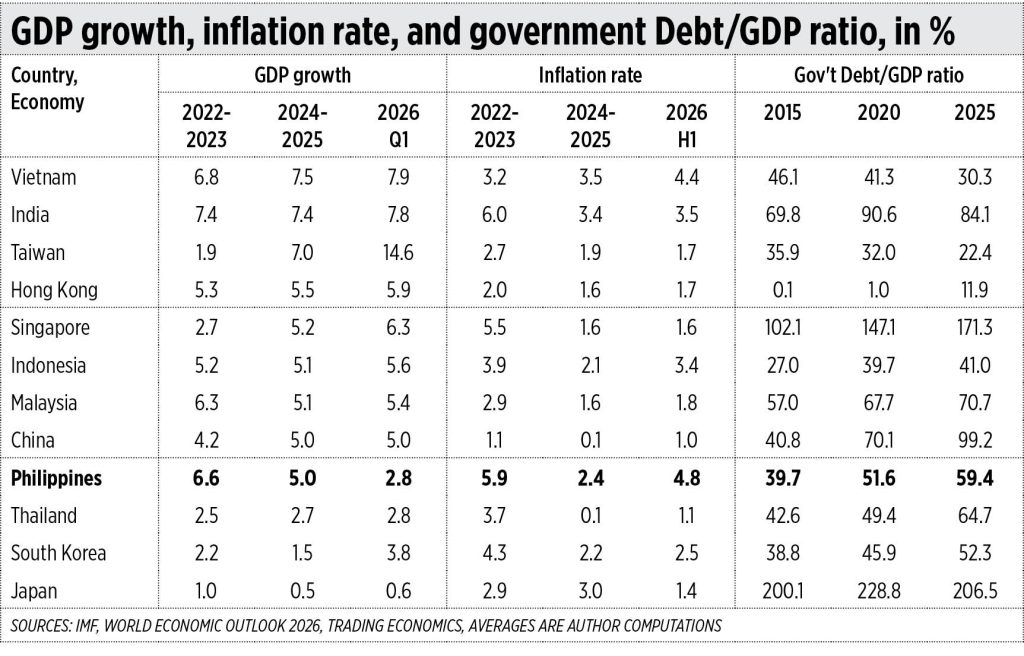
Average gross domestic product (GDP) growth from 2022 to 2026 has slowed, from 6.6% in 2022-2023 to 2.8% in the first quarter (Q1) of this year. The large-scale flood control and infrastructure corruption scandal has weighed on business and investment sentiment.
Several Asian economies have sustained growth momentum through 2026. Four countries that reported GDP performance for the second quarter of 2026 were Vietnam at 8.4%, Malaysia at 5.8%, Singapore at 5.7%, and China at 4.3%. These regional comparisons are relevant because the earlier SONA statements framed the Philippines as one of the fastest-growing economies in Asia and the world.
The inflation rate eased in 2024-2025, but this year’s 4.8% inflation rate is the highest among Asian countries, as shown in the accompanying table in the source article.
The public debt-to-GDP ratio is also rising and moving back toward nearly 60%. This figure covers outstanding debt only and does not include guaranteed debt. That matters for fiscal assessment because the 2022 SONA target was expressed as a debt-to-GDP threshold, while the deficit target depends on the government’s ability to reduce borrowing needs over time.
The Philippines has attained upper-middle income country (UMIC) status, with gross national income (GNI) per capita of $4,850. This is within the $4,636 to $14,375 range required to be classified as an upper-middle income country.
The budget deficit-to-GDP ratio has remained high: -7.3% in 2022, -6.2% in 2023, -5.7% in 2024, and -5.6% in 2025. Reaching -3% by 2028 would be almost impossible unless the ratio is brought down to -4.5% this year.
The unemployment rate averaged 4.4% from 2022 to 2025, then rose to 5.1% in January-May this year. Slower growth, higher inflation, and a difficult external economic environment caused by the continuing Middle East conflict have contributed to higher unemployment and underemployment rates.
The country’s attainment of UMIC status this year, as announced by the World Bank this month, is a major achievement for the administration. At the same time, both external and internal challenges continue to affect the country’s economic and fiscal position.
The government should scale back both energy taxation and subsidy programs. One option would be to cut the oil excise tax in exchange for reducing subsidies to jeepneys, motorcycle taxis, and similar programs. Other subsidies, including those for non-rich groups, should also be reduced. These include the expensive and wasteful military and uniformed personnel pension system, large subsidies to state universities that continue expanding campuses in each province, and related policies.
The government should focus on fiscal consolidation, reducing the budget deficit, and lowering annual borrowings.
Bienvenido S. Oplas, Jr. is the president of Bienvenido S. Oplas, Jr. Research Consultancy Services and Minimal Government Thinkers. He is an international fellow of the Tholos Foundation.
