Economic Measures and Fiscal Pressures Highlighted in President Marcos Jr.'s 2026 SONA
Key Takeaways
- •President Marcos allocated over P60 billion through year-end for subsidies including diesel relief for jeepney drivers, free and discounted rides for commuters, reduced terminal and toll fees, and waived expressway charges for agriculture-accredited trucks.
- •The President announced three tax relief measures: expanding the income tax exemption threshold to P350,000 annually, exempting small businesses from the minimum corporate income tax, and granting amnesty for unpaid income, estate, donor, and value-added taxes.
- •The Philippines faces significant fiscal pressure, with the full-year 2026 programmed deficit at P1.66 trillion and daily interest payments rising from P1.55 billion in early 2023 to P2.66 billion by the first half of 2026.
- •Inflation averaged 6.8% in the second quarter of 2026, the highest rate in East Asia, driven largely by agricultural price pressures amplified by elevated diesel taxes and global crude costs.
- •Critics note that the subsidy programs predominantly benefited urban transport systems while rural agricultural machinery operators received comparatively limited direct support, and suggest that temporarily suspending fossil fuel excise taxes could more effectively address inflationary cost drivers.
In his 2026 State of the Nation Address (SONA) delivered last Monday, President Ferdinand Marcos, Jr. outlined an extensive series of subsidies and spending expansions aimed at easing the burden on transport operators, passengers, and agricultural stakeholders. The President also announced forthcoming tax relief measures.
Among the key subsidies enumerated were the following:
Drivers received cash relief through the government's Assistance to Individuals in Crisis Situations (AICS) program, along with a P10-per-liter diesel subsidy for passenger jeepneys and UV Express units.
Passengers benefited from free ride programs, and where rides were not free, a 20% fare discount was applied — on top of the existing 20% discount already available to students, senior citizens, and persons with disabilities.
In Metro Manila, commuters on the LRT2 and MRT3 received a 50% fare discount. At airports and seaports, the government temporarily reduced various facility usage fees, including terminal fees, landing and take-off fees, harbor fees, anchorage and berthing fees, and storage fees.
At the Parañaque Integrated Terminal Exchange (PITX), terminal fee collection for passenger vehicles was suspended for three months. On expressways, toll fee discounts of up to nearly P200 were offered.
For trucks carrying agricultural products and food ingredients loaded onto Ro-Ro vessels, terminal fees were reduced from P500 to just one peso. Toll fees on expressways were waived entirely for trucks accredited by the Department of Agriculture.
The President stated that over P60 billion has been allocated for these measures, running through the end of the year.
On tax relief, the President announced three measures. First, the income tax exemption threshold would be expanded to include those earning no more than P350,000 per year, and income tax would be lowered for other workers. Second, small businesses would no longer be subject to the minimum corporate income tax. Third, amnesty would be granted for unpaid taxes — including income tax, estate tax, donor's tax, and value-added tax — along with associated penalties.
These announcements represent substantial spending expansions and revenue reductions. Under normal fiscal conditions — a balanced budget or a mild deficit below P800 billion per year — such measures might be broadly welcomed.
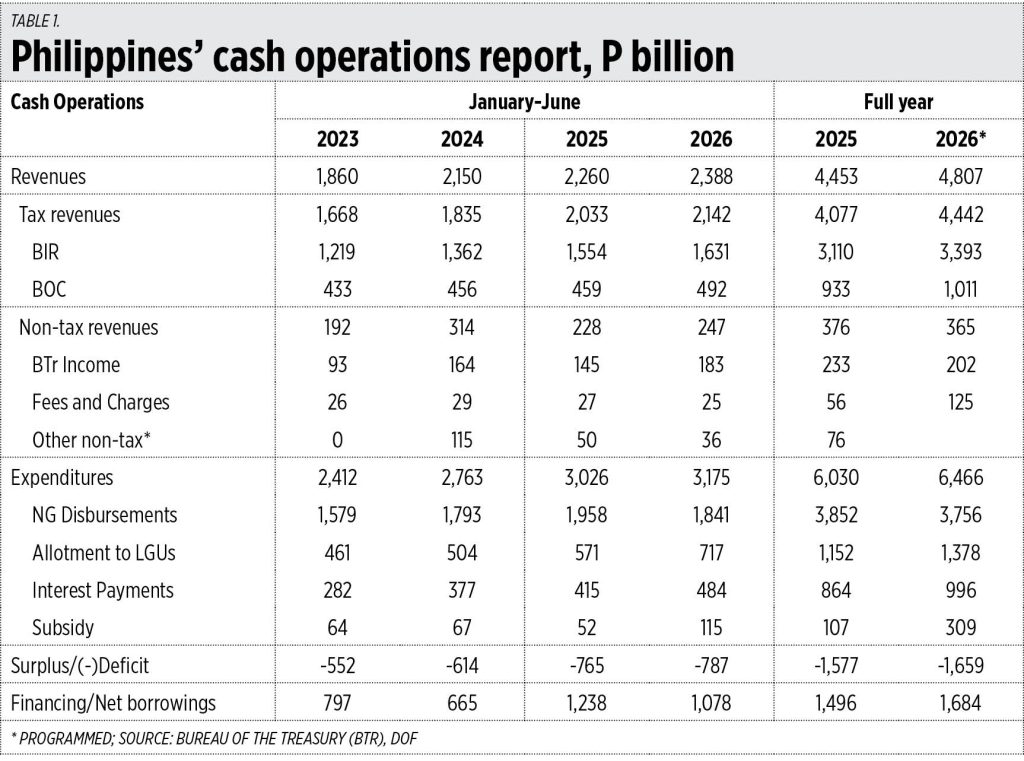
However, the country's fiscal space is already constrained. The budget deficit in the first half (H1) of 2025 reached P765 billion, followed by a further P787 billion deficit in H1 2026. The full-year 2026 programmed deficit stands at P1.66 trillion, exceeding the P1.58 trillion deficit recorded in 2025.
Interest payments have also risen sharply. From P282 billion in H1 2023 — averaging P1.55 billion per day — they jumped to P484 billion in H1 2026, averaging P2.66 billion per day. The Philippines has historically carried one of the largest debt-service burdens in Southeast Asia, a legacy of decades of deficit financing that compounds the challenge of sustaining large subsidy outlays while simultaneously reducing tax revenue.
Despite the government's subsidy programs, inflation in the Philippines has remained elevated. In the second quarter (April–June) of 2026, average inflation reached 6.8%, the highest rate in East Asia. By comparison, Bangladesh faces structural inflationary challenges, while Pakistan has experienced a significant inflation surge following sudden restrictions on the flow of cheap energy imports from Middle Eastern neighbors.
A recurring argument in policy discussions is that the government should have prioritized temporarily suspending the excise tax on fossil fuel products — gasoline, diesel, coal, and similar items — rather than relying primarily on various subsidies.
Much of the Philippines' high inflation stems from agricultural price pressures. Farm equipment such as tractors, harvesters, threshers, irrigation pumps, small rural trucks, and fishing boats overwhelmingly run on diesel. The Philippines is a net importer of petroleum products, meaning global crude price movements feed directly into domestic fuel costs. With high diesel taxation — a P6/liter excise tax plus 12% VAT amounting to P6.72/liter, rates substantially increased under the Tax Reform for Acceleration and Inclusion (TRAIN) Law that took effect in 2018 — combined with successive oil price increases, most of these elevated costs have been passed on by farmers and fishermen to consumers.
The subsidies outlined by the President have predominantly favored urban transport systems, provincial buses, and trucks. In rural areas, agricultural machinery operators received comparatively limited direct support.
The policy responses undertaken by the administration were designed to alleviate inflationary pressure. An alternative approach in future policy rounds could involve a temporary suspension of excise taxes on fossil fuel products to more directly address the cost drivers behind agricultural inflation.
A day after delivering his fifth SONA, President Marcos traveled to Davao to inspect government projects. Executive Secretary Ralph Recto commented that the visit "demonstrates yet again his style of governance that is fair and without favoritism," adding: "Walang pinipiling lugar, walang pinapaboran. Kung saan kailangan ang tulong, pinupuntahan nya." (He chooses no specific place and shows no favoritism; wherever help is needed, he goes.)
Provincial visits may help the administration better understand local economic dynamics that can differ significantly from those in Metro Manila and the Central Luzon provinces.
Bienvenido S. Oplas, Jr. is the president of Bienvenido S. Oplas, Jr. Research Consultancy Services, and Minimal Government Thinkers. He is an international fellow of the Tholos Foundation.

