Commentators Say MAGA Is a Dead Battery That Can No Longer Run the GOP
Key Takeaways
- •The Republican Party's heavy midterm defeat, the first nationwide electoral test of Trump's second term, exposed the faulty assumption that MAGA followers were also committed followers of the GOP itself.
- •Timothy P. Carney argued that Trump's coalition of less religiously observant, less fiscally conservative working-class voters never became reliably conservative or Republican and cannot be counted on once Trump departs.
- •Under the 22nd Amendment, Trump cannot seek a third term, making the GOP's next presidential race its first without him as standard-bearer since 2012.
- •The commentators said the party's years of selecting candidates for loyalty to Trump rather than conservatism or quality, exemplified by Herschel Walker's Trump-endorsed 2022 Senate defeat in Georgia, damaged its candidate pipeline.
- •E.J. Dionne Jr. contended that MAGA was rooted in a contradiction between policies favoring the wealthy and populist working-class rhetoric, citing Trump's tariff focus and White House ballroom project, and argued Trump-defined MAGA will no longer work.
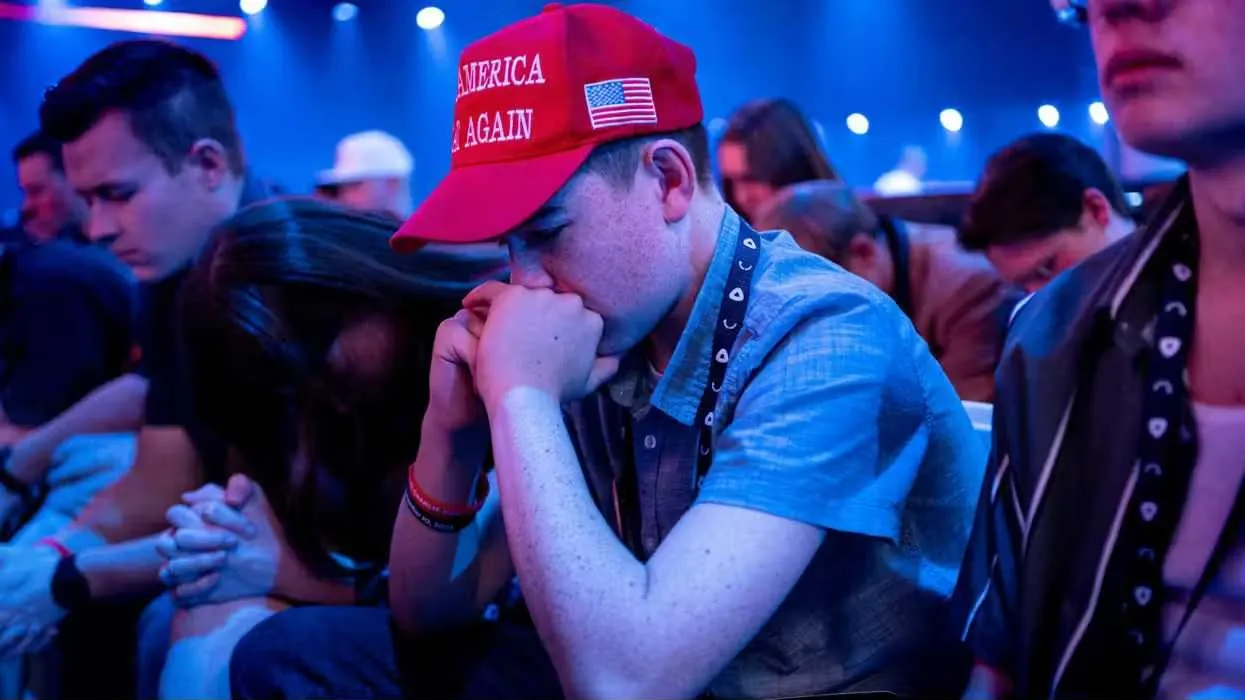
The populist sentiment that powered President Donald Trump's cult-like MAGA movement has not disappeared — Americans are still looking out for their own incomes and comfort — but as a wellspring of energy for the Republican Party, the movement has become a dry well, according to New York Times columnists Robert Siegel and E.J. Dionne Jr. and conservative Washington Examiner columnist Timothy P. Carney.
The GOP's colossal midterm wallop this month — the first nationwide electoral test of Trump's second term — laid bare a faulty assumption: that Trump's MAGA followers were also followers of the Republican Party itself. In Carney's view, they are not — and they never were.
"The Trump vote, the working-class white vote that Trump brought into the party, never became reliably conservative and Republican. These people weren't made into Paul Ryan acolytes who love the idea of reforming Social Security. And frankly, they're not the Ted Cruz vote from 2016," Carney told Siegel and Dionne during the New York Times' Saturday morning podcast, in a discussion published in a New York Times opinion piece on November 14.
Carney noted that analysts can reliably map, county by county, where residents were most likely to attend church every week during the 2016 primaries — and those were the places that voted for Sen. Ted Cruz, arguably the closest GOP alternative to a decaying Trump.
"[But] the places where you had the white evangelicals who don't attend church, they were more likely to be the Trump voter. So, the less religiously observant, the less fiscally conservative — that was the Trump vote," Carney said, adding that "the Republicans cannot rely on them now that Trump is leaving the stage." That exit is constitutionally fixed: under the 22nd Amendment, Trump cannot be elected to a third term, which makes the party's next presidential race its first since 2012 without him as its standard-bearer.
The problem for the GOP, Carney argued, is that the party has spent years selecting for loyalty to Trump and tossing out the less cultlike, rather than screening for more durable qualities like "conservatism or quality of candidate — and that also hurt the party."
"So going forward, the Republicans, there's no juice left to squeeze from MAGA. And if anybody tries to be a mini-MAGA — if JD Vance says, 'I'm going to be the next Donald Trump' — you can't be the next Donald Trump," Carney added.
Carney said he thanked God that Trump was one of a kind, with no counterpart like him — but that this singular leader broke the GOP by blowing up "what existed before the consensus — the Reagan consensus that lasted for a while — but nothing has filled that space." The Reagan consensus he invoked was the coalition of economic, religious and national-security conservatives that Ronald Reagan assembled in his 1980 landslide and that defined the GOP for the decades that followed.
What has tried to fill that space, Siegel said, is the bottom of the barrel, largely because the party has elevated loyalty over intelligence or talent.
"I just want to underscore what you said about candidates. I was thinking, 'boy, a lot of Senate Democrats who won Senate elections were lucky to have a terrible opponent,'" Siegel said. "And then it occurred to me: it's not luck that you get Herschel Walker running for the Senate, only because loyalty and fame have been elevated to values that dwarf every other talent that a candidate might have." His example was Walker, the former NFL running back whose Trump-endorsed 2022 Senate bid in Georgia ended in defeat by incumbent Democrat Raphael Warnock.
Carney said he has spoken with conservative Republican circles who want to "get the old [genuine conservative] band back together," but he warned that re-nominating somebody like Romney and riding him to victory is now "a perfidious pipe dream for conservatives" in a populist political atmosphere.
"I think that MAGA is dead as such, because it was always rooted in a contradiction," Dionne said, explaining that Trump flaunted "his ties to very, very wealthy people" as well as his "obsessions with things like the ballroom," and that voters responded by "just walk[ing] away." The ballroom reference pointed to the White House ballroom project Trump launched, whose construction included demolishing part of the East Wing.
"Now, does it mean that a strongly conservative wing of the Republican Party is gone? No," Dionne added. "There's always been that. The Tea Party, in many ways, gave birth to the MAGA movement. So, there will be a right wing of the Republican Party, but MAGA specifically defined by Donald Trump — and this odd contradiction of policies that often help the wealthiest people, but rhetoric that was directed to working people, usually using tariffs as his way in — I think that just will not work anymore." The Tea Party he cited was the anti-establishment conservative surge that erupted in 2009 and reshaped Republican primaries heading into the 2010 midterms. The open question the three leave behind is whether the GOP's candidate pipeline can be rebuilt to screen for qualities beyond the loyalty that Carney and Siegel identified as the party's costly selection flaw.
Source: Alternet

