Maersk to Trial Rotor Sail on Containership in Wind-Assisted Propulsion Pilot
Key Takeaways
- •Anemoi Marine Technologies will build a single fixed rotor sail, 5 m in diameter and 35 m tall, for installation on a Maersk Lima-class containership in mid-2027.
- •The installation will be the first use of rotor sails on a containership, a vessel type where deck space constraints have previously limited wind-assisted propulsion.
- •Testing will occur during normal commercial operations, mainly on North and South Atlantic routes, where consistent wind exposure supports evaluation of fuel savings.
- •A 2019 independent trial of Norsepower rotor sails on a Maersk Tankers LR2 delivered verified annual fuel savings of 8.2%, equal to roughly 1,400 tonnes of CO2.
- •The IMO has agreed a net-zero framework for international shipping, including fuel standards and pricing measures due to take effect later this decade, adding commercial pressure to adopt fuel-saving technologies.
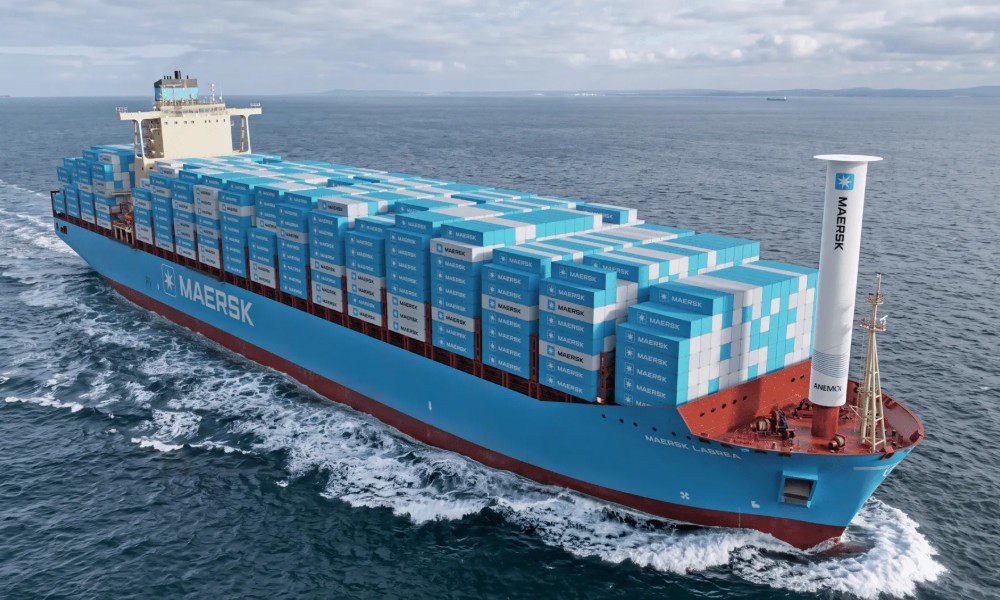
Danish container line Maersk is bringing wind-assisted propulsion to its liner fleet, with plans to install a 35 m rotor sail on one of its 8,700 teu vessels next year.
British supplier Anemoi Marine Technologies will design and manufacture a single fixed rotor, measuring 5 m in diameter and 35 m in height, for a ship from the Maersk Lima class. Installation is scheduled for mid-2027.
The system will be tested during normal commercial operations, primarily on North and South Atlantic routes, allowing Maersk to gather operating data before deciding whether the technology has wider relevance across its fleet. Route selection matters for wind propulsion economics: savings depend on wind conditions, so Atlantic services — where crossing patterns offer consistent wind exposure — are a common testing ground for the technology.
According to Anemoi, the installation will mark the first use of rotor sails on a containership. The company typically fits three to five rotors on large ships, which makes the single-sail Maersk project a relatively contained pilot rather than a full-scale deployment. Containerships present particular challenges for wind-assisted propulsion, since deck space is occupied by stacked containers and cargo-handling equipment, which helps explain why the technology has so far been proven mainly on bulk carriers, tankers and other vessel types with more open decks.
Rotor sails harness the Magnus effect to generate additional thrust from wind, reducing the load on the main engine when conditions are favorable. Anemoi has already deployed the technology on bulk carriers and has been developing designs for tankers and LNG carriers.
As SplashTech reported in June, Anemoi, Hafnia and Guangzhou Shipyard International secured DNV approval in principle for integrating 5 m by 35 m folding rotors into MR tanker designs. Anemoi has also developed installation concepts for ultramaxes with NACKS.
The AP Møller Holding name is not new to the technology. As Splash reported in 2019, an independent trial of two Norsepower rotor sails aboard a Maersk Tankers LR2 produced verified fuel savings of 8.2% over a year, equivalent to roughly 1,400 tonnes of CO2. Maersk Tankers is separate from the container shipping operation, making the new project the first such move into the liner fleet. The pilot also comes as shipping lines face tightening international rules on greenhouse gas emissions, with the IMO having agreed a net-zero framework for international shipping that includes fuel standards and pricing measures set to take effect later this decade — pressure that makes fuel-saving technologies such as rotor sails commercially relevant beyond their engineering appeal.
