Macap's Supra G Series Targets Extraction Consistency and Operational Efficiency for Coffee Chains
Key Takeaways
- •Macap launched the Supra G Series in October 2025 to address extraction consistency and operational challenges for coffee chains.
- •Denis Girardi said grind and dose stability are more important to drink repeatability than machine-side variables such as temperature and pressure.
- •The grinder is designed to reduce manual intervention, coffee waste, and staff training demands during busy service periods.
- •The Supra line is built on a standardised platform with 68 mm or 83 mm burr options to simplify inventory and spare-parts management.
- •Macap said customers have praised the grinder’s instant tare detection, low static, and accurate dose data display.
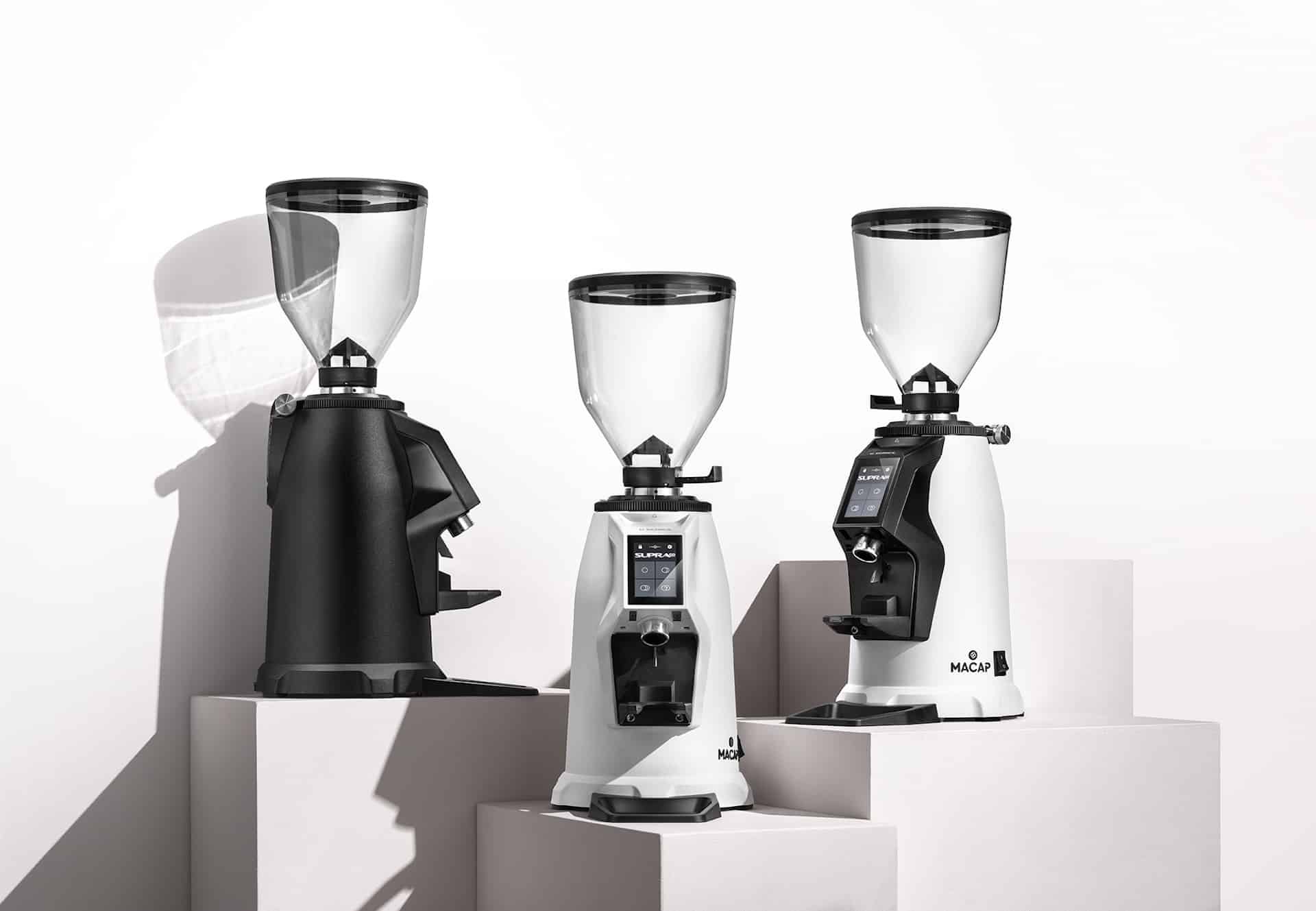
Macap's Supra G Series is designed to help coffee chains improve extraction consistency while reducing the operational burdens of staff training and ongoing grinder recalibration—a growing priority as multi-site coffee operators worldwide face tightening labour markets and rising expectations for beverage uniformity across locations.
Denis Girardi, who brings more than two decades of experience in the coffee industry, emphasizes that while espresso machines often command attention, the grinder is the component that ultimately determines the customer experience across a coffee chain. In high-volume settings, variability arises from multiple—and frequently unavoidable—sources, and these factors can compound to materially affect cup quality.
"Generally speaking, the variables on the machine side are temperature and pressure. On the grinder side, however, they are the distribution of fines and boulders, as well as dosing accuracy," Girardi says. "In larger coffee chains, inconsistency in staff training and preparation is a major factor, which is further exacerbated by shift rotations. In high-volume coffee shops, rush hours amplify all these variables because they put greater stress on the equipment."
Girardi, who has worked for some of the world's largest coffee brands, currently serves as Sales Manager and Business Developer at Macap. The Italian grinder manufacturer, founded in 1930 in Venice and operating in more than 70 markets, positions itself as a practical partner for coffee chains seeking extraction consistency while managing operational costs through reduced staff training, intervention, and recalibration requirements.
Purpose-Built for Peak Demand
Girardi considers the Supra G Series—launched in October 2025—a direct response to these operational challenges.
"The Supra G Series was designed specifically to handle these peak workloads flawlessly, maintaining a completely stable output without altering dose or quality," he says. "[Consistent grinder performance] is the single most critical point in a coffee shop. [It] has the highest impact on overall drink repeatability when it comes to coffee quality. If you control the grind and the dose at the source, you stabilise the extraction regardless of the surrounding environment."
Beyond extraction quality, Girardi argues that a dependable grinder reduces the cognitive load on staff during busy service periods. The "unavoidable variation" in barista skill levels across shifts and locations is "effectively compensated for by the superior reliability and consistency of the grinder's output."
With conventional on-demand grinders, staff training places heavy emphasis on the ability to continuously fine-tune grinder settings throughout the day. The Supra G Series is intended to eliminate much of that requirement.
"Achieving excellent grind uniformity—and, above all, gravimetric (grind-by-weight) dose reliability—means less coffee waste during the morning dial-in process and significantly less reliance on the individual barista's level of sensitivity and experience," Girardi says. "If you utilise a grinder that is virtually unaffected by thermal expansion and temperature fluctuations, combined with high power and high-volume capability, the need for manual intervention throughout the day is also drastically reduced."
Gravimetric grinding has become an increasingly established benchmark across the commercial grinder segment, with multiple manufacturers introducing grind-by-weight technology in recent years. Macap's entry with the Supra G Series places it within a competitive field where dose accuracy and thermal stability are now expected features rather than premium differentiators.
"The more the grinder is capable of managing heavy workloads smoothly, the less your staff needs to constantly recalibrate it. And when operator intervention is minimised, this leads to a significant reduction in the time and costs associated with staff training."
Real-World Feedback
According to Girardi, customer feedback has been overwhelmingly positive, with three features drawing particular praise.
"The instant tare detection is the fastest on the market, and it [is] by far the most praised feature," he says. "Secondly, chains love the fluffiness of the ground coffee and the complete absence of static electricity. Third is the absolute accuracy of the dose data shown on the display: what you see is exactly what you get in the portafilter."
Standardised Platform for Multi-Site Operations
While in-cup performance remains a top priority for coffee chains, Girardi notes that these businesses increasingly seek equipment that is easier to maintain, standardise, and support across multiple locations. This reflects a broader industry shift in which chain operators are consolidating equipment suppliers and prioritising common platforms to reduce maintenance complexity and spare-parts inventory across their estates. To that end, Macap built the Supra G Series around a common platform.
"The entire Supra line is built on a single, standardised platform available with either 68 millimetre or 83 millimetre burrs, allowing operators to streamline their inventory and use the same spare parts across models," Girardi says.
"Furthermore, it features our FOS (Fast Opening System), which greatly simplifies daily cleaning, burr replacement and, most importantly, direct access to the anti-clumping mechanism, which is typically one of the highest-wear components in any coffee grinder," he adds.
Engineering and Development Process
The Supra G Series was developed through an iterative engineering approach combining mechanical design, electronics, and extensive field testing. Luca Marchesini, who brings over two decades of experience in the coffee machines and grinders industry, explains that this multidisciplinary process begins with mechanical experimentation on burr geometry.
"This is where different cutting patterns are tested to achieve a precise and repeatable particle size distribution," Marchesini says. "Alongside mechanical design, significant emphasis is placed on high-performance motors, engineered to deliver stable torque and consistent speed under varying load conditions."
"This is complemented by advanced sensor technology and control electronics, which monitor and regulate parameters such as weight, temperature, and dosing accuracy to ensure consistent output over time."
Marchesini notes that these technical developments are continuously validated through sensory testing and barista workshopping, where extraction quality and taste outcomes guide further refinements.
"Crucially, extensive field testing in real café environments plays a key role, allowing engineers to assess performance under peak workloads, environmental variations, and daily operational stress," he says. "Overall, the process is driven by continuous feedback between engineering precision, electronic control systems, and real-world usability, ensuring both performance and reliability at the highest level."
Cost Control Through Consistency
Echoing Girardi's observations, Marchesini highlights how these engineering features translate into concrete outcomes for multi-site operators. When grind size distribution is consistent, as with the Supra G Series, extraction becomes more predictable and stable, which can ultimately reduce the need for complex machine features designed to compensate for grinder inconsistency.
"In practical terms, a highly reliable grinder allows cafés to achieve excellent results even with simpler equipment, shifting the focus from reactive correction to controlled input," he says.
"Reliable Supra grinder performance plays a key role in controlling costs. When grind output is consistent, baristas need fewer adjustments throughout the day, which reduces wasted coffee during dial-in and minimises the number of unusable shots."
"In addition, lower retention, more stable dosing, [and] correct coffee drop into the portafilter help limit product waste, while consistent results reduce the need for remakes. Over time, this translates into better use of raw materials, improved labour efficiency, and a more predictable cost structure."
A Controllable Variable
For coffee chains balancing quality objectives with staffing challenges, Girardi identifies the grinder as a pressure point that operators can manage with relative ease.
"A grind-by-weight grinder is the primary step toward significantly reducing staff training costs, as it makes the barista's workflow much easier when aiming for consistency," he says. "It doesn't necessarily compete against closed, interconnected systems, but it dramatically reduces the operational impact of having or not having highly skilled baristas on-site, providing a highly reliable, standalone control point."
More information is available at macap.it/en.
This article was first published in the July/August 2026 edition of Global Coffee Report. The original article is available at https://www.gcrmag.com/how-the-supra-g-series-helps-coffee-chains-improve-consistency/.
